The Rise of the Modern Haunt Industry
From Knott's Berry Farm in 1973 to today's immersive horror experiences, how professional haunted attractions became a billion-dollar business.
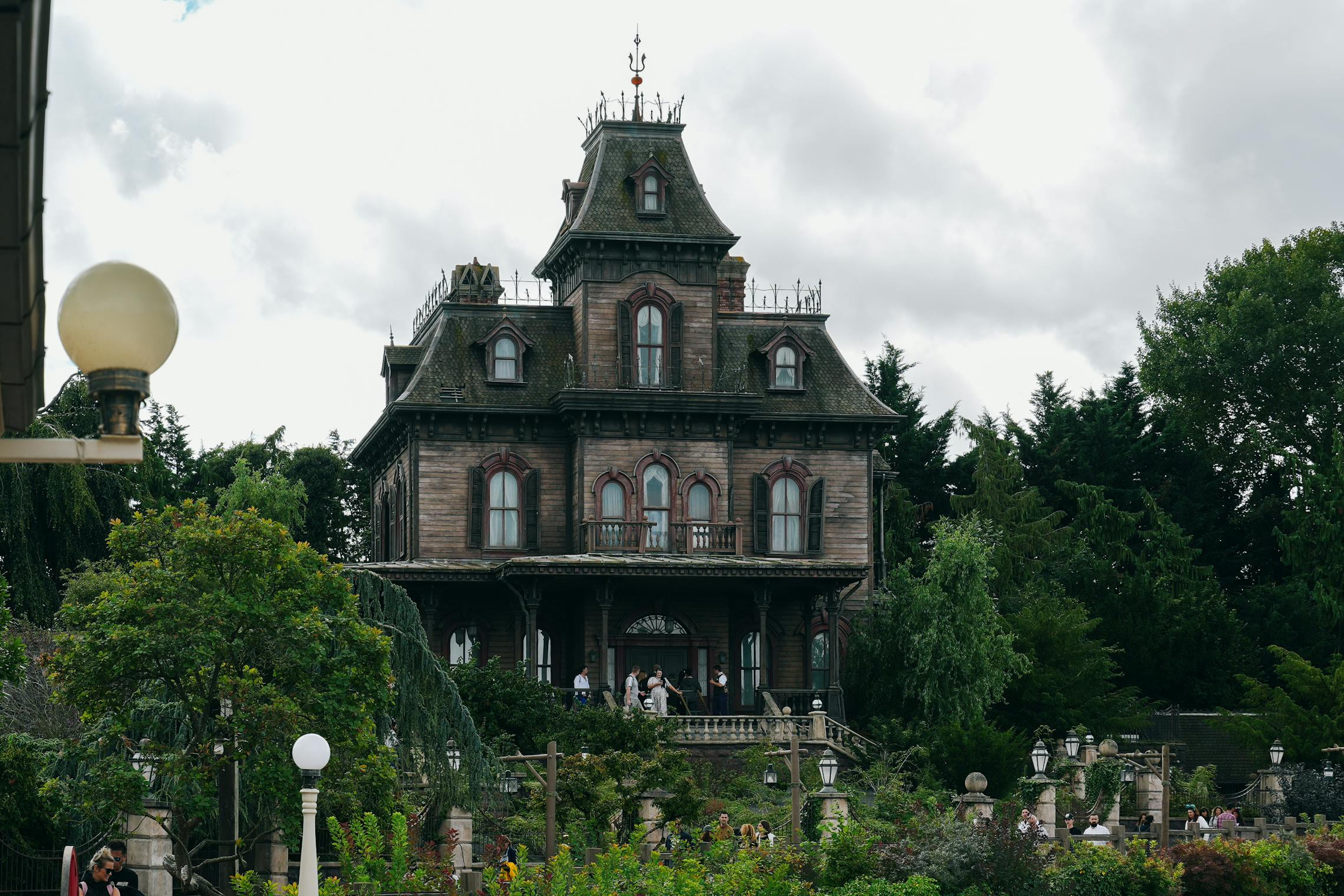
The first time someone charged admission to walk through a dark room full of scary things, they probably didn’t realize they were starting an industry. But the American haunted attraction business now generates an estimated $300 million in annual ticket sales, employs tens of thousands of seasonal workers, and has developed its own trade shows, professional organizations, and celebrity designers. This is the story of how scaring people became a profession.
The Charity Haunt Era
Haunted houses existed before the 1970s, but they were almost exclusively community affairs. Jaycees chapters (the United States Junior Chamber of Commerce) ran haunted houses as fundraisers starting in the 1950s and 1960s. These were typically set up in borrowed spaces, staffed by volunteers, and built from plywood, black paint, and ingenuity. The scares were simple: peeled-grape eyeballs, cold spaghetti brains, a volunteer in a gorilla mask jumping out from behind a curtain.
These charity haunts served a useful civic function. They gave teenagers something to do on Halloween, raised money for local causes, and provided a controlled environment for the kind of transgressive experience that people crave during the season. By the late 1960s, thousands of communities across the United States ran some version of the charity haunted house.
The format had limitations, though. Volunteer labor meant inconsistent quality. Borrowed spaces meant rebuilding from scratch every year. And the fundraising model meant there was no economic incentive to invest in permanent infrastructure or professional-quality design.
Knott’s Berry Farm Changes Everything
In October 1973, Knott’s Berry Farm in Buena Park, California, transformed its Ghost Town area into a Halloween event. The park stayed open late, added fog, costumed actors, and atmospheric effects, and charged admission to what it called the “Halloween Haunt.” It was not the first commercial haunted attraction, but it was the first large-scale professional production, and it proved that people would pay real money for a high-quality scare.
The Knott’s model was significant for several reasons. It used permanent infrastructure (the existing theme park), employed professional designers and performers, and treated the haunted experience as entertainment rather than fundraising. It demonstrated that the economics of scaring people could support serious investment.
Other theme parks took notice. Universal Studios launched its Halloween Horror Nights in 1991. Six Flags started Fright Fest. Disney, characteristically, went in a gentler direction with Mickey’s Not-So-Scary Halloween Party. The theme park haunt became a standard autumn offering, drawing millions of visitors annually and generating hundreds of millions in revenue.
The Professional Haunter
The 1980s and 1990s saw the emergence of the professional haunter: someone who designed, built, and operated haunted attractions as a primary or significant business. Companies like Netherworld (Atlanta), Eastern State Penitentiary’s Terror Behind the Walls (Philadelphia), and The Darkness (St. Louis) invested in permanent or semi-permanent locations, year-round design and construction, and production values that rivaled professional theater.
The industry developed its own infrastructure. The International Association of Amusement Parks and Attractions (IAAPA) began hosting haunt-specific programming. The Transworld Halloween and Attractions Show, held annually in St. Louis, became the industry’s premier trade event, featuring vendors selling everything from pneumatic scare props to theatrical fog systems to hyper-realistic silicone masks.
Professional haunted houses also pushed the boundaries of design. Scene-by-scene narrative, sophisticated lighting, practical effects, animatronics, and custom sound design replaced the plywood-and-strobe-light approach. The best modern haunted attractions are closer to immersive theater than to the charity haunts of the 1960s.
Immersive Horror and the Experience Economy
The 2010s brought a new category: immersive horror experiences that blurred the line between haunted house and theatrical performance. Companies like Delusion (Los Angeles), created by Jon Braver, built narrative-driven experiences where guests moved through a story, interacted with actors, and made choices that affected their path. These weren’t walk-through attractions. They were participatory performances with production values to match.
At the extreme end, “extreme haunts” like McKamey Manor pushed into genuinely controversial territory, subjecting participants to physical and psychological stress that critics compared to torture. McKamey required participants to sign lengthy waivers, pass a physical exam, and use a safe word to exit. The ethical questions around extreme haunts sparked real debate within the industry, with many professional haunters distancing themselves from the practice.
More commercially successful was the rise of “haunt” as an umbrella term for immersive seasonal entertainment. Escape rooms, which exploded in popularity during the 2010s, frequently adopted horror themes. Interactive theater companies incorporated Halloween-specific productions. Even established cultural institutions (museums, historic sites, botanical gardens) launched after-dark Halloween events that used theatrical scare techniques.
The Economics
The haunt industry’s financial structure is distinctive. Most haunted attractions operate for four to six weekends per year, generating their entire annual revenue in roughly 30 operating nights. Successful haunts can gross between $500,000 and several million dollars during this window. The largest, like Universal’s Halloween Horror Nights, generate tens of millions.
Labor is the biggest cost. A major haunted attraction might employ 200 to 500 seasonal actors, plus technical crew, security, and operations staff. The actor pool draws from a specific demographic: people who enjoy performing, can handle physical demands (standing for hours, screaming, jumping), and are willing to work odd hours in uncomfortable conditions. It is, by many accounts, enormously fun.
The industry supports a substantial supply chain of manufacturers producing animatronic props, silicone masks, theatrical fog machines, lighting equipment, sound systems, and scenic materials. Many of these companies sell year-round to the growing home haunt market, blurring the line between professional and amateur.
What Haunts Tell Us
Professional haunted attractions are interesting because they monetize something that should be irrational: the desire to be frightened in a controlled setting. People pay money to have their heart rate elevated, their stress hormones triggered, and their fight-or-flight response activated. They do it voluntarily, often with friends, and they describe the experience as fun.
The haunt industry has gotten very good at delivering this experience. The best modern haunts use techniques drawn from psychology, theater, architecture, and sound design to create precisely calibrated fear responses. They know that anticipation is scarier than surprise, that isolation is scarier than crowds, that what you can’t see is scarier than what you can.
This is Halloween at its most professionally refined: a folk tradition about the fear of death, transformed into a commercial entertainment that lets people practice being afraid. The industry that grew from a few Jaycees chapters and one theme park in Buena Park now represents one of the most interesting intersections of art, commerce, and human psychology in American entertainment.