Samhain: What We Actually Know About Halloween's Celtic Roots
The Celtic fire festival that became Halloween, examined honestly, including what the historical record does and doesn't tell us.
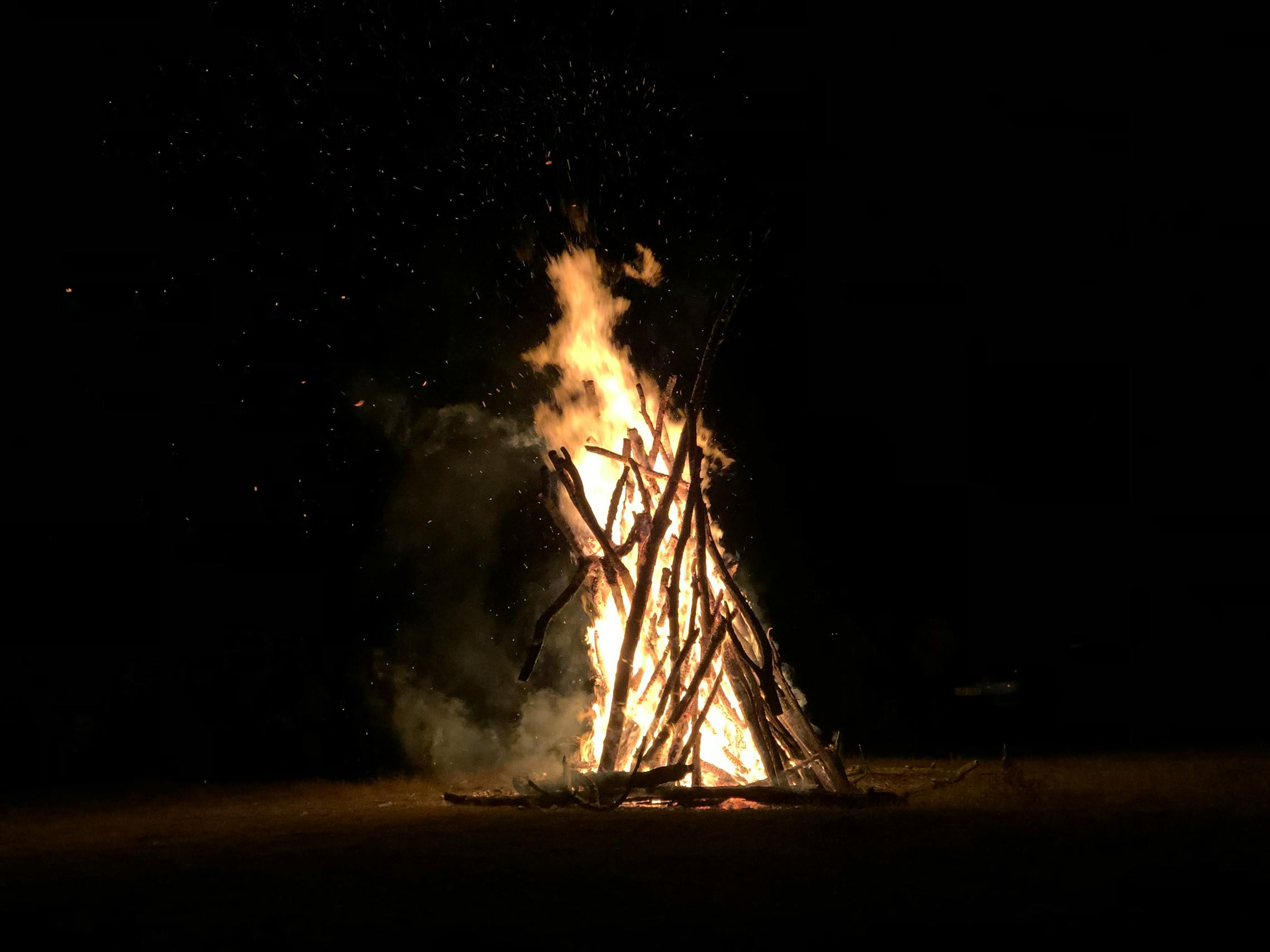
Every October, someone will tell you that Halloween is “really” Samhain, the ancient Celtic festival of the dead. They’ll describe it with the confidence of someone who was there. They weren’t. Neither were the people who wrote down most of what we think we know about it.
Here’s the honest version.
The Problem with Celtic Sources
The Celts didn’t write things down. Not because they couldn’t (they had contact with literate Mediterranean civilizations for centuries) but because their knowledge traditions were oral. Druids reportedly spent up to twenty years memorizing their lore. When those traditions finally appeared in writing, it was through two unreliable filters: Roman observers with political agendas and Irish Christian monks working centuries after the fact.
Julius Caesar described Celtic practices in De Bello Gallico around 50 BCE, but Caesar was building a case for conquest, not conducting anthropology. The Irish mythological texts, particularly the Lebor Gabala Erenn and the Tochmarc Emire, reference Samhain repeatedly, but these were compiled between the ninth and twelfth centuries by monks who had their own reasons for presenting pagan customs in certain ways.
So when you read about Samhain, hold the details loosely. The broad strokes are probably right. The specifics deserve skepticism.
What We Can Reasonably Say
The Celtic year was divided into two halves: the light half beginning at Beltane (roughly May 1) and the dark half beginning at Samhain (roughly November 1). Samhain, pronounced “SAH-win” or “SOW-in” depending on which Celtic linguist you ask, marked the end of the pastoral season. Herds were brought down from summer pastures. Cattle deemed unlikely to survive winter were slaughtered, their meat preserved. The harvest was in. The agricultural year was over.
This wasn’t a minor date on the calendar. Samhain was one of four major fire festivals (along with Imbolc, Beltane, and Lughnasadh), and multiple sources suggest it was the most significant. The Mound of the Hostages at Tara, a Neolithic passage tomb predating the Celts by millennia, is aligned to the Samhain sunrise, which tells us this seasonal marker mattered to the people of Ireland long before anyone called it Samhain.
Fire and Darkness
Communal bonfires were central to the observance. The Tlachtga fire festival, held on the Hill of Ward in County Meath, is described in medieval Irish texts as the place where the Samhain fire was lit before all others. Communities may have extinguished their household hearths and relit them from this central flame, though this detail comes from later sources and may represent an idealized version of the practice.
The archaeological record at the Hill of Ward does show evidence of large-scale burning, animal bone deposits, and ritual activity spanning several centuries. So while we can’t confirm every detail of the medieval descriptions, something significant was happening there.
The Boundary Between Worlds
Multiple Irish texts describe Samhain as a time when the boundary between the living and the dead, between the human world and the Otherworld, became thin or permeable. The Echtra Nerai (“The Adventure of Nera”) sends its protagonist into the Otherworld on Samhain night. The Aislinge Oenguso features supernatural events tied to the festival.
Whether ordinary Celts believed they might encounter spirits on Samhain night, or whether these were literary conventions used by later storytellers, we can’t say with certainty. But the association between this date and the supernatural is old and consistent.
Disguises and Offerings
The claim that Celts wore costumes or disguises on Samhain is common but hard to pin down in the earliest sources. Later medieval accounts describe mumming and guising traditions associated with the festival, and it’s reasonable (though not provable) that these customs had older roots. Leaving food offerings for spirits is better attested, appearing in multiple texts and aligning with folk practices that survived in Ireland and Scotland well into the modern era.
From Samhain to Halloween
The transition from Samhain to Halloween was neither sudden nor simple. When Pope Gregory III designated November 1 as All Saints’ Day in the eighth century (and Pope Gregory IV extended this to the universal Church in 835), the Christian feast was layered over the existing Celtic observance. Whether this was deliberate appropriation or coincidence is debated by historians with strong opinions on both sides.
What’s clear is that the customs didn’t vanish. They adapted. The bonfires continued in Ireland and Scotland for centuries. The association with spirits and the dead persisted. Food offerings evolved into soul cakes. Disguises became guising. And by the time Irish and Scottish immigrants brought these traditions to North America, the old festival had been transformed into something new while retaining its essential character: a night when the ordinary rules are suspended and the darkness is, briefly, welcome.
The medieval transformation of these customs is where the story gets more complicated.