The Real Origins of Trick-or-Treating
From medieval souling to the 1927 newspaper in Blackie, Alberta, the surprisingly recent and distinctly North American history of trick-or-treating.
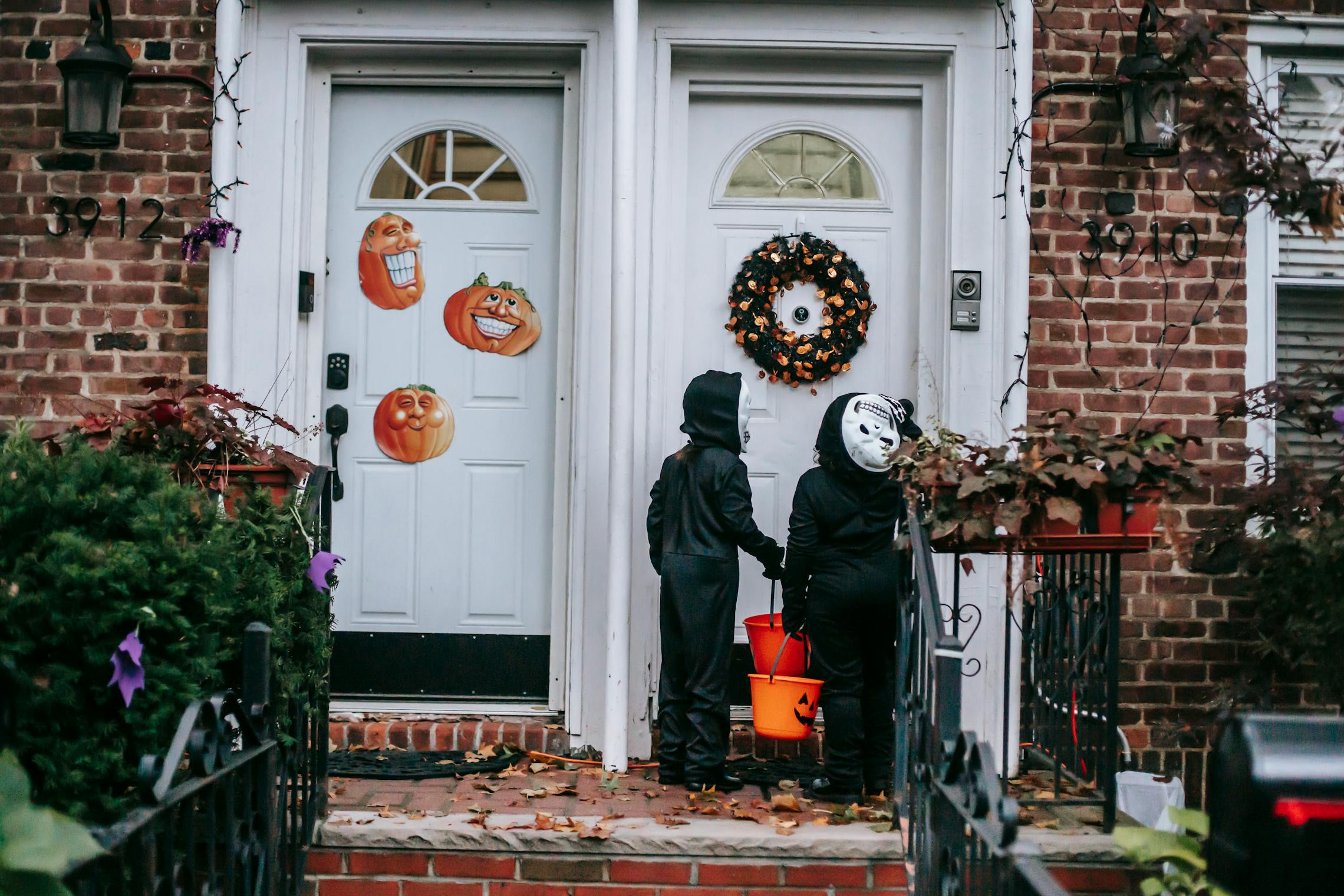
Ask most people when trick-or-treating started and they’ll guess it’s ancient. It isn’t. The phrase “trick or treat” first appeared in print in 1927, in a newspaper from a small town in Alberta, Canada. The practice as we know it (costumed children going door to door for candy on October 31) didn’t become widespread in the United States until after World War II.
This is one of the youngest “old” traditions in American life.
The Older Roots
Trick-or-treating didn’t emerge from nothing. It has at least three plausible ancestors, none of which are a direct, unbroken line.
Souling was the medieval English practice of going door to door on All Souls’ Day (November 2) to collect soul cakes in exchange for prayers for the dead. It was practiced from at least the fifteenth century and survived in some English communities into the early twentieth century.
Guising was the Scottish and Irish tradition of wearing disguises on Halloween night, visiting neighbors, performing a song or recitation, and receiving food or coins. Records of guising go back to at least the sixteenth century, and it was still common in Scotland when Halloween customs crossed the Atlantic.
Belsnickeling and other European mumming traditions involved costumed visits to neighbors’ homes during various calendar occasions, though these weren’t specifically tied to Halloween.
The connection between these practices and modern trick-or-treating is suggestive but not proven. There’s a gap in the historical record between the folk customs of the British Isles and the sudden appearance of trick-or-treating in North America.
The Canadian Connection
The earliest known use of “trick or treat” in print comes from the Lethbridge Herald of November 4, 1927, reporting on Halloween activities in Blackie, Alberta: “The youthful tormentors were at no loss for ‘ichts. All havens requisite to an ideally wild Hallowe’en had been duly considered. The ‘ichts demanded an adequate toll of ‘tricks and treats’ from residents.”
Several other Canadian newspaper references follow through the early 1930s. This isn’t surprising. Canadian immigration from Scotland and Ireland was heavy throughout the nineteenth century, and these communities brought their Halloween customs with them. What’s interesting is that the Canadian version seems to have formalized the implicit bargain of guising (perform, receive treat) into an explicit one (give us treats or we’ll play tricks).
The “trick” part was real. Halloween pranking in early twentieth-century North America was serious business. Overturned outhouses, soaped windows, unhinged gates, blocked roads, and general vandalism were common enough that newspapers regularly reported the damage. In some communities, Halloween night was known as “Mischief Night” or “Cabbage Night,” and the destruction went well beyond pranks.
Trick-or-treating may have emerged partly as a community response to this problem. Give the kids candy and maybe they’ll leave your outhouse alone.
The 1930s: A Custom Takes Shape
Through the 1930s, trick-or-treating spread across North America, moving from Canadian and northern U.S. communities southward. Newspapers and magazines began acknowledging it as an established practice. The American Home magazine published a guide for dealing with trick-or-treaters in 1939. Local civic organizations started promoting Halloween parties and supervised trick-or-treating as alternatives to destructive pranking.
The practice was interrupted by World War II. Sugar rationing made candy a scarce commodity, and some communities discouraged trick-or-treating as wasteful. But the custom was established enough to survive the hiatus.
The Postwar Explosion
The real expansion came after 1945, driven by the same forces that created modern suburban America. Returning GIs and their families poured into new developments like Levittown, creating neighborhoods perfectly designed for trick-or-treating: safe streets, consistent house spacing, a critical mass of children, and parents who wanted their kids outside for a few hours.
The candy industry recognized the opportunity immediately. In the late 1940s and 1950s, manufacturers began marketing individually wrapped candies specifically for Halloween. Before this, trick-or-treaters received homemade treats, fruit, coins, or nuts. The shift to commercial candy was driven by convenience, marketing, and (later) safety concerns about homemade items.
By the mid-1950s, trick-or-treating was a mass phenomenon. The Peanuts comic strip featured it. Disney produced a Donald Duck cartoon about it in 1952. UNICEF launched its Halloween collection program in 1950. The custom had gone from regional curiosity to national institution in about twenty years.
The Candy Lobby’s Role
The relationship between the candy industry and trick-or-treating is worth examining with clear eyes. The National Confectioners Association actively promoted trick-or-treating through advertising and community outreach starting in the 1950s. By the 1970s, the connection between Halloween and candy was so entrenched that the sugar industry successfully lobbied to extend Daylight Saving Time through October, arguing (correctly) that an extra hour of evening light would increase trick-or-treating and candy sales. The Energy Policy Act of 2005 finally made this change permanent.
This isn’t a conspiracy. It’s ordinary commercial interest. But it does mean that the version of trick-or-treating most of us grew up with, the one centered on commercially manufactured candy, was significantly shaped by the people selling that candy.
The Safety Panic
The 1970s and 1980s brought persistent fears about poisoned candy and razor blades in apples. Sociologist Joel Best has studied these claims extensively and found that documented cases of strangers tampering with Halloween candy are almost nonexistent. The most famous case, the 1974 poisoning death of Timothy O’Bryan in Texas, was perpetrated by the child’s own father for insurance money.
The panic was real even if the threat was largely imaginary, and it permanently changed trick-or-treating. Homemade treats disappeared. Unwrapped items were discarded. Hospital X-ray programs for candy inspection appeared and persisted for decades. Trick-or-treating hours were formalized and shortened. Some communities moved the activity to daylight hours or replaced it entirely with “trunk-or-treat” events in church parking lots.
What We Made
Trick-or-treating is a genuinely American invention (or Canadian, if you’re counting), assembled from older parts but recognizable as something new. It took medieval souling, Scottish guising, community responses to teenage vandalism, postwar suburban geography, and candy industry marketing, and fused them into a ritual that now consumes roughly 600 million pounds of candy per year. Ancient it isn’t. Impressive it certainly is.