Lighting Your Haunt Part 2: Fixture Types
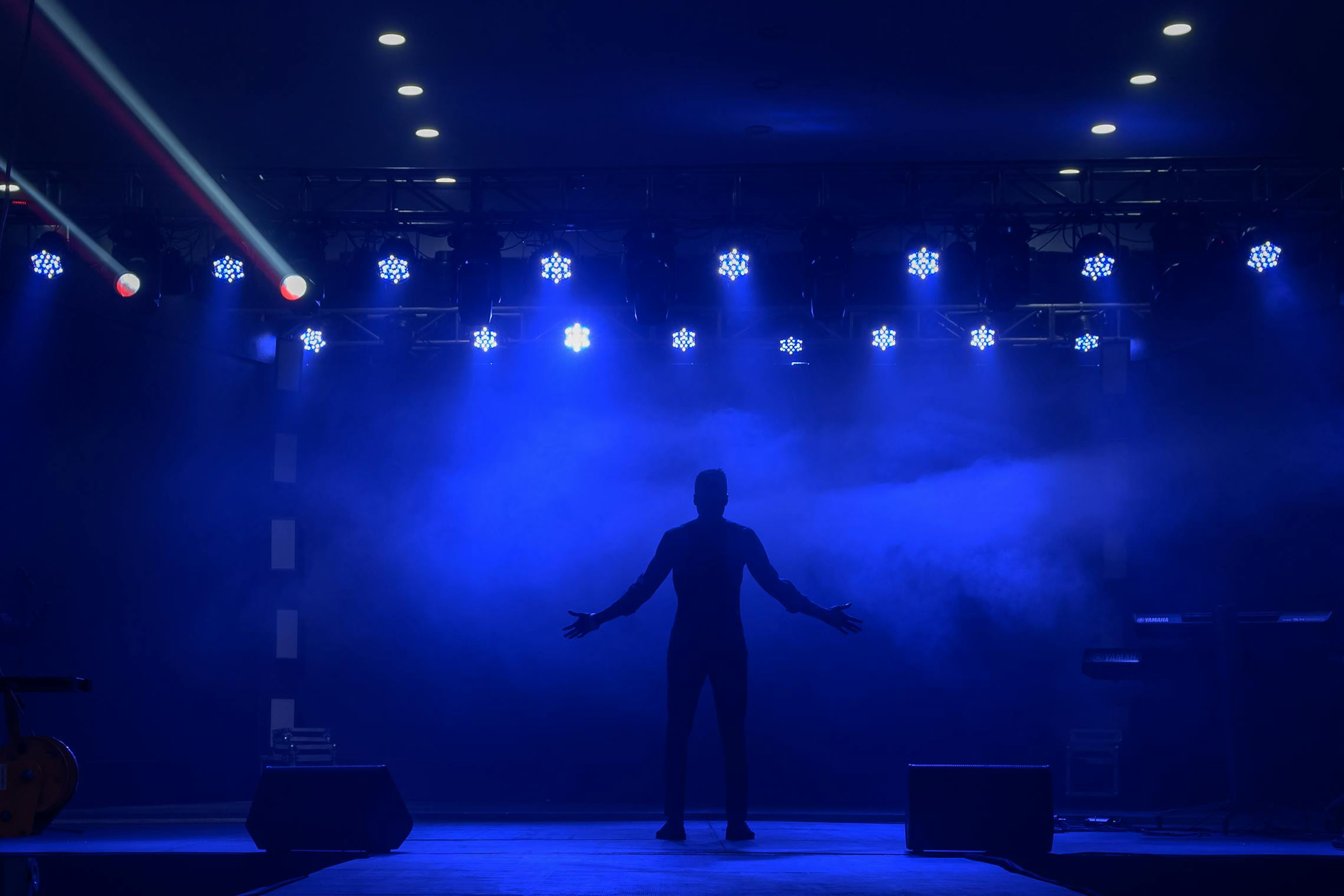
Color theory tells you what to do. Fixtures determine how you do it. The Halloween lighting market ranges from $5 clip-on colored bulbs to $500 DMX-controlled moving heads. Most home haunters need something in between. This lesson breaks down every common fixture type, what it does well, and where it falls short.
LED Spotlights
The workhorse of home haunt lighting. A compact LED spotlight in a colored housing produces a focused beam that you aim at a specific prop, surface, or area. They’re cheap ($5-15 each), low power, and available in every color.
Best for: Uplighting props, highlighting focal points, creating colored pools on walls and floors.
What to look for: Single-color LEDs produce purer, more saturated color than white LEDs with a colored filter. Look for units with a ground stake for outdoor use and a clamp or bracket for indoor mounting.
Quantity: Plan for one spotlight per major prop or focal point. A typical front yard haunt needs 6-12 spotlights.
PAR Cans
PAR (Parabolic Aluminized Reflector) cans are the cylindrical fixtures you see in stage lighting. Modern LED PAR cans use RGB or RGBW LEDs, meaning a single fixture can produce any color. Many include multiple modes: static color, fade, strobe, and sound-activated patterns.
Best for: Large area washes, setting base lighting for a scene, DMX-controlled shows.
Price range: $20-50 for basic RGB PAR cans, $60-150 for RGBW with DMX input.
The advantage over spotlights: One PAR can replaces three or four single-color spots because you can dial in any color. If you change your mind about the palette for a room, you adjust the fixture instead of swapping hardware.
String Lights
Forget white or multicolor party strings. For Halloween, you want single-color string lights in purple, orange, or warm white. Green and red strings also work in specific contexts (swamp, hellscape).
Best for: Ambient background glow, outlining structures, wrapping around trees and railings. String lights provide broad, diffused illumination that softens the space and gives guests enough visibility to navigate.
Indoor tip: Run purple string lights along the ceiling perimeter of a room at floor level, tucked behind furniture. The indirect glow creates a base atmosphere without any visible light source.
Outdoor tip: Wrap orange or purple strings through tree branches. The light filters through the branches and creates organic shadow patterns on the ground. Pair with fog for a haunted-forest effect.
Smart Bulbs
WiFi-enabled color-changing bulbs (Philips Hue, LIFX, or budget alternatives) fit standard light sockets and produce millions of colors at adjustable brightness. You control them from your phone or, better, through automation routines.
Best for: Rooms with existing light fixtures. Swap your regular bulbs for smart bulbs, set them to deep red or purple, and control them remotely. Trigger a color flash when a motion sensor activates. Set them to flicker mode for a candlelight simulation.
Limitation: Smart bulbs are wide-angle, omnidirectional light sources. They’re terrible at focused effects. Use them for ambient room lighting, not for highlighting specific props.
Blacklights (UV)
Ultraviolet light makes white and fluorescent materials glow while leaving everything else dark. The effect is striking: white fabric, teeth, certain paints, and laundry detergent all fluoresce brightly against a nearly invisible background.
Best for: Neon/toxic themes, making white costumes glow (ghosts, skeletons), revealing hidden messages painted in UV-reactive paint, psychedelic or supernatural scenes.
Types: LED blacklight bars ($15-30) cover a wide area and are the most practical. Blacklight bulbs screw into standard sockets but have limited throw. Blacklight tubes (fluorescent) are being phased out in favor of LED.
Caution: Cheap “blacklight” LEDs are often just purple LEDs, which look purple but don’t actually emit significant UV. True UV LEDs have a wavelength of 365-395nm and will make fluorescent materials glow. Check the specs.
Strobes
A strobe light fires rapid, intense white flashes that fragment motion and create a disorienting, nightmarish effect. In a fog-filled room, a strobe turns the air itself into a flickering wall. Combined with an approaching figure, the effect is deeply unsettling because you can’t track smooth movement.
Best for: Scare zones, corridor approaches, lightning simulations, reveal moments.
Speed: Adjustable strobes let you control the flash rate. Slow strobes (1-2 flashes per second) create a “lightning” effect. Fast strobes (8-12 per second) create the disorienting motion-fragment effect. Most consumer strobes default to the fast range.
Safety: Post a visible warning before any area with strobing lights. Some guests have photosensitive epilepsy. Provide an alternative route or clearly mark the strobe zone so affected individuals can skip it.
Lasers
A laser projector emits patterns (dots, grids, galaxies) that sweep across surfaces. Green and red are the most common colors. In fog, lasers create visible beams and geometric patterns floating in the air.
Best for: Large outdoor spaces where individual spotlights can’t cover enough area. A single laser projector can blanket a 30-foot wall with moving patterns. In fog, the beams create a tunnel or cage effect that’s visually spectacular.
Safety: Never aim a laser at eye level or into the path of traffic. Mount lasers high and angle them downward, or aim them at surfaces well above head height. Even low-power consumer lasers can cause eye damage with direct exposure.
Real Candles and Flame Effects
Nothing matches the quality of actual candlelight. The warm flicker, the subtle movement, the smell of beeswax. For a gothic or Victorian haunt, real candles are irreplaceable.
Best for: Dining scenes, altars, mantelpieces, intimate close-up areas where guests can appreciate the detail.
Safety: Use dripless candles in stable holders, away from curtains, fabric, paper, and costumes. Never leave candles unattended. Place them on non-flammable surfaces. Consider battery-operated LED candles for high-traffic areas, saving the real ones for controlled, supervised locations.
LED candle tip: The cheap ones look terrible. Invest in higher-end LED candles with realistic flicker. Place them inside frosted glass holders or lanterns to obscure the fake flame.
Budget Allocation
For a typical home haunt, here’s a reasonable lighting budget breakdown:
| Category | Quantity | Budget |
|---|---|---|
| LED spotlights (colored) | 8-12 | $60-120 |
| PAR cans (RGB) | 2-4 | $60-150 |
| String lights | 3-5 sets | $30-50 |
| Blacklight bar | 1-2 | $20-40 |
| Strobe | 1-2 | $15-30 |
| Candles (LED or real) | 10-20 | $20-40 |
| Total | $205-430 |
You can start much smaller. Four colored spotlights and two strands of purple string lights ($40 total) make an enormous difference over a porch light and a single jack-o’-lantern.
Now that you know your fixture options, the next lesson applies them room by room inside your haunt.
Next up: Part 3: Indoor Techniques