Mischief Night, Devil's Night, Cabbage Night: The Many Names for October 30
Where each name for the night before Halloween is used, where the pranking tradition came from, and how it changed from soaped windows to Detroit's fires.
On October 31, 1924, the Chester Times in Pennsylvania ran two stories about the same night under two different names. The front page said “last night” had been designated “Mischief Night” by “hundreds of youngsters in the lower wards of the city, who staged a premature Halloween celebration.” They removed signs and put discarded autos on the trolley tracks. Page four said the night before Halloween “is known among the juvenile population as ‘Devil’s Night.’” Both reports are quoted in the Dictionary of American Regional English (DARE), and they are the earliest uses that dictionary gives for either name meaning October 30.
The Names and Where They’re Used
DARE, the University of Wisconsin’s dictionary of regional American speech, has an entry for each of these. The regions below are DARE’s labels where it gives one, and the dates are the earliest citations it gives. Unless another source is named, every newspaper quoted on this page is quoted in DARE.
| Name | Where (per DARE) | Earliest citation | What the kids did |
|---|---|---|---|
| Cabbage Night | Northeast and Great Lakes; now mostly western and southern New England and the New York City area | 1861, Trenton, NJ (meaning Halloween) | Threw cabbages, stalks and stumps at houses |
| Gate Night | North and North Midland east of the Mississippi, especially southeastern New York | 1867, Columbus, OH | Lifted gates off their hinges and carried them away |
| Corn Night | North Midland and the Appalachians | 1882, Wellington, OH | Threw dried, shelled corn at windows, doors and people |
| Mischief Night | Northeast, especially New Jersey and southeastern Pennsylvania | 1884, Janesville, WI (meaning Halloween); 1924 for October 30 | All of the above |
| Doorbell Night | Scattered, North and Midland | 1891, Indianapolis | Rang doorbells, or jammed them so they kept ringing |
| Devil’s Night | Scattered, especially southeastern Michigan | 1893, Iowa (meaning Halloween); 1924, Chester, PA for October 30 | Vandalism; in Detroit from the 1980s, arson |
| Chalk Night | Central Atlantic and southern New England | 1893, Mount Carmel, PA | Chalked houses and sidewalks |
| Moving Night | Baltimore | 1895, Lewisburg, PA; Baltimore by 1920 | Carried off porch furniture, gates and anything else loose |
| Clothesline Night | Scattered, especially west of the Mississippi | 1898, Hutchinson, KS | Cut down clotheslines |
| Soap Night | Scattered, North and North Midland | 1902, Logansport, IN | Soaped windows |
| Picket Night | No DARE label; citations from Indiana, Iowa, California, Missouri and Sayreville, South River and Union Beach, NJ | 1908, Clinton, IN | Damaged picket fences |
| Garbage-can Night | Scattered, chiefly Inland North and North Midland | 1908, Pittsburgh | Tipped over garbage and ash cans |
| Damage Night | Southwestern Ohio | Cincinnati Public Schools manual, 1947 | General vandalism |
| Hell Night | Scattered, especially New Jersey | 1954, Asbury Park, NJ | “Destruction-bent” pranks |
| Goosey Night | Northern New Jersey and New York City | 1969, New Brunswick, NJ | Eggs, flour-filled socks, shaving cream |
| Fox Night | No DARE label; citations from Michigan’s Upper Peninsula and Duluth, MN | A DARE informant recalling about 1935 | Doorbells and soaped windows |
In New Jersey the name changes by county. A 2009 study in American Speech, quoted in DARE, found Mischief Night “everywhere in the state with two exceptions”: Goosey Night in Passaic County, the eastern half of Sussex County and northeastern Morris County, and Cabbage Night “only in Bergen County.” The line can run between neighboring towns. A DARE correspondent wrote in 2015: “Where I grew up, Union Beach NJ we called it Mischief Night. We moved to the next town over, and they called in [sic] Picket Night.”
Baltimore has its own name, even though the Harvard dialect survey (below) counts Maryland as Mischief Night territory. In 1920 the Baltimore Sun explained that “‘Moving Night,’ as the eve of Halloween is called by the younger element,” was “observed by carrying off the property of others.” In 2005 a Baltimorean told DARE: “everyone in Baltimore calls it that, but i dont think anyone outside of Baltimore does.”
Cincinnati had several. DARE’s citations there include damage night, garbage night and beggars night, and one informant called it cabbage night, which is the name Smithsonian Magazine gives for the city.
From Halloween to October 30
The Trenton Daily State Gazette reported on November 1, 1861: “Last night was the holiday we know as Hallow Eve, or popularly in this latitude as ‘Cabbage night.’ We noticed sundry boys armed with cabbages.” A Janesville, Wisconsin, events list for October 31, 1884, reads “Halloween. Mischief Night.” (DARE’s editors note that it “seems to be to Halloween night itself.”) In 1893 an Iowa paper reported that Des Moines college students “stabled a cow in the chapel on devil night, commonly called Halloween.”
A separate prank night before Halloween is in print by 1883, when the Wheeling Daily Intelligencer in West Virginia described Corn Night as “the evening preceding Hallow E’en.” An 1891 Indianapolis Journal writer remembered that when he was a boy the pranks “were strung out for three or four successive nights.” In 1904 the journal Dialect Notes defined Gate Night as “the night of 30th Oct.” and Door-bell Night as October 29.
The Harrisburg Patriot printed an “official list” in 1916 that began with Ash Can Night on October 21. In 1919 the Auburn Citizen in New York announced “the new order”: “The 28th is Cabbage Night, the 29th Gate Night, the 30th Door-bell Night, and the 31st Ghost Night.” A Middletown, New York, writer in 1918 said Garbage Can Night was “something new to the writer, having developed since he was a lad.”
The sources disagree on when Mischief Night reached the United States. Smithsonian folklorist James Deutsch, citing Time magazine, wrote that it “may have first appeared in the United States in the 1930s and 1940s, possibly connected to the turmoil of the Great Depression and the threat of World War II.” The Detroit Historical Society says it “made its way to the U.S. during the 1930s and 1940s.” DARE’s newspaper citations put the name in print in 1884 and attached to October 30 by 1924. In 1936 the Chester Times was still explaining it: “Now, in addition to Hallowe’en night there is ‘Mischief Night.’”
Older Roots in Britain and Ireland
England had a Mischief Night first, on a different date. DARE’s entry notes that the term is attested in Yorkshire and Lancashire from 1830 for April 30, the night before May Day, and from 1850 for November 4, the night before Guy Fawkes Day. The Detroit Historical Society also traces the name to “the day before May Day.” One American name may point back to the November date: DARE suggests Fox Night, used in Michigan’s Upper Peninsula and Duluth, is perhaps a folk etymology of “Fawkes night.”
Ireland’s pranks happened on Halloween itself, and cabbage was involved. In the late 1930s, schoolchildren across Ireland wrote down local customs for what is now the Schools’ Collection at dúchas.ie. At Barkhall School near Letterkenny, County Donegal, a 48-year-old informant reported: “Some people celebrate it by hitting other people’s doors with cabbage stalks.” Halloween historian Lisa Morton told History.com that Irish boys would “tie strings to cabbages and pull them through fields to scare people,” and that the Scots would “pull up a cabbage stalk, get it smoking and shove it up to a keyhole” so the house filled with “noxious-smelling vapor.”
Two sources do draw the line. History.com says some places called October 30 Cabbage Night “harkening back to the old Scottish pranking tradition,” and the Detroit Historical Society says Devil’s Night “stemmed from the European tradition of Mischief Night.” Neither cites evidence for the connection, and we found none that documents it. The American record starts with names for Halloween night, not for a separate eve, and the move to October 30 is documented only in the United States. (For the older Scottish and Irish house-visiting customs, see our history of medieval Halloween.)
What the Pranks Were
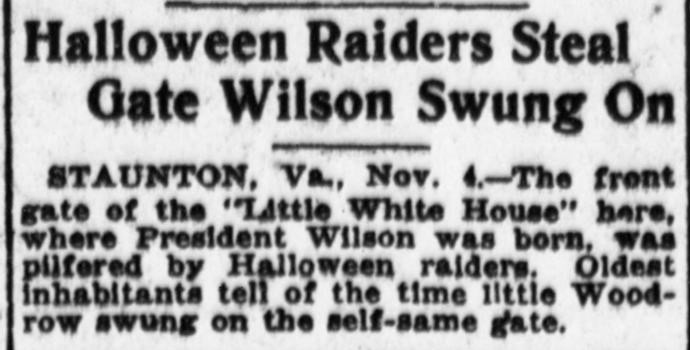
Gates. “Last night was gate night,” the Daily Ohio Statesman in Columbus reported in 1867, “and the way the little cusses did perform the ceremony of taking gates off their hinges and carrying them off was a caution to carpenters.” In Hamilton, Ohio, in 1891, “the usual number of gates were missing this morning. ’Squire Meckley had his front steps taken.” In 1916 the gate went missing from the president’s birthplace.
Corn, cabbage and soap. In Decatur, Illinois, in 1909, “Corn was thrown all over the city and the windows in the business district were marked up with soap.” A Burlington, Iowa, writer in 1925 said Soap Night was when kids “beg their mothers for scraps of soap and make pumpkin faces on windows.” North Adams, Massachusetts, called it “Cabbage stalk night” in 1901.
Doorbells. A 1918 Joplin, Missouri, paper explained the technique: “A toothpick inserted at the side of the button will make the ringing continuous.” Historian Samira Kawash, in a 2011 article in the American Journal of Play, found a 1932 Los Angeles story about “a band of wandering youths who rang doorbells and departing left a dead fish dangling on the doorknob,” and a 1929 case in which a 13-year-old girl was hit by an air gun fired at kids “engaged in the Halloween pastime of ringing doorbells.”
Clotheslines, fences and cans. Hutchinson, Kansas, 1898: “Nearly every clothesline hanging out was cut down. Many were stolen.” Clinton, Indiana, 1908: “considerable damage is annually done to the paling fences of the city.” Baltimore’s Sun warned in 1935 that on Moving Night everything movable, “from a back gate to a flower pot,” was in danger of “being transported to a neighboring yard.”
Chalk. The Chester Times announced Chalk Night in 1945: “Buildings, preferably brick, will be marked and drawn with cabalistic symbols.” Connellsville, Pennsylvania, had a worse problem in 1912, when “the most obscene writing and drawing have been in shocking evidence the morning following chalk night.”
Outhouses and fire. JSTOR Daily quotes Yale anthropologist Ralph Linton in 1951: “the prevalence of indoor plumbing has taken much of the sport out of Halloween.” It also describes an early-1900s Connecticut incident in which pranksters loaded a wagon with trash, set it on fire, and pushed it “downhill toward trees, setting them ablaze.”
Ruth Edna Kelley’s The Book of Hallowe’en (1919), quoted by Kawash, gives the whole list in one place: “Mischievous spirits choose it for carrying off gates and other objects, and hiding them or putting them out of reach. . . . Bags filled with flour sprinkle the passers-by. Door-bells are rung and mysterious raps sounded on doors, things thrown into halls, and knobs stolen.”
Escalation, parties and the first “trick or treat”
Towns tried to buy the night back. Kawash counts a 1914 carnival in Ocean Park, California, as one of the earliest citywide Halloween festivals meant to divert pranksters; a year later it was a three-day Harvest Home Festival. One headline put the logic plainly: “Halloween parties [are] not only [a] treat for children, but prevent expensive pranks.”
The pranks got bigger anyway. JSTOR Daily cites a 1937 Journal of Education article about a South Dakota town of under 18,000 people where Halloween 1932 “brought general property damage in excess of five thousand dollars, and left the streets and avenues in the city strewn with 135 truckloads of junk and refuse.” The school superintendent, who called the night “Hell-o-e’en,” said the police had been “out-generaled [and] out-manoeuvred” by a “triumphant army of boys,” and he answered with a school party and barbecue.
The first known “trick or treat” in print, from Blackie, Alberta, in 1927, sits in the middle of a prank report. Kawash quotes it: “No real damage was done except to the temper of some who had to hunt for wagon wheels, gates, wagons, barrels, etc., much of which decorated the front street. The youthful tormentors were at back door and front demanding edible plunder by the word ‘trick-or-treat’.” In 1934 the Helena Independent in Montana ran the headline “The Gangsters of Tomorrow” over a story in which “Pretty Boy John Doe” told a housewife, “Madam, we are here for the usual purpose, trick-or-treat.” In 1939 Doris Hudson Moss advised American Home readers that with food and a welcome, “the little rowdies from the other side of town will join in the party spirit and leave your front gate intact.”
Historians disagree about who invented the treat side of the bargain. History.com, summarizing Lisa Morton, says that by 1933 the holiday “had become so destructive that cities were considering banning it.” In Morton’s own words, many cities decided instead that “they might be able to buy these kids off.” Kawash notes that the historian David Skal reads the Moss article the same way, as evidence that adults began trick-or-treating as a bribe. Kawash disagrees: “Adults wrote about trick-or-treating, but there is no evidence that they suggested or initiated the practice.” In her reading the practice came out of “a hodgepodge of extant festive practices and a dose of pop-culture imagination,” including the 1930s gangster shakedown. She does agree that the adult-run festivals were meant to divert pranks.
Either way, the prank names started turning into treat names. On November 1, 1947, the Pottstown Mercury reported: “Apparently worn out by their efforts on Mischief Night, Pottstown’s youngsters spent their energies in begging for cookies and nuts at front doors, and attending parties.” In 1950 the PTA in Smethport, Pennsylvania, sponsored “Cabbage Night” as “the only night for ‘Trick or Treat.’” Kawash quotes historian Nicholas Rogers: “the 1950s saw the taming of Halloween. . . . By 1960 much of the mischief formerly associated with the holiday had ebbed.” In 1975 a police lieutenant in Bucks County, Pennsylvania, looked back: “The old days of Mischief Night when kids just threw corn are gone. . . Now it’s all just property damage and heartache.”
Detroit’s Devil’s Night
Detroit didn’t invent Devil’s Night, but it made the name infamous. DARE’s first Detroit citation comes from the Detroit Free Press in 1969, when police reported “widespread incidents of vandalism Thursday night as cruising carloads of youths celebrated ‘Devil’s Night,’ the eve of Halloween.”
The Detroit Historical Society says the night stayed “largely harmless” from the 1940s through the 1970s. In the early 1980s, rising unemployment left empty houses, “the perfect target for arsonists.” By 1983 a Detroit dispatcher could call that year’s count of deliberately set fires “about average for ‘Devil’s Night’” (a Montana paper quoted by DARE). The City of Detroit’s own table, published in its Angels’ Night 2016 newsletter, gives the fire counts:
| Year | Fires |
|---|---|
| 1984 | 810 |
| 1994 | 354 |
| 2010 | 169 |
| 2011 | 94 |
| 2012 | 93 |
| 2013 | 95 |
| 2014 | 97 |
| 2015 | 52 |
| 2016 | 59 |
The newsletter defines Angels’ Night as the three days of October 29 to 31 and doesn’t say whether the older counts used the same window. The Detroit Historical Society calls 1984 the highest year on record, at “more than 800 fires.”
The Historical Society dates a curfew to 1986, keeping anyone under 18 off the streets after 10 p.m. on October 30 unless an adult was with them. In 1995, the Society says, the city began enlisting neighborhood volunteers for Angels’ Night, “a city-sanctioned volunteer operation” whose volunteers “operated much like a neighborhood watch.” The city’s own 2016 count was 6,037 patrol and community-group volunteers plus 220 others, and it towed about 269 abandoned vehicles in the run-up. “This coalition has brought an effective end to a difficult chapter in Detroit’s history,” Mayor Mike Duggan said that year.
A 2019 study in Ecological Economics, “Hidden Costs of Blight and Arson in Detroit: Evidence From a Natural Experiment in Devil’s Night,” used the annual spike to measure what arson smoke does to air quality. The paper’s abstract notes that about a fifth of Detroit’s housing is vacant, blighted or abandoned, that an estimated 20 abandoned structures burn each day, and that in 2011 the fire commissioner adopted a policy for abandoned buildings known as “Let it Burn.” It puts the health burden on elderly residents from arson-related carbon monoxide alone at “greater than $300 million.”
The Historical Society says the city ended Angels’ Night in 2017 and replaced it with “Halloween in the D.” The City of Detroit dates Halloween in the D to 2018. In 2023 it gave out more than a million pieces of candy with nearly 600 volunteers, and drew 20,000 people to its two park events and another 20,000 to recreation centers.
Where the Names Survive
The UWM Dialect Survey (Jøhndal, Longenbaugh, Samuels and Vaux) asked 1,298 people what they call the night before Halloween, and 881 of them, about 68 percent, said they had no word for it. Devil’s Night led the named answers with 178, then Mischief Night with 88, cabbage night 14, “devil’s eye” 13, beggar’s night 13, goosy night 10, gate night 6, trick night 3 and mat night 2.
The larger Harvard Dialect Survey by Bert Vaux and Scott Golder, as reported in DARE, had 10,640 respondents: 11.13 percent said devil’s night, 10.84 percent mischief night, 1.68 percent cabbage night, 0.78 percent devil’s eve and 0.39 percent gate night. Mischief Night answers came chiefly from southern New England, southeastern New York, New Jersey, eastern Pennsylvania and Maryland. Devil’s Night answers came chiefly from southern New England, southeastern New York, New Jersey, Maryland and Michigan. Cabbage Night was concentrated in Vermont and eastern New York, southern New England and the New York City area.
Treat these as rough maps. When the New York Times built its dialect quiz from the Harvard questions, University of Pennsylvania linguist Mark Liberman warned at Language Log that “the real usage distribution of such alternatives may not emerge accurately from answers to questions like this.”
DARE’s recent files show where the smaller names hang on. Gate Night still had “special measures in place” in Nanuet, New York, in 2016. Goose Night was “still big in Butler” in Morris County, New Jersey, in 2015, and a Queens native remembered Goosey Night as “throwing eggs at people and property, pounding ‘friends’ with flour filled socks, spraying shaving cream all over cars and doors.” Washington County, New York, reported in 2014 that “Everyone knows that the night before Halloween is ‘Cabbage Night’.” Doorbell Night in Connecticut, 2015: “Doesn’t seem to happen too much anymore, thankfully.” Duluth’s Fox Night was a 1970s and 1980s thing with “no costumes and no candy,” and by the mid-1990s, one former participant said, “the whole concept had died out completely.”
Some neighborhoods had rules. A 2012 DARE correspondent from the Germantown section of Philadelphia explained that chalk night came first, then soap night, then Mischief Night, when “you could only toilet paper houses & other mischief, but no soaping or chalking” because “that was reserved for their special nights.”
Damage Night was still around in 1986, when teenagers on a spree in Springfield Township outside Cincinnati punctured “108 tires on 59 cars.” In 1998 the Doylestown, Pennsylvania, Intelligencer reported that police in west-central New Jersey had “asked stores to prohibit the sale of eggs to minors in anticipation of Mischief Night.”
Myths Worth Dropping
“Devil’s Night started in Detroit.” Iowa and Pennsylvania had the name decades before Detroit’s first DARE citation in 1969.
“Gate Night was when farmers’ gates were opened to let the livestock loose.” Every DARE citation describes gates lifted off their hinges and carried off, dropped on lawns or thrown into the next yard.
“Cabbage Night is named for skunk cabbage.” The skunk-cabbage story does exist: a 1977 to 1978 New Jersey dialect study quoted in DARE says Bergen County’s name “is said to refer to the custom of leaving skunk cabbages on neighbors’ porches.” But the name was in print in 1861, when Trenton boys were “armed with cabbages,” and the early citations are about garden cabbages, stalks and stumps. The skunk cabbage looks like a later local explanation.
“Black Halloween, 1933,” and “cities banned Halloween.” Morton’s claim, via History.com, is that cities were “considering” a ban. We found no source that names a city that banned it, and none that uses the label “Black Halloween.”
“The earliest Mischief Night was 1790.” This date circulates with no primary source we could check. The earliest date we could verify is DARE’s 1830 for Yorkshire and Lancashire.
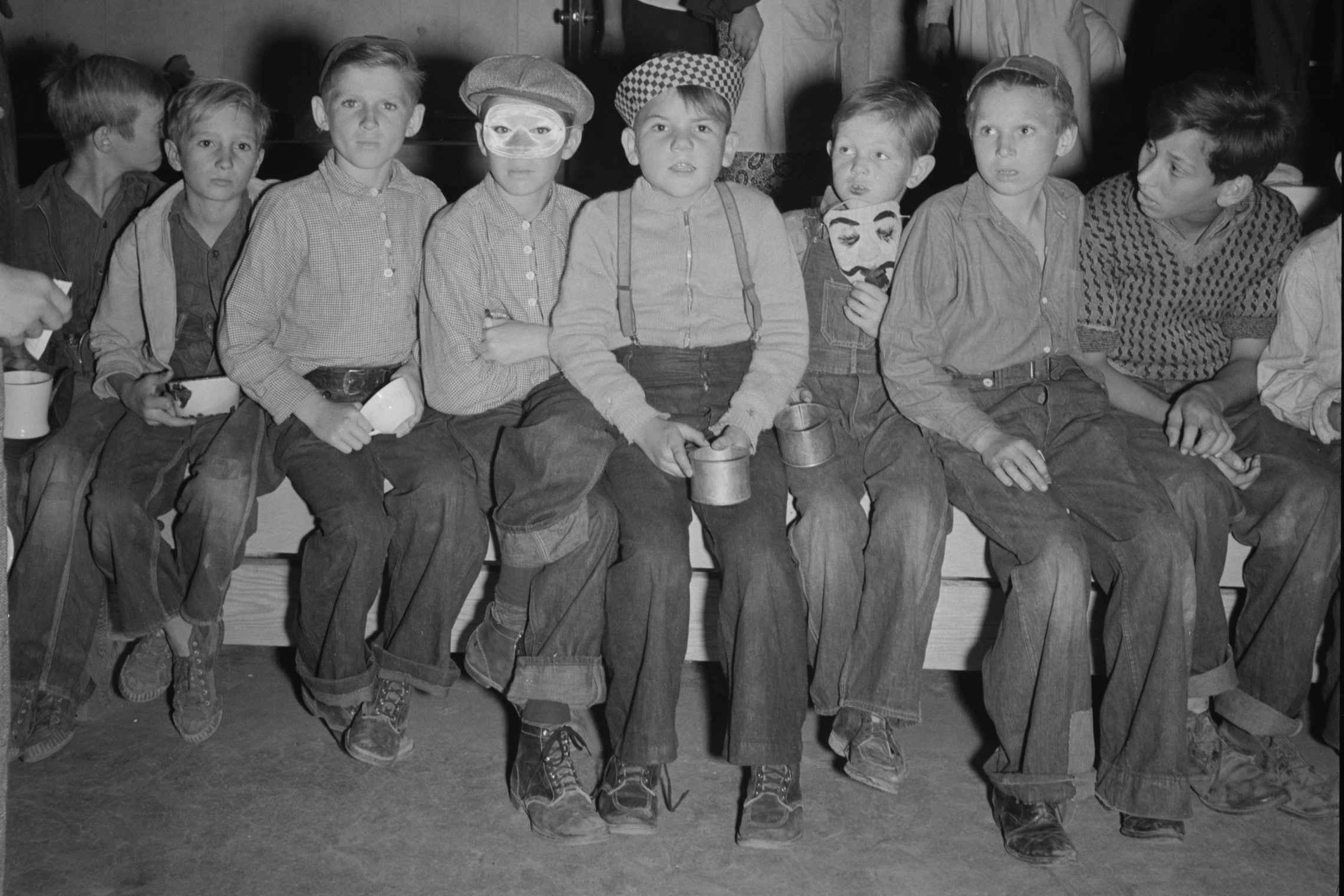
Top photo: Dorothea Lange, “Children at Halloween party, waiting for signal to come for refreshments,” Shafter migrant camp, California, November 1938. Farm Security Administration collection, Library of Congress.