Collecting Vintage Halloween: Dennison's Bogie Books, Beistle Die-Cuts, Postcards, and Spotting Reproductions
Where the paper Halloween that collectors hunt came from, when each piece was made, where the sources disagree on the dates, and how the maker's own reissues tell you what you're holding.
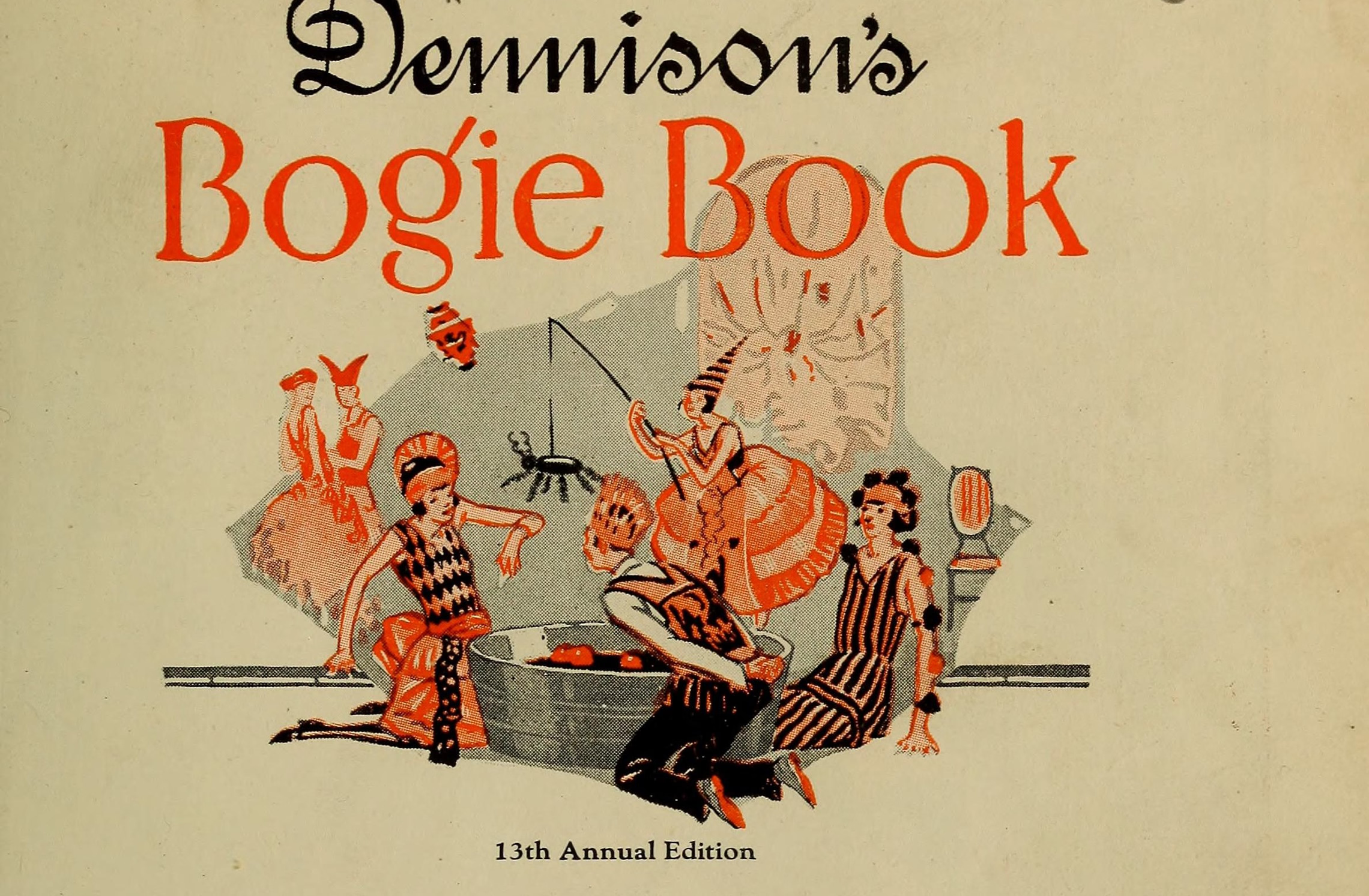
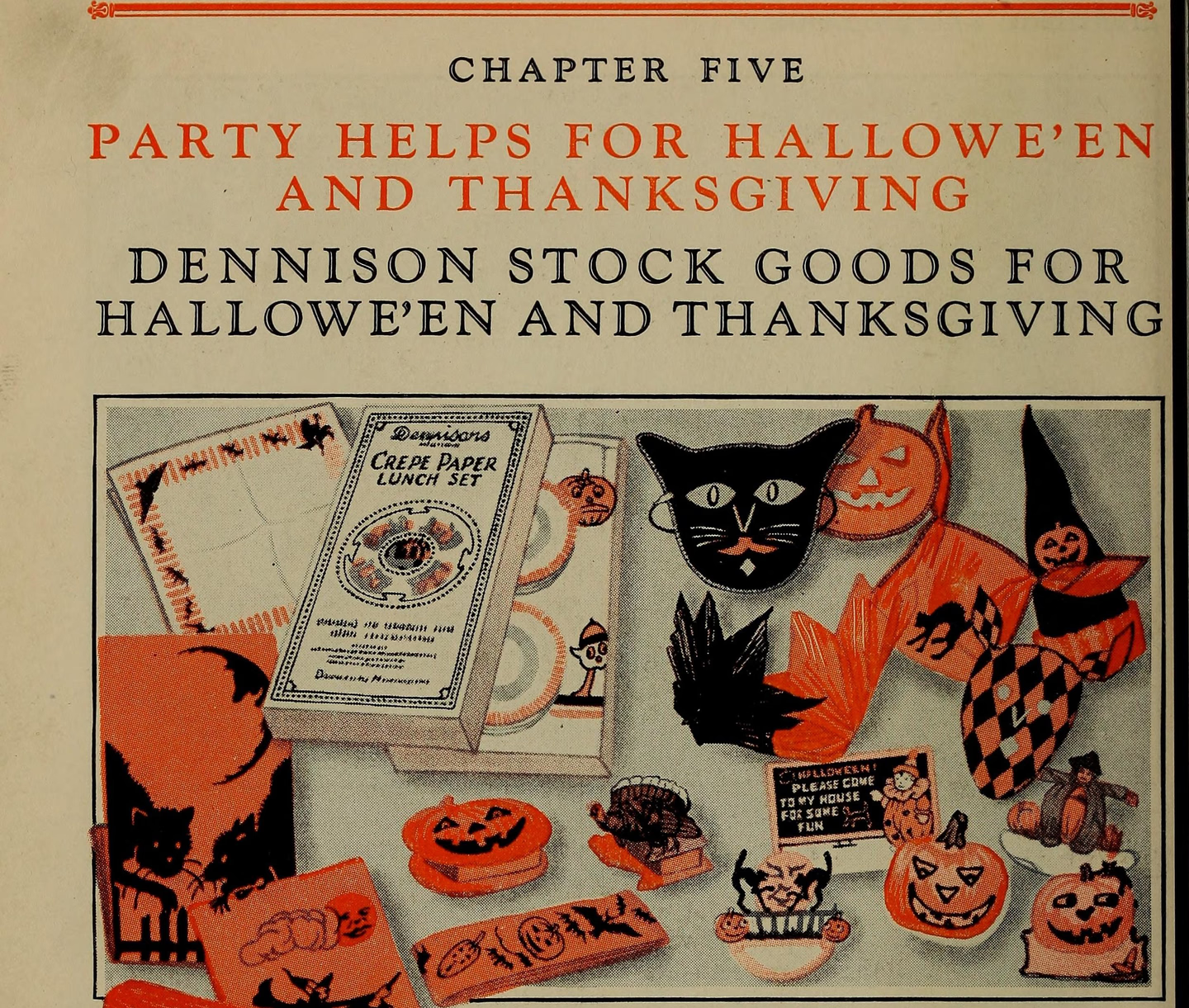
In the mid-1920s a fold of Dennison crepe paper, 10 feet long and 20 inches wide, cost 15¢ in a plain color and 25¢ or 30¢ in a printed pattern of “witches, black cats, pumpkins, bats, autumn leaves, fruit and turkeys.” Crepe borders were 10¢ each, and festoons ran 75¢ to $1.50 a dozen. Those prices sit on page thirty of the Dennison’s Bogie Book the Library of Congress scanned, a 13th annual edition that told hostesses the “made-up articles illustrated in the book, such as costumes, favors, centerpieces, score cards and serving cups, are not stock items,” but models to copy from stock goods (Library of Congress). A century later the booklet itself is the collectible, along with the die-cuts, honeycomb and postcards of the same years.
Dennison and the Bogie Books
Dennison Manufacturing started with jewelry boxes. The Framingham History Center, which holds the company’s archive, says Boston watchmaker Aaron Dennison and his father, Colonel Andrew Dennison, a shoemaker, began making them in Brunswick, Maine, in 1844. In 1897 the company consolidated in Framingham, Massachusetts, bringing boxes from Brunswick, labels and tags from Roxbury, and sealing wax and crepe paper from Brooklyn. It called itself “The Tag Makers,” and by 1925 it was producing 2 billion tags a year (FHC historical note).
Crepe paper turned it into a party company. According to the same finding aid, in 1892 “four young, creative women in Buffalo, NY” saw that crepe worked for “lamp shades, costumes and party favors,” and Dennison brought the “Heath Sisters” into its stores to teach customers in “up to 50 colors.” In 1896 it published Art and Decoration in Crepe and Tissue, “the first of a long line of successful Dennison crafts and party publications.” The FHC says Dennison “became the first American manufacturer of crepe,” that its crepe papers “are highly valuable collectibles today,” and that by the 1920s “sales of crepe surpassed tag sales.”
When the Halloween Line started
The year on this page, 1909, is the best-supported start date, but the sources don’t agree on what happened in it.
- Lisa Morton says Dennison, “starting in 1909, published (almost) annual Halloween decorating guides called Bogie Books,” and that the first one “is among the rarest of Halloween collectibles, with only two known to exist” (Morton, #1; #7).
- The FHC’s historical note says “The Halloween Line was launched in 1911 with eight items” (FHC).
- The FHC’s own box list contradicts that note. Box 8 holds a “Table Decorations for Halloween & Thanksgiving Postcard, c1906,” advertisements from 1909 for “napkins and paper,” price lists beginning with “Hallowe’en Line 1909,” and a folder of “Dennison’s Bogie Books, Correspondence and advertisements, 1909-1915” (FHC Series 14).
- The edition numbers point later still. The FHC lists its 1923 Bogie Book as the “11th edition” and its 1924 copy as a “reprint, 12th edition.” The Library of Congress copy is the “13th Annual Edition.” It turns down requests to reprint “A Gruesome Tale,” the ghost story “that appeared in the 1924 edition,” because “Most of the people who used this last year will want something new,” and prints a new one instead, which makes it the 1925 book. Counting back one edition a year puts the first at 1913. That arithmetic is ours, and Morton’s “(almost) annual” allows for gaps.
None of these sources settles whether a Bogie Book was among the 1909 material.
What survives, and when the name ended
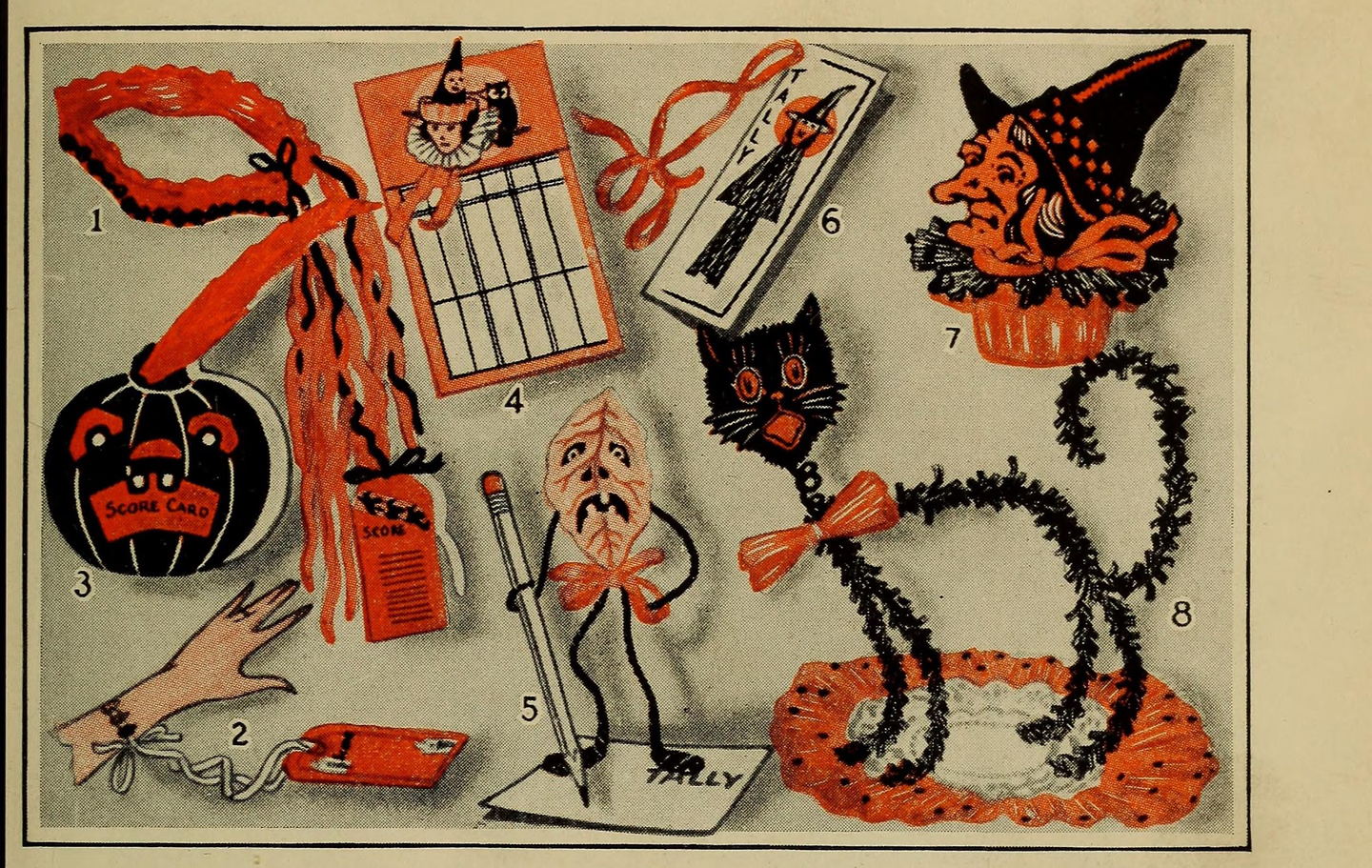
The FHC’s Box 8 holds Bogie Books for 1917, 1921, 1922, 1923, 1924 and 1925 (FHC Series 14). Its 2014 Dennison exhibit displayed a “10 cent ‘Dennison Bogie Book’” offering children ideas for Halloween costumes and decorations, according to the exhibit write-up the History Center reposted (FHC). The Library of Congress catalogs its copy as a periodical dated “192-” and has put 42 page images online; they are public domain (LOC).
- The FHC: in 1927 Dennison launched Dennison’s Party Magazine, a 40-page large-format magazine “published six times a year, replacing the three previous books (Gala, Christmas, and Bogie).” In 1929 it became Parties, four issues a year with a Halloween number, and it was “discontinued after Summer 1931 issue” (FHC Series 10). The name then came back once: Box 8 holds a 1931 book of “Dennison’s Halloween Suggestions” subtitled “The New Bogie Book,” and The Halloween Book (1933). Box 9 holds Halloween Parties, “A Book of Decorations, Favors, Games and Stunts by Dennison,” in 1934 and 1935 editions (FHC Series 14).
- Morton: the Bogie Books “would continue through 1926 (or 1935, if you count the succeeding ‘Parties’ publications)” (Morton, #7). Her 1935 end matches the FHC’s last Halloween Parties booklets, though by the FHC’s listing the magazine called Parties stopped in 1931.
Dennison’s Halloween Line ran until 1960-61. The archive holds 1957 correspondence about the “1960-61 new Special Day Line taking the place of old Halloween Line and Spring Line” (FHC Series 14).
One piece the archive lacks is Hobgoblinville. Dennison’s Spring 1928 dealer bulletin, What’s Next?, advertised “A new Hobgoblinville cut-out,” saying it “comes in three sections.” The FHC’s post on it quotes a collector who describes a “six section” table decoration issued in 1928 “for the then-steep price of $2.00.” The History Center says it does not own one (FHC).
A 1928 internal study in the archive reads: “As far as this country is concerned, Dennison was the first manufacturer in the holiday field…. By means of the Retail Stores and of booklets distributed annually since 1900 to home consumers, various festive days have become more widely observed than heretofore, and with their observance the Dennison name has become inseparably linked” (FHC Series 14).
Who Made Halloween a Retail Holiday?
The date the commercial holiday began is one of the disputes in Halloween history, and the sources here don’t agree. Morton, looking at the postcards and party guides, writes that “it’s safe to say that American retailing created the holiday we cherish now” (Morton, #1). She reads a 1909 postcard, a harvest card with “HALLOWEEN” crudely stamped over a line of James Whitcomb Riley, as evidence that “Halloween was surging in popularity in 1909, and was becoming commodified in the process” (Morton, #7). The FHC says Dennison’s 1911 line is one “which many have credited as resurrecting a ‘holiday’ that had faded from popularity” (FHC). Writing for JSTOR Daily, Betsy Golden Kellem puts it later: “the American commercial holiday didn’t develop until the middle of the twentieth century,” driven by everything from the Great Pumpkin to licensed costumes, although she also cites Leigh Eric Schmidt’s history of commercial American holidays from 1870 to 1930 (JSTOR Daily). Our history of Halloween’s commercialization covers the costumes, candy and yard displays that came after.
Beistle’s Die-Cuts and Honeycomb
Almost everything about Beistle’s early years comes from the company. Its history page says Martin Luther Beistle, a salesman for the Pittsburgh Art Calendar Company, saw a honeycombing technique in Heidelberg, Germany, and “conceived and designed a process to honeycomb tissue paper.” The company opened in Pittsburgh in 1900, moved to Oakville, Pennsylvania, was incorporated in 1907, and “its manufacturing moved to the second floor of a wagon shop,” then moved to nearby Shippensburg. It calls itself “the oldest continuing manufacturer of decorations and party goods in the United States” (Beistle). Haunted Attraction Network says it “has not been able to verify it independently” (HAN).
Beistle’s reissue storefront says the company started “in the basement of his home near Pittsburgh,” partnered early on with the Paper Novelty Company to become “a pioneer in honey combed tissue decorations,” and that “the first seasonal decorations added to the catalog were Halloween.” It counts “over 1000 different designs and decorations” added since 1921, and says early designs bore “the copyright of Martin Beistle, Henry Luhrs, and other partnerships of the company” (Vintage Beistle).
That copyright line is where dating gets contested. Per HAN, M. L. Beistle died in 1935, ownership passed to his son-in-law Henry E. Luhrs, who became president in 1941, and “the H.E. Luhrs copyright mark on a die-cut points to the 1940s and early 1950s” (HAN). The Smithsonian’s National Museum of American History dates its four cardboard “swinging” black cats by Beistle to around 1930 and says they “were created by graphic designer Henry E. Luhrs” (NMAH; object record 1991.0176.08).
Collector Mark B. Ledenbach, quoted by Haunted Attraction Network, says “All of the top-tier items from the Shippensburg, PA firm were produced in the 1920s and into the early 1930s.” The sales he recorded run from a stated average of $40 to $50 for a common cat-and-crescent-moon die-cut to $3,700 for a skeleton-in-graveyard die-cut from around 1932. What drives the gap, in his words: “Some items were made and sat on the shelves. These items are the ones that are elusive today, having been made for the single season only.” In May 2026 he wrote, “I’ve noticed a definite decline in prices recently” (HAN).
Postcards, 1910 to 1925
Morton, who has collected Halloween postcards for 25 years, says “from about 1910 to about 1925, there were around 3,000 Halloween postcards produced” (Morton, #1). That is after Victoria’s death in 1901, so “Victorian Halloween postcard” is usually the wrong label; the parlor Halloween of the 1800s is in our history of Victorian spiritualism.
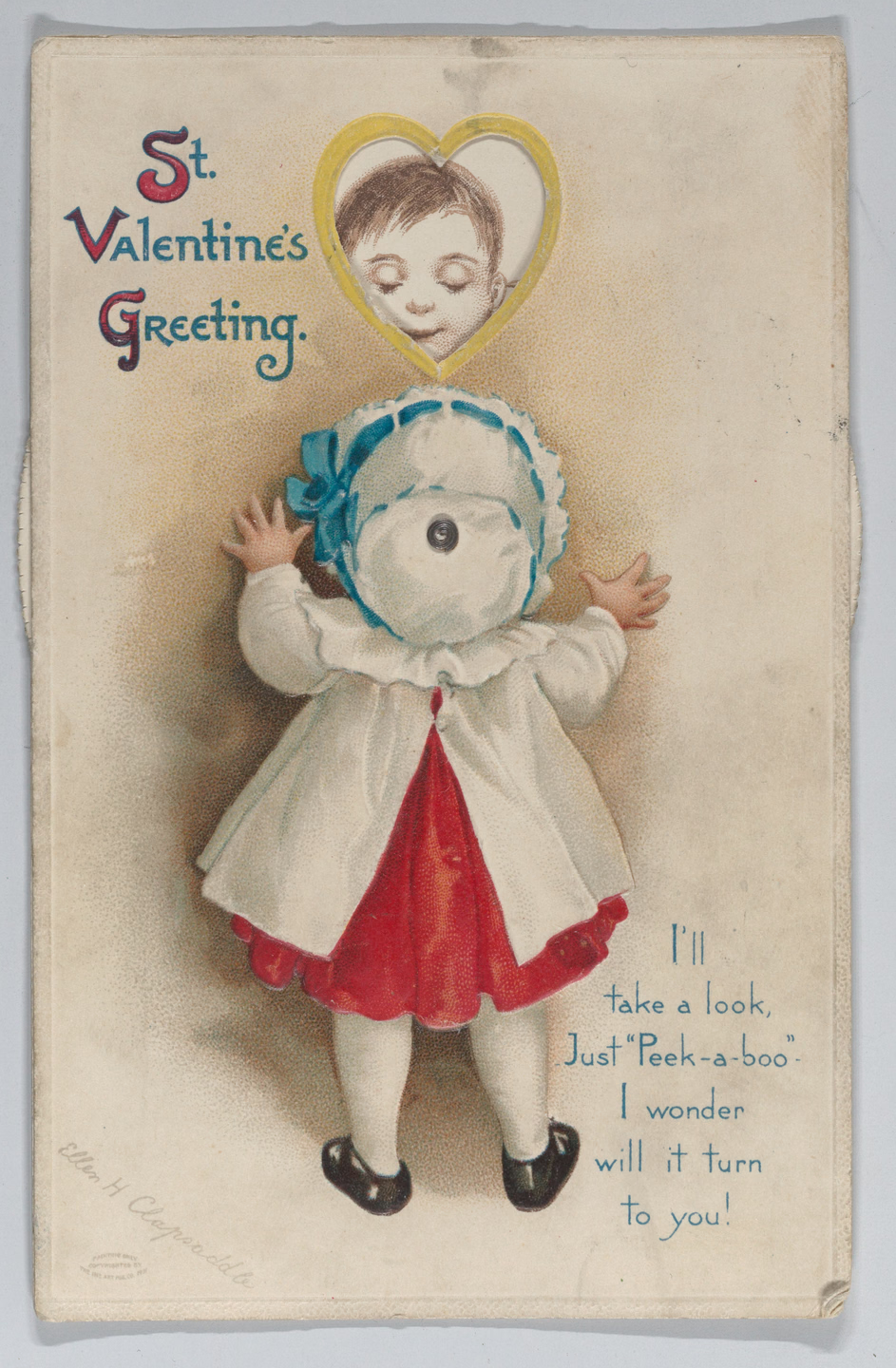
Morton calls Ellen H. Clapsaddle’s work “sought after by collectors today” and writes that she was born in South Columbia, New York, in 1865, produced “over 3,000 postcards in different subjects,” lived in New York City from 1915, and died at the Peabody Home for Aged and Indigent Women in 1932 (Morton, #3). The Metropolitan Museum of Art gives her dates as 1865 to 1934. The Met’s 1913 Clapsaddle valentine shows how cards of these years were made: “Heavy die-cut card stock, chromolithography, metal grommet” (The Met).
Morton flags two dating traps:
- The postmark isn’t the print date. One of her cards is dated 1909 and was mailed in 1921 (Morton, #2).
- Early witches don’t have green skin. “Most of the witches shown on the early postcards are dressed in green or red,” she writes, and none have green faces; she credits Margaret Hamilton in 1939’s The Wizard of Oz for that change (Morton, #9).
Morton says “these postcards are all in the public domain.” Our free vintage Halloween prints are public-domain magazine covers and illustrations from 1893 to about 1930.
Noisemakers and Paper-Mache Lanterns
Morton’s card of a boy whirling what looks like a flag, from about 1910, actually shows a “ratchet-style noisemaker, also known as a ‘rattletrap’ or a ‘horse fiddle.’” It predates mass-produced Halloween noisemakers: “at this time, a noisemaker would’ve been either homemade or imported from Germany.” She has seen early ones with “a little wooden witch or pumpkin head on top,” and says “the metal noisemakers with the gorgeous graphics wouldn’t appear until about the 1940s” (Morton, #8). The noise went with the mischief, which our history of Mischief Night covers.
Paper-mache jack-o’-lanterns, like the NMAH’s pair from around 1940 with “brightly colored facial features … printed on paper inserts” (NMAH), have their own guide: vintage paper mache pumpkins. The hollow plastic yard figures that followed, and the Smithsonian’s records of Union Products’ pink flamingo, are in our guide to vintage Halloween blow molds.
Spotting Reproductions
Haunted Attraction Network says Beistle licensed a firm called Party Partners in 2003 to reissue some classic designs. Per Ledenbach, quoted by HAN, “Although the packaging was clearly marked denoting the item as new, the actual items were not, so collectors had to rely on their knowledge of highlight colors, paper stock types and size to differentiate new from old.” HAN adds that once the packaging is gone, “there is nothing printed on the item to give it away.” On the black cat band reissue, Ledenbach says the copies “can be identified by their white accents, two bottom slots on each for a folded cardboard stand and orange/brown backsides,” and “The give-away on that item is the glossy paper stock” (HAN).
For the 2012 Vintage Beistle line, Ledenbach says he urged Beistle to alter reissues “in terms of size, colors, printed sides and paper stock … as well as the need to print the original and updated copyright dates directly onto these items,” and that “They found value in those suggestions and adopted them.” Per HAN, two copyright dates on a piece mark it as a modern reissue: “The manufacturer is telling the buyer what they are holding” (HAN). HAN also notes that Beistle’s own “Halloween-Vintage” filter makes no reproduction claim and gives no original design year, so the printed dates remain the thing to check.
Current reissues say what they are in the listings. Vintage Beistle’s Halloween Classic Cutouts (item 00429, $9.99 for seven) are “Printed on both sides,” on cardstock, and “Reproduction Vintage art is circa 1929” (Vintage Beistle). Beistle’s Vintage Halloween Cutouts (item 00464, suggested retail $10.99 for four) come “W/12’ cord; prtd 2 sides” (Beistle). Printed sides were on Ledenbach’s list of changes, but none of these sources says every original was printed on one side, so a printed back is a reason to look for the dates, not proof.
Postcards get reproduced too. Morton’s black cat, witch and vegetable-man jack-o’-lantern card from about 1915 “has been reproduced a lot,” and she thinks shops in Salem were selling copies when she visited (Morton, #1).
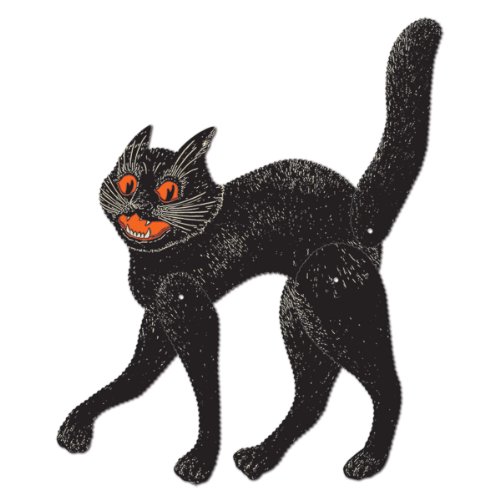
Beistle Scary Cat Cut Out Vintage Halloween Party Decorations, 20.5 in
A jointed, arched-back cat in black, orange and white, 20.5 inches, with movable arms, legs and tail. Printed on both sides on cardstock, and the listing says it is made in Pennsylvania.

Beistle Vintage Halloween Cutouts, 4 Count, 8.5 to 9.25 in
Four double-sided cardstock cutouts drawn from eight retro designs (jack-o'-lanterns, witches, black cats, owls and a haunted house among them), each 8.5 to 9.25 inches. Which four you get isn't specified.
Storing and Displaying Paper
The Library of Congress’s advice for works on paper applies to a die-cut or a Bogie Book as much as a print. Keep them “cool (room temperature or below), relatively dry (about 35% relative humidity),” away from “attics, basements, and other locations with high risk of leaks and environmental extremes.” Store them in “acid- and lignin-free folders, mats, and document boxes” or “polyester film sleeves,” and never use paper clips, rubber bands, “self-adhesive tape, and/or glue.” Mark with “pencil, not ink.” Acidic papers get “Individual/isolated storage … to prevent acids from migrating into the other works on paper” (LOC, works on paper).
The Library puts “poor quality papers with high lignin content (e.g., newsprint …)” and “colored papers” in its “very light sensitive” group: no more than 3 foot-candles, only while being viewed, for no more than 3 to 5 months, followed by at least 3 years in the dark. “Dim light over a long period of time is just as damaging as bright light over a short period of time” (LOC, light). A cutout that goes up every October for a month is on that clock.
For albums, the Library says to use “polyethylene, polypropylene, or polyester film plastics,” to mount with “wheat-starch paste instead of any other kind of glue” or with photo corners, and to store the album flat in a “well-fitting box that keeps out light, dust, and pests” (LOC, albums). For honeycomb, Ledenbach’s warning via HAN: “opening and closing the honeycomb stresses the main body and degrades the honeycomb” (HAN).

BCW Continental Postcard Sleeves, 4 3/8 x 6 1/4 in, 100 Count
Acid-free polypropylene sleeves, open on the short side, 4 3/8 by 6 1/4 inches. Polypropylene is one of the plastics the Library of Congress lists as safe. The Met's 1913 Clapsaddle card measures 5 1/2 by 3 9/16 inches, so measure yours first: a card that size fits with room to spare.
For the props and costumes that share the closet with your paper, see how to store Halloween decorations.