The Yard Haunt Movement and the DIY Halloween Renaissance
Home haunters, online communities, the 12-foot skeleton, and how maker culture created a new golden age of Halloween creativity.
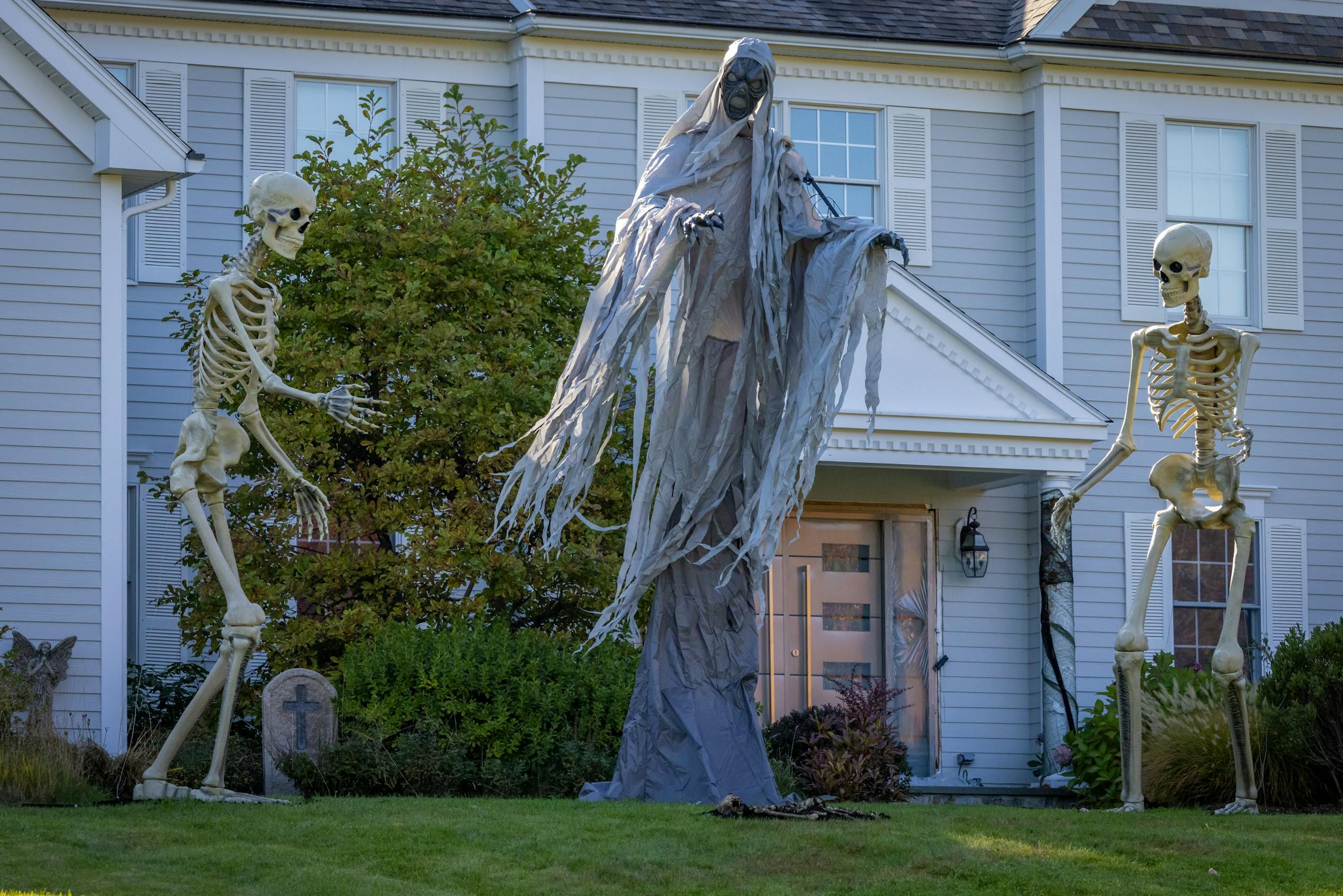
Somewhere in your neighborhood, there’s a house that goes too far for Halloween. Not in a bad way. In the way that makes you slow your car and stare. The yard is a graveyard, or a swamp, or a crashed alien site, or a Victorian funeral parlor. The owner has been building it since July. The fog machine cost more than your last vacation. The motion-activated pneumatic zombie that lunges from behind the tombstone was fabricated by hand in a garage workshop.
That person is a home haunter, and they are part of a movement that has quietly become one of the most interesting creative communities in America.
Before the Internet
Home haunting has always existed in some form. As long as people have decorated for Halloween, some percentage have decorated more than others. But before the internet, home haunters worked in isolation. You could build an elaborate yard display, but your reference materials were limited to whatever you’d seen in person, whatever appeared in seasonal magazine articles, and whatever you could figure out yourself.
The results were often impressive (creative people are creative regardless of their access to information), and the professional haunt industry was growing in parallel. But the lack of community meant that techniques were reinvented constantly. Someone in Ohio would independently figure out the same fog-chilling method that someone in Oregon had worked out three years earlier. There was no shared knowledge base.
The Forum Era
Everything changed between roughly 2000 and 2005. Online forums, particularly HauntForum.com (founded 2003) and HalloweenForum.com (founded 2004), created gathering places for home haunters to share techniques, photographs, build logs, and encouragement. For the first time, a person building tombstones in their garage could see how a hundred other people had built tombstones in their garages.
The effect was dramatic. Techniques that had been closely held by professional haunters or independently reinvented by amateurs became common knowledge. How to carve rigid foam into realistic stone. How to use Monster Mud (a mixture of dryite joint compound and latex paint over a fabric form) to create cheap, durable figures. How to build pneumatic pop-up scares using sprinkler valves and PVC pipe. How to age and weather props to look convincingly old.
The forums also created social infrastructure. Home haunters organized regional “make and take” events where members gathered to build props together. They shared tool recommendations, material sources, and vendor reviews. They documented their seasonal setups in exhaustive photo threads and offered constructive criticism. The community was collaborative in a way that commercial interests rarely are. People freely shared techniques they had spent years developing.
YouTube and the Visual Revolution
YouTube, which launched in 2005, added a crucial dimension. Written instructions for building a pneumatic groundbreaker are useful. A video showing someone building one from start to finish is transformative. The home haunt community embraced YouTube immediately, and the platform’s recommendation algorithm did the rest, surfacing haunt content to millions of viewers who hadn’t known they were interested.
YouTube also turned the best home haunts into minor celebrities. Channels dedicated to Halloween prop building, yard haunt walkthroughs, and scare reaction compilations accumulated millions of views. Creators like Wicked Makers, DIY Creepy, and The Hacksmith (who occasionally turned his engineering skills to Halloween) demonstrated that professional-quality results were achievable in a home workshop.
The visual documentation also raised the bar. When you can see what the best home haunters are producing, “good enough” gets redefined. The quality of amateur yard haunts increased noticeably through the 2010s, driven by shared knowledge, accessible tools, and the mild competitive pressure of knowing your neighbors might be watching.
The Maker Culture Connection
The home haunt movement overlapped significantly with the broader maker culture that emerged in the 2000s and 2010s. Arduino microcontrollers enabled automated lighting, sound triggering, and prop control at low cost. 3D printers produced custom pieces that would have required professional fabrication a decade earlier. CNC routers cut precise foam and wood components. LED lighting replaced incandescent bulbs, enabling effects that would have been prohibitively expensive or fire-hazardous with older technology.
This wasn’t a one-way transfer. Halloween prop builders were early adopters of maker tools, and their projects (which tend to be visually spectacular and satisfyingly practical) became popular content in maker spaces and on platforms like Instructables. The annual overlap between maker fairs and Halloween season produced a reliable stream of ambitious, technically sophisticated projects.
The Twelve-Foot Skeleton
In 2019, Home Depot introduced a twelve-foot-tall skeleton decoration priced at $299. It became, unexpectedly, a cultural phenomenon. The skeleton (fans call it “Skelly”) sold out almost immediately. Resale prices reached four figures. Social media accounts dedicated to the skeleton’s adventures, seasonal outfits, and neighborhood appearances accumulated hundreds of thousands of followers. Home Depot has expanded the line annually, adding giant werewolves, witches, and other oversized figures, but the original skeleton remains the icon.
The twelve-foot skeleton is interesting not because it’s a great piece of design (it’s decent but not exceptional) but because of what it represents: the normalization of ambitious Halloween decorating. Before Skelly, a twelve-foot yard prop was something a dedicated home haunter would build over the course of months. After Skelly, it was something any homeowner could buy and set up in an afternoon. The skeleton lowered the barrier to entry for spectacular display, and it signaled to the broader public that going big for Halloween was normal, even expected.
Dedicated home haunters have mixed feelings about the trend. Some welcome the increased visibility and enthusiasm. Others note, with the dry resignation of craftspeople watching mass production enter their field, that a bought skeleton is not the same as a built one. Both perspectives have merit.
The Community Today
The home haunt community in the mid-2020s is larger, more technically sophisticated, and more connected than ever. Facebook groups have supplemented (and in some cases replaced) the original forums. Discord servers enable real-time conversation. TikTok and Instagram Reels provide short-form inspiration. Regional haunt groups organize prop swaps, build days, and coordinated neighborhood events.
The community has also developed its own informal economy. Small businesses selling specialized materials (casting resins, silicone mold-making supplies, custom LED controllers, pneumatic scare kits) serve the home haunt market. Etsy shops sell patterns, plans, and finished props. A few home haunters have turned their hobby into full-time work, creating content, selling designs, or consulting for commercial haunted attractions.
Why It Matters
The yard haunt movement matters because it represents something genuinely countercultural in the age of passive consumption: people making things. Not buying them (though they buy plenty of supplies). Not outsourcing them. Building, fabricating, painting, wiring, programming, and installing them, often in collaboration with neighbors, friends, and online communities of strangers who share a very specific obsession.
Halloween has always been a participatory holiday. You don’t watch Halloween the way you watch the Super Bowl. You dress up, you go out, you hand out candy, you build something. If you want to start building, our yard haunt basics guide covers everything from layout to lighting, and the yard haunt inspiration gallery shows what the community has produced. The home haunt movement is the most ambitious expression of that participatory spirit, a community of adults who spend months each year creating free public art in their front yards. That the art is designed to scare children and delight neighbors only makes it more characteristically American.