The Dead Wedding
A jilted-bride dinner party built from Dickens, the V&A, the Met and a 1919 Halloween book: every clock stopped at twenty to nine, a foam bride-cake under glass, a cold wedding breakfast, a jilted toast, and the real history of white wedding dresses, which starts with mourning.
Decor Checklist
- Crafare 3-Tier Foam Cake Dummies (4, 6 and 8 inch) Essential
The bride-cake. Foam, not food: the 6-inch tier goes under the glass dome, labelled NOT FOOD
Shop on Amazon → - KVMORZE Glass Dessert Dome with Base, 10.2 in Essential
The glass the bride-cake sits under, so nobody mistakes it for dessert
Shop on Amazon → - Peohud 5-Candle Metal Candelabra, 10 in Essential
Bronze five-arm candelabra for the long table, holding LED tapers only
Shop on Amazon → - Homemory Ivory Flameless Taper Candles (6) Essential
Real-wax LED tapers in ivory, sized for the candelabra
Shop on Amazon → - Ivory Lace Table Runners, 14 x 120 in (2) Essential
Polyester lace down the long table, over a plain cloth
Shop on Amazon → - White Creepy Cloth, 79 x 79 in Nice to have
Torn into strips for the doorframes and the tops of the curtains, above head height
Shop on Amazon → - LILUYTO Champagne Silk Roses (12) Essential
The faded bridal flowers, in silk rather than dried
Shop on Amazon → - Lily's Home Antique-Style Mantel Clock Essential
The clock in the room, stopped at twenty to nine with its battery out
Shop on Amazon → - Roman Numeral Quartz Pocket Watch Optional
The groom's watch, the only clock at the party that keeps running
Shop on Amazon → - Classic Black Guest Book Nice to have
The witness book guests sign at the door
Shop on Amazon →
Menu
Playlist
Listen on Hallowmix →
Costumes
Host
- The bride who waited: a thrifted ivory dress gone yellow, the veil half arranged, one shoe
- The groom who never came, in a frock coat with a pocket watch still running
Guests
- Mourners in full black, or in half-mourning greys and purples
- A guest in 1840s wedding finery gone yellow
- The best man, still waiting
- The one who objected
- Mary, Queen of Scots, in white, which was mourning for a French queen
Party Timeline
- 5:00 PM: Salmon poached and chilling, chicken salad and egg filling made, cake baked and frosted in its pan. Every clock in the house set to 8:40.
- 7:00 PM: Guests arrive and sign the witness book.
- 7:30 PM: The processional. The groom does not come.
- 8:00 PM: The wedding breakfast.
- 8:40 PM: The clocks stop. The Dickens reading, and the bride-cake unveiled under glass.
- 9:00 PM: The jilted toast.
- 9:30 PM: Vows, a writing game.
- 10:00 PM: The first dance, to a 1904 waltz.
- 10:30 PM: The real cake.
- 11:00 PM: 'Cancel That Wedding March' and dancing. At midnight, 'Danse Macabre' and Kelley's coffin line.
Shopping List
- Invitations and place cards (free printables), 110 lb cardstock, A7 ivory envelopes
- Foam cake dummies, a glass dome with base, a NOT FOOD card
- One or two five-arm candelabras, ivory LED tapers, batteries for the tapers and the clock
- Lace runners, a plain tablecloth, white creepy cloth, silk roses, a mantel clock, a guest book
- A 4-pound side of salmon, cider vinegar, fresh tarragon or dill, lemons
- 8 boneless, skinless chicken breasts, mayonnaise, lemons, Dijon, celery, shallots, parsley, tarragon
- 12 eggs, mayonnaise, sour cream, white vinegar, spicy brown mustard
- Cake flour, sugar, baking powder, butter, eggs, vanilla yogurt or whole milk, vanilla and almond extracts; shortening, confectioners' sugar and milk for the buttercream
- Three bottles of brut sparkling wine, sugar cubes, Angostura bitters, lemons
- Three bottles of prosecco or cava, white grape juice, a berry liqueur, an orange liqueur, berries, strawberries, mint
- 6 Bosc pears, 1 1/2 vanilla beans, 9 cups seltzer
The Premise
The ceremony was set for twenty minutes to nine. The groom sent a letter instead. The bride stopped every clock in the house at that minute, left the feast on the table and never took the dress off. Guests arrive as the wedding party that was invited and has been waiting ever since: the bride’s side, the groom’s side, the best man, the one who objected, and a row of mourners in black, because in this house the wedding and the funeral are the same event.
The history on this page comes from Project Gutenberg’s text of Great Expectations, the Victoria and Albert Museum, the Metropolitan Museum of Art, JSTOR Daily and two early Halloween books, also on Project Gutenberg; the recipes are America’s Test Kitchen’s and King Arthur Baking’s. The invitation is a letter from the bride’s household, and the place cards each carry a clock stopped at 8:40 and a role.
It’s a party for twelve, and it borrows from three other blueprints without repeating them. For talking to the dead, run the Haunted Victorian Séance. For the marriage fortunes (the ring in the cake, the apple and the mirror), the Fortune Teller’s Parlor has the games. For waltzing in black and red, the Vampire’s Ball. This one is ivory, grey and black, and nobody gets married.
White Was for Mourning
The French queens
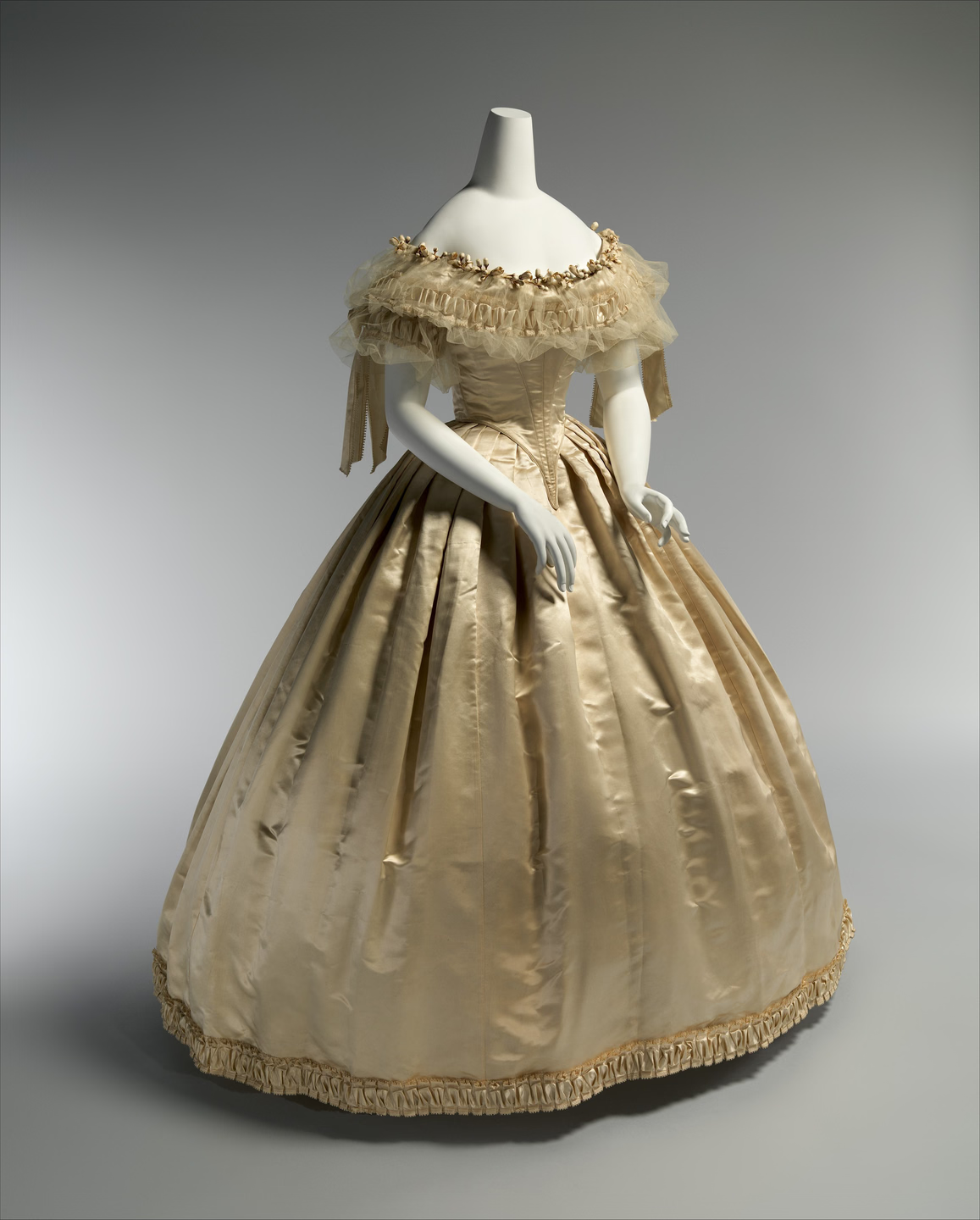
JSTOR Daily’s history of the wedding dress has the fact this party is built on: “In 1558, Mary Queen of Scots wore white during her wedding to the soon-to-be King of France, despite the fact that white was a color of mourning for French queens at the time” (JSTOR Daily).
The same piece says white wasn’t the rule for most of history: “although brides did wear white when they could afford it, even the wealthiest and most royal among them also wore gold, or blue, or, if they were not rich or royal, whatever color their best dress happened to be.” Its earliest recorded Western example is the English Princess Philippa in 1406, “dressed in a white tunic lined with ermine and squirrel fur.”
Victoria, and the colour of the dress
Queen Victoria married Prince Albert in 1840, and the sources describe that dress in different ways:
- The V&A says she “helped popularise the fashion for white when she got married in 1840” and “set a royal precedent by choosing a simple ivory satin dress which was very much in the fashions of the day.” It adds: “Earlier royal brides had worn white but their dresses were often woven or heavily embroidered with gold or silver” (V&A, Honiton lace wedding veil, T.43&A-1947).
- JSTOR Daily says the dress, “now in the Royal Collection (minus its lace overlay), is really more of an ivory, or even a light pink.”
- The popular version is that she wore white and started the fashion.
We don’t settle it. The V&A calls her ivory satin a royal precedent that “helped popularise” white, and JSTOR Daily says white was already on brides who could afford it, so nobody on this page calls her the first. For the party, it means the bride’s dress should be ivory, cream or yellowed, not optical white.
It meant money
JSTOR Daily is blunt about the symbolism: “White dresses did not symbolize virginity or even purity, but rather were costlier and harder to keep clean, and thus communicated the status and wealth of the wearer.” By 1849, it says, Godey’s Lady’s Book was claiming white had always been the custom, and “Victorian ideals of weddings, romantic love, and purity were projected backwards” onto it.
Nor was a wedding dress worn once. “Even Queen Victoria repurposed her own wedding dress and veil for subsequent use,” JSTOR Daily says. The V&A holds a woman’s mourning dress in “black silk satin trimmed at the sleeves with lace, British, 1840s, altered in the 1860s” (V&A, T.53-2002). A thrifted dress that’s been let out, taken in and gone yellow is period-correct.
The flowers weren’t always real, either. The V&A’s 1854 orange-blossom wedding wreath is “completely made from feathers,” and its record notes that “Imitation blossom was normally made from wax, paper, or cloth” (V&A, T.6-2008). Silk roses are the period choice here as well as the safe one.
Mourning, by the calendar
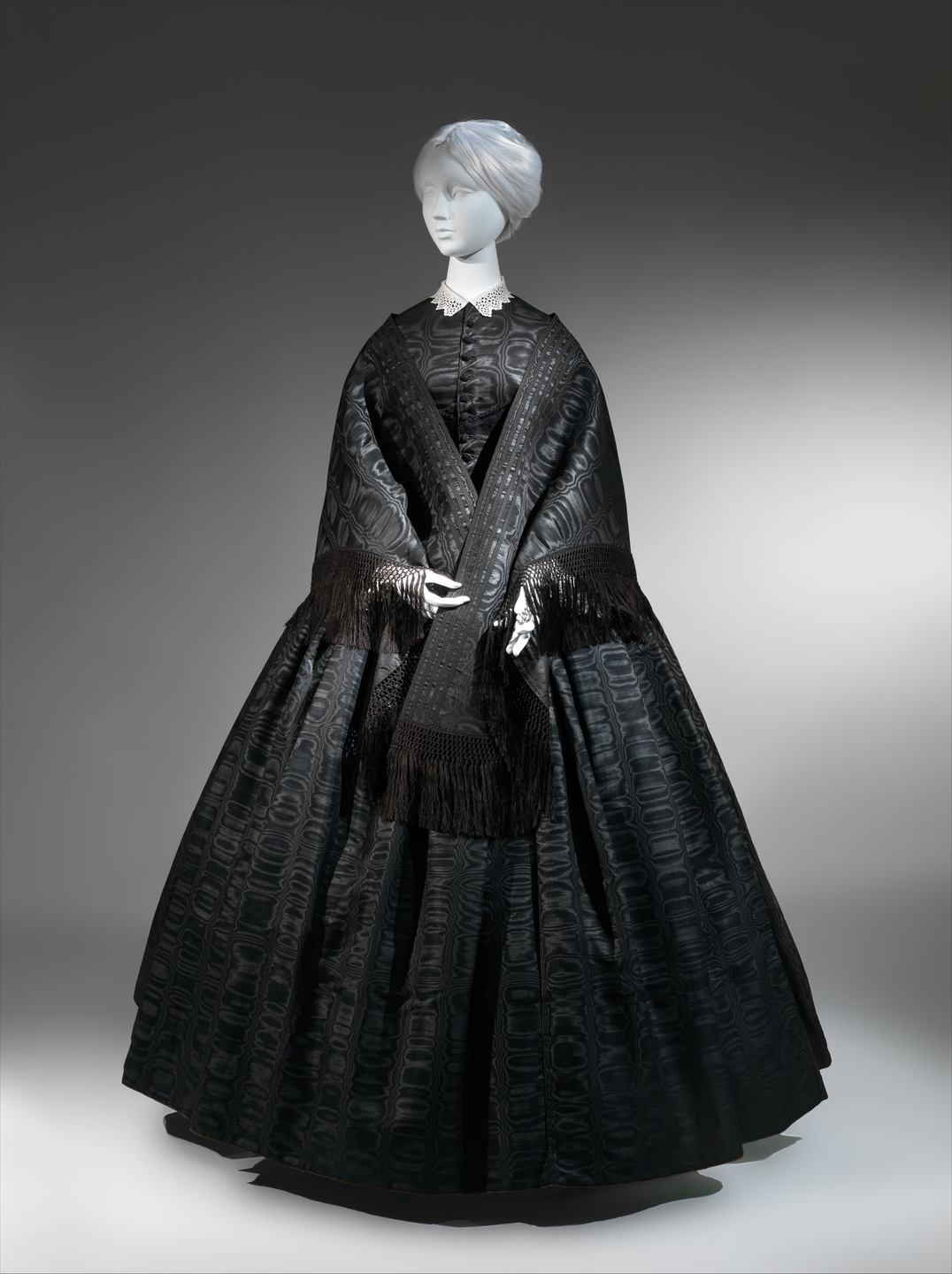
JSTOR Daily’s piece on mourning quotes Walter R. Houghton’s American Etiquette and Rules of Politeness: “The deepest mourning is that worn by a widow for her husband. It is worn two years, sometimes longer.” The stages “progressed from simple black dresses, usually made of crape, to grays and purples, often with lace or other adornments, in a phase sometimes called half-mourning” (JSTOR Daily). Victoria herself “wore mourning clothes from the death of her consort, Prince Albert, in 1861 until her own death in 1901.”
A V&A gallery label adds that “A cult of mourning developed from the 1860s onwards and the rules for mourning dress were strict, requiring special dull, matte fabrics such as crêpe” (V&A, T.47:1, 2-2018). The Met’s 2014 Costume Institute show on the subject covered “mourning dress from 1815 to 1915,” including “mourning gowns worn by Queen Victoria and Queen Alexandra,” and “the later introduction of color with shades of gray and mauve” (The Met).
The House Where the Clocks Stopped
What Dickens actually wrote
Miss Havisham appears in Chapter VIII of Great Expectations. Pip sees “that everything within my view which ought to be white, had been white long ago, and had lost its lustre and was faded and yellow.” He notices “that her watch had stopped at twenty minutes to nine, and that a clock in the room had stopped at twenty minutes to nine.” Later in the chapter: “It was then I began to understand that everything in the room had stopped, like the watch and the clock, a long time ago.” Her shoe on the dressing table, “once white, now yellow, had never been worn” (Project Gutenberg).
Chapter XI is the feast: “a long table with a tablecloth spread on it, as if a feast had been in preparation when the house and the clocks all stopped together.” Its centrepiece is “so heavily overhung with cobwebs that its form was quite undistinguishable.” She tells Pip what it is: “It’s a great cake. A bride-cake. Mine!” And, a moment later: “It and I have worn away together.”
Chapter XXII gives the reason, in Herbert’s telling: “The day came, but not the bridegroom.” The letter arrived while she was dressing, and Herbert says twenty minutes to nine was the hour “at which she afterwards stopped all the clocks.”
The coffin instead of the groom
Halloween fortune-telling was mostly about finding a husband. Ruth Edna Kelley’s The Book of Hallowe’en (1919) collects the charms, and in its Scottish chapter it quotes an anonymous “Tale of Hallowe’en” in which a girl tries one and sees something else: “what does she see in the moonlicht but her ain coffin moving between the doors instead of the likeness of a gudeman! and as sure’s death she was in her coffin before the same time next year” (Project Gutenberg). Read it aloud at midnight.
The mirror charm comes down in three versions, and they don’t agree:
- Kelley (1919): a girl goes into a room at midnight, “cuts an apple into nine slices, holding each on the point of a knife before she eats it,” and “may see in the moonlit glass the image of her lover looking over her left shoulder, and asking for the last piece of apple.”
- Mary E. Blain, Games for Hallow-e’en (1912): “by light of candle comb your hair; face of your future partner will appear in glass, peeping over your shoulder” (Project Gutenberg).
- Lisa Morton: “sitting before a mirror at midnight on Halloween, eating an apple and brushing one’s hair” (Lisa Morton).
The candle in Blain’s version stays out of this party (see the lighting below), and her lead-melting fortune does too. The Fortune Teller’s Parlor runs the rest of the marriage games safely.
Dressing the House
The long table
One long table, or two pushed together, dressed as the feast that was never eaten: a plain white or ivory cloth, ivory lace runners end to end, the candelabras, silk roses laid along the middle, and every place set. Leave the plates empty until the food goes out.

2 Pack Ivory Lace Table Runners, 14 x 120 in
Two ten-foot ivory runners in 100% polyester lace, per the listing, with four ribbons. End to end they run the length of two tables. Stock was down to 8 when this page was written, so look for a second source if it's gone.
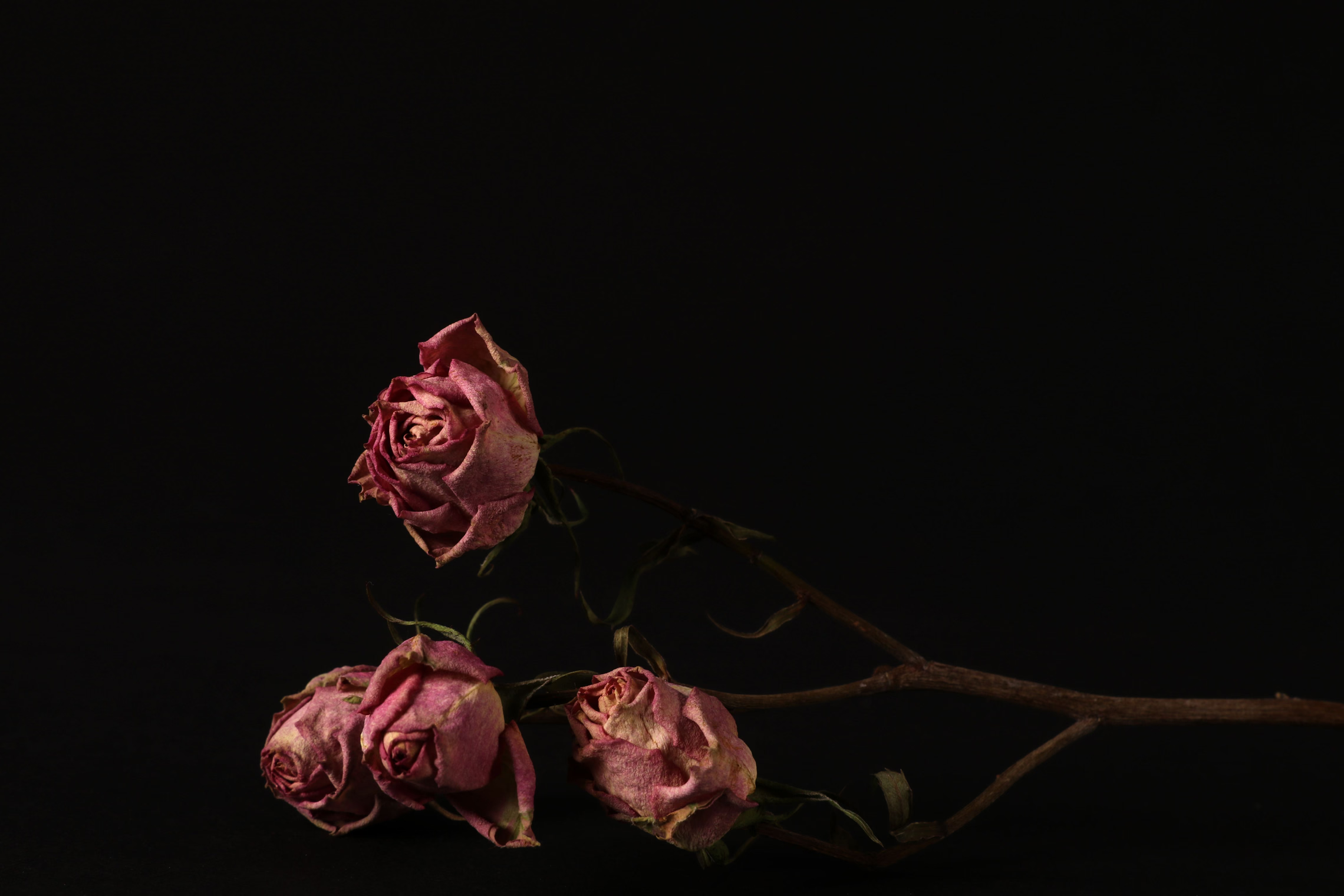
The roses are silk, not dried. NFPA’s Halloween tip sheet says “Dried flowers, cornstalks, and crepe paper catch fire easily. Keep all decorations away from open flames and other heat sources like light bulbs and heaters” (NFPA). Our rule: even silk flowers stay a hand’s width from the LED tapers.

LILUYTO 12 Champagne Silk Roses
Twelve silk roses in a faded champagne colour, 2.3-inch blooms on 18-inch stems you can trim, per the listing. Cut some short and lay them on the runner; stand the rest in a jug on the side table.
The bride-cake, under glass
Dickens’s cake is under cobwebs and mice. Ours is foam, and it never goes near the food. Take the 6-inch tier from a set of foam cake dummies, drape it with a strip of grey or white creepy cloth and a silk rose, and set it on the base of a glass dome with a small card: NOT FOOD. Put it on its own side table, away from the buffet, the candelabras and the real cake. The 4- and 8-inch tiers can stack beside it on a cake stand for a ruined three-tier look.

Crafare 3-Tier Foam Cake Dummies, 4, 6 and 8 in
A decorating dummy, not a cake. The middle tier goes under the dome below, and the other two stack beside it. Hold a tier up against the dome before the party to check it clears with a rose on top.

KVMORZE Glass Dessert Dome with Base, 10.2 in
A 10.2-inch glass dome, 5.9 inches tall, on an 11.8-inch acacia tray, per the listing. Once it's held a prop, keep it as a prop.
No glitter, dust or paint on the real cake. The FDA advises bakers “to avoid using glitter and dust products to decorate cakes and other food items unless the products are specifically manufactured to be edible,” and says that “If the label simply says ‘non-toxic’ or ‘for decorative purposes only’ and does not include an ingredients list, the product should not be used directly on foods” (FDA). The decay look lives on the foam cake only. If you want a shimmer on the real one, the label has to say edible and list its ingredients.
The light
Veils, lace, trains, silk flowers and cobweb in one room: every light at this party is an LED. That’s our rule, and NFPA’s sheet gives the reason: “Decorations are the first thing to ignite in more than 800 reported home fires each year. Nearly one-third of these fires were started by a candle.” Put ivory LED tapers in a five-arm candelabra at each end of the table and turn the overheads off.

Peohud 5-Candle Metal Candelabra, 10 in
A bronze-finish five-arm candelabra about 10 inches tall, for tapers under 1 inch across, per the listing. It's sold for wax tapers; at this party it holds the LED ones below.

Homemory Ivory Flameless Taper Candles with Remote (6)
Ivory real-wax LED tapers with a remote, sold in sixes. Check the diameter against the candelabra's cups before the party, and run them on the steady setting for most of the evening.
Use the steady mode for most of the evening. Our fake fire guide’s section on flicker and photosensitivity explains why.
The cobwebs
Dickens’s cobwebs are over the cake. Ours are over the doorframes. Tear white creepy cloth into strips and hang them from curtain rods and the tops of doorframes, above head height, away from every light and out of reach of the food. Our rule: no stretch cobweb or creepy cloth on the table, the buffet or the candelabras. NFPA also says to “keep exits clear of decorations so nothing blocks escape routes,” so the front and back doors stay bare.
The clocks
Every clock in the room reads twenty to nine. Set the hands of a mantel clock to 8:40 and take the battery out; this antique-style mantel clock runs on one AA, per its listing. Do the same to any wall clocks you can reach, and turn the phones face down.

Lily's Home Antique-Style Mantel Clock, Black
An 11 3/4-inch mantel clock with large Roman numerals, scroll hands and a distressed face, per the listing. It's quartz and runs on one AA battery, so stopping it is a matter of pulling the battery.
The groom’s pocket watch is the exception. Set it to 8:40 before he leaves the house and let it run: his is the only clock at the party that didn’t stop.
The Wedding Breakfast
The menu
A cold spread that can sit on the table the way Dickens’s feast did, served on platters that get swapped, not left out.
- Cold poached salmon. ATK’s Oven-Poached Side of Salmon cooks a 4-pound side in a foil packet at 250 degrees “until the color of the flesh has turned from pink to orange, and the thickest part measures 135 to 140 degrees,” then chills it. It “can be refrigerated for up to 2 days,” serves 8 to 10, and goes out with lemon wedges and minced tarragon or dill. ATK says “a whole side of salmon displayed elegantly on a platter is a sure-fire way to impress your guests.”
- Chicken salad. ATK’s Classic Chicken Salad gently cooks four breasts in salted water brought to 170 degrees, then dresses them with mayonnaise, lemon, Dijon, celery, shallot, parsley and tarragon. It serves 4 to 6 and keeps 2 days, so make it twice, the day before.
- Deviled eggs. ATK’s Basic Deviled Eggs makes a dozen halves from 6 eggs, with the yolks pressed through a sieve into mayonnaise, sour cream, vinegar and spicy brown mustard. ATK says the whites and filling “can be refrigerated separately for 2 days.” Make two batches and fill them just before guests arrive.
The cake she never cut
The real cake is King Arthur’s Tender White Cake: cake flour, butter, “4 large egg whites plus 1 whole large egg,” yogurt or milk, and vanilla and almond extracts, made by “the paste method (aka reverse creaming).” Bake it as a 9 x 13 sheet. King Arthur warns that “This white cake is very tender,” and that a sheet cake is “best served straight from the pan, to avoid crumbling,” so frost it in the pan with King Arthur’s Easy Vanilla Buttercream Frosting, which makes “about 2 3/4 cups, enough for a 9” x 13” cake or 18 cupcakes.” Bring it out at 10:30 from the kitchen, never from the bride-cake table.
Keeping it safe
Serve on small platters and swap them rather than topping them up. The FDA’s buffet advice is to “replace the serving dishes with the fresh ones throughout the party,” keep cold food at “40 °F or colder,” and not leave perishables out more than 2 hours (FDA). Salmon, chicken salad and deviled eggs are all perishable, so set the platters over ice and bring them out in rounds.
The FDA’s nine major food allergens are “milk, eggs, fish, Crustacean shellfish, tree nuts, peanuts, wheat, soybeans, and sesame” (FDA). This menu has fish (the salmon), eggs (the deviled eggs, the mayonnaise in the chicken salad, and the cake), milk (butter, yogurt or milk, sour cream, the buttercream) and wheat (the cake). The cake also carries almond extract, so tell guests who avoid tree nuts, or leave it out. Label every dish.
The Bar
The jilted toast
At 9:00, everyone raises a glass to the groom who didn’t come. ATK’s Champagne Cocktail is a sugar cube soaked with 1/4 teaspoon of Angostura bitters in a chilled flute, topped with 5 1/2 ounces of Champagne and a lemon twist. ATK says: “We strongly prefer Champagne here, but you can use another quality sparkling wine as long as it’s brut or extra brut.” Three bottles cover twelve toasts.
The punch
ATK’s Holiday Punch for a Crowd makes 16 from three bottles of prosecco or cava, 12 ounces of white grape juice, 6 ounces each of a berry liqueur and an orange liqueur, berries, strawberries and mint, all combined in the bowl. ATK notes that “Champagne punches are truly a classic cocktail category, dating all the way back to the 1700s in Europe,” and that if the punch will sit longer than 30 minutes, it recommends “adding six large (2-inch) ice cubes to the bowl.”
The pale one
ATK’s Pear and Vanilla Spritzer is “inspired by cream soda” and has no alcohol: two Bosc pears and half a vanilla bean puréed and strained, then topped with 3 cups of seltzer. It serves 4, so triple it. The purée keeps in the fridge “for up to 2 days.” Put it in its own labelled pitcher.
What’s in a glass
NIAAA says one US standard drink “contains about 14 grams, or about 0.6 fluid ounces, of pure alcohol,” the amount in “a 5-ounce glass of wine at 12% alcohol by volume” (NIAAA). The arithmetic below is ours, assuming 12% wine:
- The toast: 5 1/2 ounces of 12% wine is about 1.1 standard drinks.
- The punch: three bottles of 12% wine hold about 15 standard drinks, and 6 ounces of a 40% orange liqueur about 4 more, before the berry liqueur, whose strength you’ll have to take from its label. Split 16 ways, that’s at least 1.2 per cup.
So a guest who has the toast and two cups of punch has had about three and a half. Check your bottles’ labels; wines and liqueurs vary.
The Music
The Library of Congress’s National Jukebox streams the wedding records of the day:
- “Mendelssohn’s Wedding March,” Prince’s Military Band, recorded April 30, 1909 (Library of Congress). The 7:30 processional, for a groom who doesn’t turn up.
- The “Bridal Chorus” from Wagner’s Lohengrin, by Arthur Pryor’s Band, June 13, 1913 (Library of Congress).
- “The Wedding of the Winds Waltz,” by John T. Hall, played by the Victor Dance Orchestra under Walter B. Rogers, June 23, 1904 (Library of Congress). The first dance.
- “Cancel That Wedding March,” by Ted Snyder and Bert Kalmar, sung by Gene Greene, February 17, 1911 (Library of Congress). We only vouch for the title; it’s the 11:00 song.
- Saint-Saëns’s “Danse Macabre,” Prince’s Orchestra, August 10, 1915 (Library of Congress). Midnight.
In between, our Originals playlist has “Danse Macabre” again and the rest of the concert pieces.
Running the Evening
7:00 PM: The witnesses
Send the Dead Wedding invitation three weeks ahead. At the door, every guest signs the witness book with their name and their role, then finds their place card: The Bride’s Side, The Groom’s Side, The Best Man (Still Waiting), The One Who Objected, The Maid of Honour, The Widow in Full Crape, The Cousin in Half-Mourning, The Organist, The Keeper of the Cake, The Last to See the Groom, The Letter-Bearer and The Witness.

Classic Black Guest Book
A black hardcover guest book with lined pages. It sits on the hall table as the witness book.
7:30 PM: The processional
Play the 1909 wedding march. Everyone stands and turns to the door. Nobody comes through it. The Letter-Bearer, who has been told beforehand, walks in with an envelope and hands it to the bride, who reads it and sets it down unopened on the table for the rest of the night.
8:00 PM: The wedding breakfast
The platters go out. The bride sits at the head of the table and does not eat.
8:40 PM: The clocks stop
The host taps a glass. Someone reads the two Chapter VIII lines about the watch and the clock, then the Chapter XI line about the feast. The bride lifts the cloth off the dome and says the line: “It’s a great cake. A bride-cake. Mine!”
9:00 PM: The jilted toast
Champagne cocktails. The best man gives the speech for a groom who isn’t there, and every guest adds one sentence about where he went.
9:30 PM: Vows
Our game. Each guest gets a card and three minutes to write the vows the groom would have said, in period language. The bride reads them out without names, and the table votes on which one she’d have kept. The winner gets the pocket watch to hold for the rest of the night.
10:00 PM: The first dance
“The Wedding of the Winds.” The bride dances with whoever the vows vote chose. Before anyone waltzes, trains get bustled or pinned up and veils come back over the shoulder: NFPA’s tip sheet says to “stay away from long trailing fabric,” and a train on a dance floor is also how people fall.
10:30 PM: The real cake
From the kitchen, in its pan, cut into squares. The bride-cake stays under its dome.
11:00 PM to midnight
“Cancel That Wedding March,” then whatever gets people dancing. At midnight, put on “Danse Macabre,” turn the LED tapers down to their lowest setting, and read Kelley’s coffin line aloud.
Costume Guide
Nobody at this party changes the colour of their skin. No white or grey full-face base: the dress, the veil and the hair carry the ghost. For shadowed eyes and a tired look, our makeup and fake blood guide covers the eye work.
- The bride. A thrifted wedding dress that has already gone ivory, or a new one tea-stained, a veil half arranged and one shoe, as in Chapter VIII. Our adult costume guide’s Miss Havisham has the rest. Keep the veil back from the candelabras when she sits.
- The groom who never came. A frock coat or a dark three-piece suit and the pocket watch, still running.
- The mourners. Full black in a matte fabric, or half-mourning in grey and purple, per JSTOR Daily. For jewellery, jet: JSTOR Daily says diamonds were “considered an appropriate material for mourning jewelry, as was jet, since it is black.”
- The guest in 1840s finery gone yellow. Any cream or ivory evening dress, a lace shawl, silk flowers in the hair.
- Mary, Queen of Scots. White, for the reason at the top of this page.
A cathedral veil is a lot of fabric near a lot of people. The CPSC’s summary of its clothing flammability rule says “Fabrics likely to be classified as Class 2 or Class 3 textiles include sheer rayon or silk,” and that “Class 3 textiles, the most dangerously flammable fabrics, are unsuitable for use in clothing because of their rapid and intense burning.” It lists fabrics made entirely from “acrylic, modacrylic, nylon, olefin, polyester, and wool” as ones that “consistently pass as Class 1 textiles” (CPSC). Class 1 is the normal flammability class, not fireproof. If a thrifted veil or overlay is sheer silk or rayon, it’s one more reason this party has no flames.

SAMKY 1-Tier Cut Edge Cathedral Veil, Light Ivory
A 120-inch light ivory cathedral veil, 72 inches wide, with a plain cut edge on a sewn-in wire comb, per the listing. The listing doesn't name the fibre. Pin the tail up before the dance.
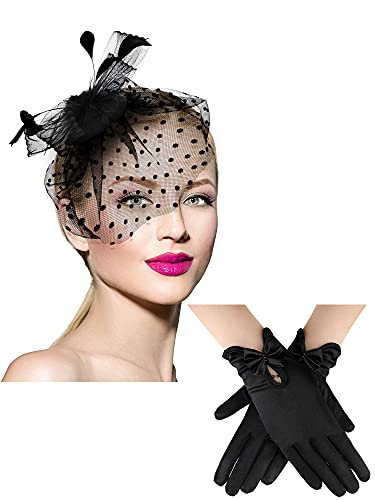
Geyoga Black Fascinator with Veil and Lace Gloves
A small black fascinator hat with a short mesh veil, and a pair of lace gloves, per the listing. It turns any black dress into full mourning.
For photos, our photo booth ideas work well with one rule: the backdrop is the table and the dome.
Production Notes
Budget Breakdown: The core decor comes to about $165: the foam dummies, the glass dome, one candelabra with six LED tapers, the runners, the creepy cloth, the roses and the mantel clock. Cardstock and envelopes add about $41. Food for twelve (the salmon, two chicken salads, two batches of eggs, and the cake and frosting) is about $95. The three toasting bottles, the punch and the spritzer run about $150 depending on the wine. That’s about $450. A second candelabra and set of tapers ($42), the guest book ($14), the veil ($23), the fascinator ($17) and the pocket watch ($12) take it to about $560.
Advance Prep: Send invitations three weeks out. Print and fold the place cards the weekend before. Make the chicken salad, poach the salmon and cook the eggs the day before. Bake and frost the cake the morning of, in its pan. Set every clock to 8:40 and pull the batteries before you dress.
What to Skip: Real flame anywhere, including a candle for the mirror charm. Dried flowers near any light. Cobweb or creepy cloth on the table or below head height. Glitter or dust on the real cake unless its label says edible and lists ingredients. Any full-face base makeup. Long trains on the dance floor. Real prayer books, memorial cards, post-mortem photographs of real people, or real hair in props: the mourning at this party is costume, not a funeral.