Here is the thing that happens to most home photo booths. You spend an hour building it. Six people use it in the first twenty minutes, mostly out of politeness. Then it sits empty in the corner for the rest of the night while everyone takes pictures of each other in the kitchen anyway.
The booth was fine. The problem was never the backdrop or the props. It was that you built a thing and did not build the behavior around it.
This guide is about the behavior. If you are looking for what to buy, our best Halloween photo booth props roundup covers the gear and, more importantly, the lighting that decides whether the pictures are worth keeping. This page is about where the booth goes, how people move through it, and what makes a second person walk up while the first is still standing there.
Nobody Walks To A Photo Booth
Guests do not make a trip. They use what is in front of them.
A booth in the spare room is a booth that requires a decision, and nobody at a party makes that decision at 10pm with a drink in their hand. A booth in the path between the kitchen and the rest of the party gets used by people who were walking past anyway.
Put it on the route, not off it. The specific spot you want is somewhere people already pause: near the drinks, at the bottom of the stairs, along the wall of the hallway everyone crosses. Not in the main room where it blocks the party, and not out of the flow entirely.
The tell that you got the placement right is that the booth is visible from where the drinks are. If a guest can see somebody else using it, they will use it. If they cannot, they will forget it exists.
A Queue Is The Feature, Not The Problem
This is the part that surprises people. You are not trying to eliminate the line. The line is the advertisement.
One group at the booth attracts the next group. Two people waiting attracts a third. An empty booth attracts nobody, no matter how good it looks. Which means your job is not throughput, it is visible activity, and a booth that is mildly busy all night beats a booth that everyone cycles through efficiently in the first half hour.
Two practical consequences:
- Do not run two booths. Splitting the traffic gives you two empty corners.
- Do not make it fast. A booth where each group takes ninety seconds holds a queue. One where they take fifteen seconds does not.
Self-Serve Or Staffed, But Pick One
The failure mode in between is a booth with a camera that people are not sure they are allowed to touch. Guests will stand near an unfamiliar camera and not pick it up. That booth is dead.
Self-serve means a phone or camera on a tripod, a remote in a visible spot, and a sign that says in plain words what to do. The sign is the entire difference. Four lines is enough: press the button on the remote, wait for the countdown, the print comes out of the slot, take it with you.
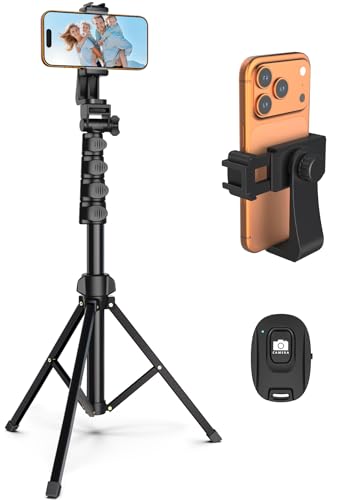
Liphisy 64-Inch Tripod for Cell Phone and Camera with Remote and Phone Holder
Sixty-four inches gets the camera to standing eye level, which is the height a booth needs and the height a table cannot give you. The included Bluetooth remote is what turns a camera into a self-serve booth rather than a thing guests are afraid to touch.
Staffed means one person, not the host, who takes the picture. This produces better photographs and works well for the first hour, and then that person wants to be at their own party. If you go this way, agree with them in advance that they are on for an hour and then it goes self-serve.
Either works. What does not work is a camera with no instructions and no person.
Backdrop Ideas That Are Not A Printed Scene
The default choice is a printed backdrop with a haunted house on it. Skip it. Printed scenes fight the costumes your guests spent money on, and they date the photographs to one particular year and one particular product.
What works, in rough order of how good the results look:
Black. Plain black fabric absorbs light, drops the room away, and makes costumes read forward like a studio portrait. It is the least imaginative option and it produces the best photographs by a wide margin, which is an annoying thing to be true.

BalsaCircle 8ft x 8ft Black Velvet Backdrop Curtain
Velvet rather than polyester, which matters because velvet eats light instead of reflecting it in patches. Eight feet square is wide enough for a group of four, and the rod pocket means it hangs off a curtain rod if you do not own a stand.
A doorway. Frame the shot through a door with the room dark behind it and one light on the subject. Costs nothing, and the frame does the composition work for you.
Foil or sequin curtain. Reflective, catches your light, and reads as deliberate rather than cheap in photographs even when it is very cheap in person. The one backdrop style that photographs better than it looks.
A wall of your own signs. If you are already printing decor, a dense grid of printed signs behind the subject is specific to your party in a way a bought backdrop never is. Our free beware signs and enter if you dare signs tile well for this, and the yard signs guide covers mounting them if you want them rigid.
Bookshelves, real ones. Depth behind the subject reads as a place rather than a background. Kill the lamp behind it, light the front, and a normal bookshelf outperforms most bought backdrops.
Whichever you pick, hang it a day early. Creases photograph badly and fabric needs a night to drop.
The Prop Table, Not The Prop Pile
Props go on a table beside the frame, laid out flat and visible, never in a basket. A basket becomes a pile in twenty minutes and a pile is where props go to die.
Two dozen pieces is the right count. More than that and guests browse instead of grabbing, and browsing kills the queue.
Our free photo booth props are printable, cut out, and mounted on dowels in an evening, which is worth doing even if you also buy a kit. Printed props are the ones you can make specific to your party, and they cost paper.
One layout detail that matters more than it should: put the props at the far side of the frame from the approach. People pick up a prop as they walk in and put it down as they leave, which keeps the table tidy on its own and stops the props from migrating into the kitchen.
Give People Something To Take
The difference between a booth people use once and a booth people queue for is whether something physical comes out of it.
A phone photo goes into a phone and is never seen again. A print gets passed around, written on, and put in a pocket. That is the whole mechanism, and it is behavioral rather than photographic.
Instant film is the straightforward way to do this, and the cost is the thing people underestimate. Film runs roughly a dollar a shot and groups reshoot constantly, so twenty guests will burn forty to sixty exposures. Budget three packs, not one, and put the spare film next to the camera where people can see it, because a guest who thinks they are using up your last shot will not take a second picture.

Fujifilm Instax Mini Instant Film, 10 Sheets x 5 Packs, 50 Shots
Fifty exposures, which is the honest number for a party of twenty once you account for groups reshooting. Buying the multipack up front costs less per shot than the twin packs and removes the temptation to ration film in front of guests.
If instant film is out of budget, the free version works: a length of twine across the wall beside the booth and a handful of clips. Guests clip their phone photos there if you are printing, or you clip nothing at all and it becomes a display for the instant prints people choose to leave behind. Either way, a wall of accumulating photographs is itself the advertisement that keeps the booth busy, which is the same principle as the queue.
The other free option is a small printed card with a QR code to a shared album. It works, and it produces far fewer photographs than a print does, because nothing physical happened.
Lighting, Briefly
One controllable light aimed at faces, warmed down toward candlelight, slightly above eye level and angled down. That is the whole of it.
A living room at night is roughly a hundred times darker than daylight, and every phone compensates by holding the shutter open long enough that laughing people smear. String lights and atmospheric gloom produce atmospheric gloom in the photographs too.
This is genuinely the highest-value thing you can spend money on and the thing every photo booth guide skips, so we gave it its own treatment in the photo booth props roundup and the Halloween lighting guide. If you only read one more thing, read the lighting section of the roundup.
The Twenty-Minute Build
In this order, the afternoon of the party:
- Pick the spot by standing where the drinks will be and looking for a wall you can see from there.
- Hang the backdrop. Weight or clamp the bottom. If it is fabric, it should have been hung the night before.
- Set the light. Slightly above eye level, angled down, warm, dimmed. Take a test photo of an actual person. An empty backdrop tells you nothing.
- Camera on the tripod at standing eye level, remote in a visible spot, spare film beside it.
- The sign. Four lines, in plain words, at eye level next to the camera. This is the step people skip and it is the one that decides whether the booth is self-serve or dead.
- Props on the table at the far side, flat and visible.
- Twine and clips on the adjacent wall.
What It Costs
| Build | Components | Cost |
|---|---|---|
| Free | A dark wall, a lamp you own, printed props, a phone | $0 |
| The one we recommend | Tripod and remote, black velvet backdrop, printed props | ~$54 |
| With prints | Above plus an instant camera and 50 shots | ~$195 |
The free column is not a consolation. A dark wall, one lamp moved from another room, our free printable props and a phone on a stack of books produces photographs that are ninety percent as good as the middle column. What it does not produce is a queue, because nothing comes out of it. If you are choosing where to spend, spend on the thing that makes an object.
Frequently Asked Questions
Where should I put a photo booth at a house party? On the route people already walk, and visible from wherever the drinks are. Guests use what is in front of them and will not make a trip to a spare room.
Why does nobody use my photo booth? Usually one of three things: it is out of the traffic path, there is a camera with no instructions so nobody knows they are allowed to touch it, or nothing physical comes out of it so there is no reason to go twice.
How many props do I need for twenty guests? About two dozen, laid flat on a table rather than heaped in a basket. More than that and people browse instead of grabbing, which stalls the queue.
Do I need a backdrop stand? Not necessarily. A rod-pocket curtain hangs off a tension rod or a curtain rail, and a doorway or a dark wall needs nothing at all. A stand is worth it if you are reusing the setup annually.
Is instant film worth the money? For getting people to use the booth, yes, more than any other single thing on this page. For photograph quality, no. It is a behavioral decision, not a photographic one.
Can I just use my phone? Yes, on a tripod, with the remote in plain sight and a sign explaining it. A phone with one good light beats an instant camera in the dark every time. You lose the physical object, so add the twine and clips if you have a printer.
What backdrop color photographs best? Black. It is dull to look at and it makes costumes read forward like a studio portrait, which is the opposite trade-off from a printed scene.
Related Resources
Print our free photo booth props and, if you are building a backdrop out of signs, the beware signs and enter if you dare signs sets.
For the gear and the lighting in depth, see best Halloween photo booth props and the Halloween lighting guide. If the booth is part of a bigger evening, our costume contest guide covers the other half of the night, and indoor Halloween decorating covers the room the booth sits in.