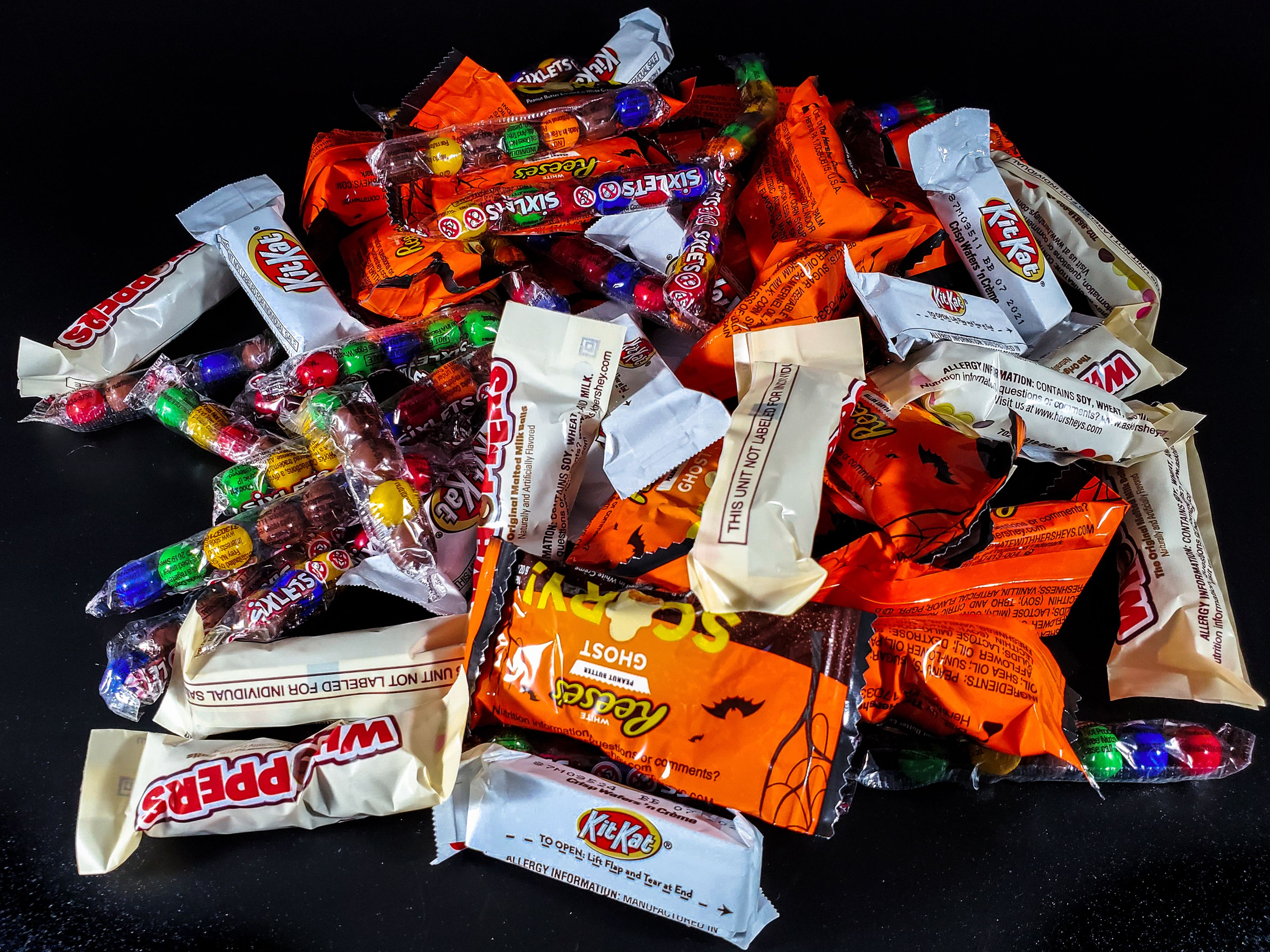
The bowl came back half full. Some of it will keep for years, some for months, and a few pieces should go in the trash tonight.
If you’re still deciding how much to buy, start with our Halloween candy guide.
How Long Each Kind Keeps
There is no single government shelf-life figure for “candy.” The numbers below come from three places: the candy makers themselves (their claims, for their own products), USDA’s FoodKeeper database, and university Extension storage guides. Where none of them gives a figure, the table says so.
| Candy | How long | Whose figure |
|---|---|---|
| Hershey candy | “Most confectionery products” are at their best flavor for one year after manufacturing; nuts shorten it | Hershey (maker’s claim) |
| Mars treats (Snickers, M&M’s, Twix and the rest) | 52 weeks “for all our treats and snack products,” but “the actual shelf life can vary” | Mars (Snickers FAQ, maker’s claim) |
| Milk chocolate | About 1 year for best quality | Iowa State Extension |
| Dark and semisweet chocolate | At least 2 years for best quality | Iowa State Extension |
| White chocolate | About 6 months for best quality | Iowa State Extension |
| Dum Dums lollipops | 36 months | Spangler (maker’s claim, this product only) |
| Gummy fruit snacks | 6 to 9 months in the pantry from the day you bought them | USDA FoodKeeper |
| Marshmallows | 1 year unopened, 1 month opened; Purdue says 2 to 3 months at 70°F | USDA FoodKeeper and NDSU Extension; Purdue Extension disagrees |
| Gummy bears | No shelf-life figure; HARIBO gives a storage range only | none found |
| Candy corn | No figure | none found |
| Caramels, taffy, Tootsie Rolls | No figure | none found |
Sources: Hershey FAQ, Snickers FAQ, Iowa State Extension AnswerLine, Dum Dums FAQ, USDA FoodKeeper, NDSU Extension Food Storage Guide (FN579), Purdue Extension CFS-423-W.
A few things the table hides:
- Hershey’s clock starts at the factory. Its year runs “after manufacturing,” not from the day you bought the bag. A bag bought in September may already be months into it.
- Nut candies go first. Hershey says “Ingredients such as nuts will shorten the shelf life.” Eat the peanut and almond bars before the plain chocolate.
- Hard candy’s 36 months is one maker’s claim for one product. Spangler says “Dum-Dums have a shelf life of 36 months” and that they “should be stored in a cool, dry environment.” We found no figure that covers hard candy as a category.
- FoodKeeper’s gummy entry is fruit snacks, not gummy bears or worms. It is the closest government figure there is. HARIBO’s FAQ asks for room-temperature storage between 55°F and 77°F and warns that its gummies “may melt and lose the character shapes” when kept warmer, but gives no shelf life.
Reading the Date on the Wrapper
USDA’s Food Safety and Inspection Service says that “Except for infant formula, product dating is not required by federal regulations,” and that “Except for infant formula, dates are not an indicator of the product’s safety” (FSIS, Food Product Dating). Its definitions of the phrases you’ll see:
- A “Best if Used By/Before” date “indicates when a product will be of best flavor or quality. It is not a purchase or safety date.”
- A “Sell-By” date “tells the store how long to display the product for sale for inventory management. It is not a safety date.”
- A “Use-By” date “is the last date recommended for the use of the product while at peak quality.”
- “Closed Dating” is “a code that consists of a series of letters and/or numbers applied by manufacturers to identify the date and time of production.” FSIS doesn’t tell you how to read any maker’s version.
Past the date, FSIS says food “should still be safe and wholesome if handled properly until the time spoilage is evident,” which means “an off odor, flavor or texture.” For candy, Hershey says: “Products kept beyond the recommended ‘best before’ date may have flavor loss or texture changes.” The FDA estimates that confusion over date labels “accounts for an estimated 20 percent of consumer food waste” (FDA).
Storing It
Pick the coolest cupboard. Purdue Extension says to “Store foods in your coolest cabinets, away from appliances, which produce heat,” and to keep the cabinets “over the range, near the dishwasher or by the refrigerator exhaust” for dishes, because “In those places, the temperature is too warm for food.” It adds that “Warm and humid climates shorten the shelf life of foods” (Purdue Extension CFS-423-W).
Mind the temperature lines. Hershey says “Temperatures above 75°F will cause chocolate to melt.” Iowa State puts chocolate’s ideal at “between 65°F and 70°F and with a relative humidity of lower than 50-55 percent,” in “a dark location,” in “an airtight container,” because cocoa butter picks up the odors of whatever is nearby.
Skip the fridge for chocolate. NDSU’s storage chart lists refrigeration for candies as “not necessary.” Iowa State goes further for chocolate: “Ideally, chocolate should not be refrigerated,” since it can absorb food odors and develop a moist surface that blooms. If your kitchen is hot and humid, it says to “tightly wrap the chocolate” first.
Use hard containers with lids, not bags. Indian meal moth larvae eat “nuts, chocolate, candies, and other confections,” and warehouse beetles go after “candy, cocoa, cookies,” according to UC Integrated Pest Management. Its storage advice is blunt: “Place it in containers with tight-fitting lids; plastic bags aren’t adequate.” It also says “Don’t mix old and new food together” (UC IPM, Pantry Pests).

OXO Good Grips POP Small Square Airtight Food Storage Containers, 3-Piece
Three 1.1-quart push-button lidded containers. OXO's own page for the 1.1-quart POP container calls it an 'Airtight container for pantry staples,' and a hard, tight lid is what UC IPM asks for.
Bloom is safe. Gray or white streaks on old chocolate are bloom. Hershey says “Chocolate that has ‘bloomed’ is safe to use, but you may notice flavor loss and texture changes.” Iowa State says bloom “does not affect either the taste or shelf life of chocolate nor does it render chocolate unsafe,” and that bloomed chocolate “may also be used in baking.”
Freezing It
NDSU’s chart gives “candies” 3 to 6 months in the freezer at 0°F. Iowa State says chocolate “can be stored in the freezer for up to a year but does not significantly change the shelf life.” The two figures cover different categories, so neither cancels the other. Purdue Extension’s freezer guide explains the limit: “Freezing maintains quality, but cannot improve it,” and “Longer storage is not dangerous, but flavors and textures begin to deteriorate” (Purdue Extension CFS-422-W).
For chocolate, Iowa State’s method avoids the temperature shock that causes bloom:
- Put it in the refrigerator, unwrapped, for 24 hours.
- “Wrap generously and freeze in an airtight container.”
- To use it, thaw it still wrapped in the refrigerator for 24 hours, then let it reach room temperature before you unwrap it.
It also says freezing “is a good option for chocolate that will be used later for baking or melting.”
Packaging. Purdue says to “Use only moisture- and vapor-proof material (aluminum foil, polyethylene bags, freezer film wraps, plastic and metal containers),” and warns that “Foil, when folded, may develop pinholes, resulting in freezer burn.” NDSU says to “Freeze foods in containers or materials designed for freezer storage.”

Rubbermaid Brilliance Food Storage Containers, 14 Piece
Seven latching containers from half a cup to 9.6 cups. Rubbermaid's own pages for its Brilliance containers list 'Freezer Safe: Yes' and an 'Airtight seal,' so one set covers the freezer and the pantry.

Ziploc Gallon Freezer Bags, Stand-Up Bottom, 28 Count
Polyethylene freezer bags, the kind Purdue lists. Ziploc says the double zipper seal helps 'protect against freezer burn.' Good for the freezer, but UC IPM says bags aren't adequate against pantry insects, so don't use them on the shelf.
Check the freezer. Purdue’s rule: “0° F or below is best. Maximum temperature should be 5° F.” Without a thermometer, it gives a test: “If freezer can’t keep ice cream brick-solid, temperature is above the recommended level. In this case, don’t store food more than a week.” A fridge and freezer thermometer costs under $10.
We found no approved source on freezing gummies, candy corn or caramels specifically, so we don’t make claims about how they come out.
Baking With It
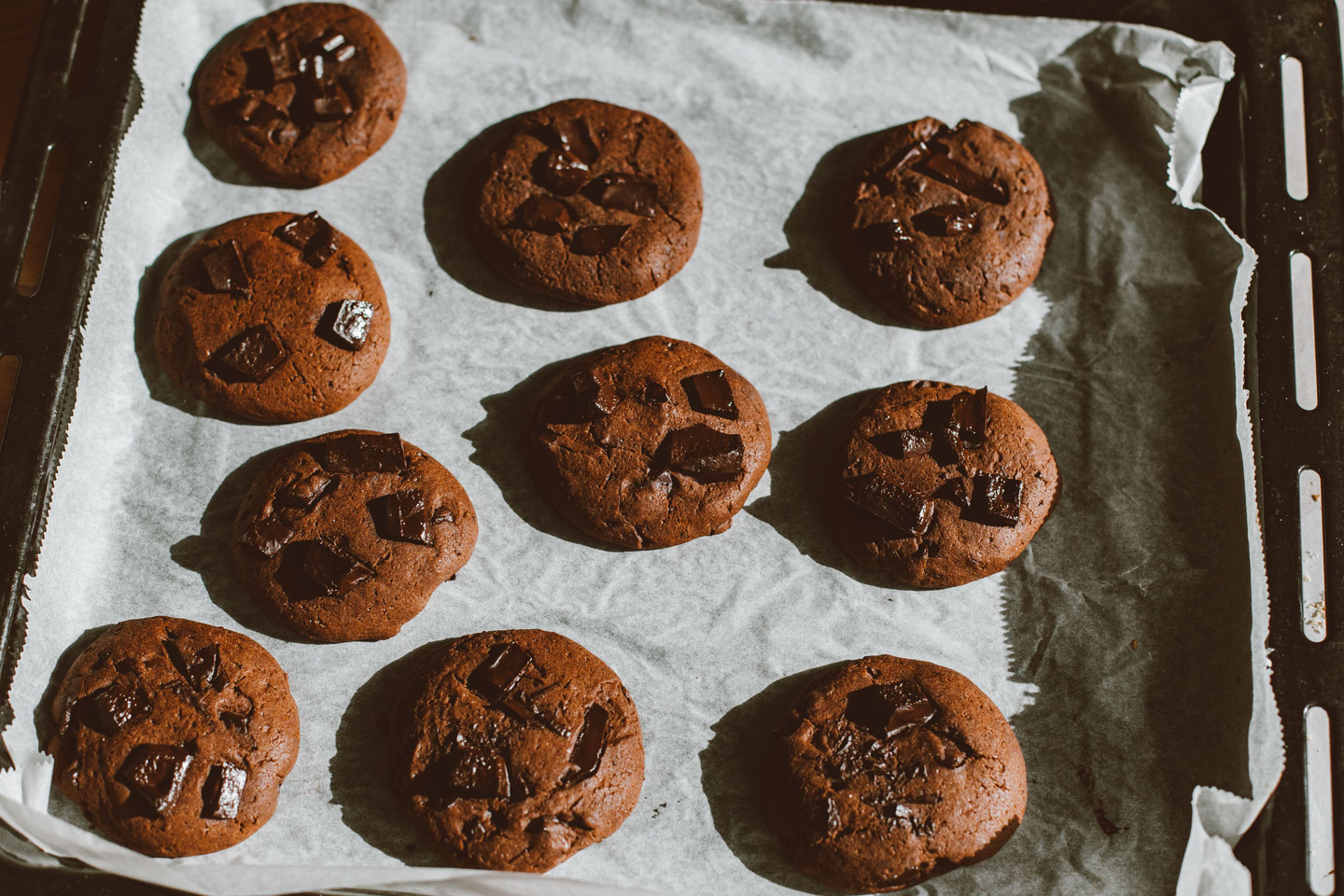
America’s Test Kitchen’s Morgan Bolling wrote the most direct advice on this. The base cookie dough she uses was developed by her ATK co-worker Mark Huxsoll, and she says it takes “1½ cups of just about any mix-ins,” Halloween candy included. Her advice: “I’d stick to chocolate- or nut-based candies, but otherwise, have fun with it.” Her suggestions: “chop up Snickers and peanuts or Twix and caramel chips or just a mix of whatever chocolate candy you have” (ATK, October 2022). Hard candy and gummies aren’t on her list.
Four recipes from test kitchens that use candy you probably have:
- ATK Loaded Triple Chocolate Chunk Cookies. Makes 16 in a 425-degree oven, with 4 ounces each of chopped white, milk and bittersweet chocolate. Bolling’s article pairs this dough with chopped candy. ATK’s note: “Underbaking the cookies ensures that they remain chewy once cool” (recipe).
- ATK Candy Bar Crispy Rice Cereal Treats. Two 2-ounce Snickers bars, chopped, and ½ cup M&M’s Minis. One cup of the mix goes into the cereal, and the “remaining heaping ¼ cup” goes on top. Makes 12 bars in a 13 by 9-inch pan, and ATK says “Do not use mini marshmallows here” (recipe).
- ATK Candy Corn Cake. The one approved recipe we found that uses candy corn: “45-50 pieces” ringed around the top of a black chocolate layer cake that serves 10 to 12 (recipe).
- King Arthur Monster Cookies. Peanut butter, oats, pretzels and “3/4 cup (179g) sugar-coated chocolate candies.” Makes 28 large cookies at 325°F, 16 to 18 minutes (recipe).
For a full party menu to put them on, see our Halloween party food ideas.
Keep It Away From the Dog (and the Cat)

Chocolate. The ASPCA’s Animal Poison Control Center says chocolate’s methylxanthines “can cause vomiting and diarrhea, panting, excessive thirst and urination, hyperactivity, abnormal heart rhythm, tremors, seizures and even death,” and that “The darker (higher cacao percentage) the chocolate, or the higher the caffeine content, the greater the risk for toxicity” (ASPCA, people foods to avoid). White chocolate is not a safe pass. The ASPCA says it “has almost no theobromine, but some dogs may be sensitive to the amount of sugar and fat and ingesting any type of chocolate may lead to inflammation of the pancreas (pancreatitis).” It also says “it will take much less chocolate to be a problem for smaller dogs than larger dogs” (ASPCA, what to do if your pet gets into chocolate).
Xylitol. The FDA says this sweetener is used in sugar-free candy “such as mints and chocolate bars, as well as sugar-free chewing gum,” and may be labeled “birch sugar or wood sugar.” In dogs it can cause “a rapid and profound decrease in the level of blood sugar (hypoglycemia), an effect that can occur within 10 to 60 minutes of eating the xylitol.” Cats “appear to be spared, at least in part, by their disdain for sweets,” but ferrets “have been known to develop low blood sugar and seizures, like dogs” (FDA, Paws Off Xylitol). The ASPCA adds that “Liver damage can occur within 12-24 hours.”
Fillings. Chocolate-covered raisins and macadamia candies carry their own risks. The ASPCA says grapes and raisins “can lead to kidney damage” in dogs, and that macadamia nuts cause “weakness, incoordination, depression, vomiting, tremors and hyperthermia,” with symptoms “within 12 hours of ingestion.” Pet Poison Helpline makes the same point: “chocolate candy and baked goods may also contain other poisonous foods including macadamia nuts, raisins, or xylitol” (Pet Poison Helpline).
Wrappers. In 2013 the ASPCA warned that “Cats love to play with candy wrappers, but ingesting aluminum foil or cellophane can cause intestinal blockage and vomiting” (ASPCA, October 2013). Empty the wrapper bowl as well as the candy bowl.
If your pet gets into it: the ASPCA’s first step is to “collect any remaining packaging,” and to note fillings, because the vet needs the type and amount. Then call your veterinarian, the ASPCA Animal Poison Control Center at (888) 426-4435, or Pet Poison Helpline at (855) 764-7661. Both lines charge a fee. Pet Poison Helpline’s chocolate page links a Chocolate Toxicity Calculator but says to “always contact Pet Poison Helpline at (855) 764-7661 for a professional assessment.”
What to Throw Out
Anything that looks tampered with. The FDA’s Halloween guidance says to “Inspect commercially wrapped treats for signs of tampering, such as an unusual appearance or discoloration, tiny pinholes, or tears in wrappers. Throw away anything that looks suspicious” (FDA, Halloween food safety tips). Under “Safe treats,” the same page tells parents not to let children eat “anything that isn’t commercially wrapped.” Under “Food Allergies,” it says a child with a food allergy shouldn’t eat “any home-baked goods he or she may have received.” If the leftovers came home in a trick-or-treat bucket, apply those rules before anything goes in a jar.
Choking hazards for small children. The FDA says parents of very young children should remove “choking hazards such as gum, peanuts, hard candies, or small toys.”
Anything with bugs. UC IPM’s signs are “Webbing in tight places of a package or tiny holes in a food container,” and its rule is “Throw away any food that has evidence of infestation.” It adds that “Stored-product pests are usually brought into the home in an infested package of food,” so check opened bags before they go in with the rest. Our decoration storage guide covers mice and moths in the boxes, too.
Anything that smells, tastes or feels off. That is FSIS’s test for spoilage past any date. NDSU’s version: “When in doubt, throw it out.”
Red 3 in candy corn. Brach’s candy corn lists Red 3 among its ingredients (Brach’s). On January 15, 2025, the FDA issued an order to revoke Red 3’s use in food, and gave makers until January 15, 2027 to reformulate. It says “Consumers could see FD&C Red No. 3 as an ingredient in a food or drug product on the market past the effective date in the order if that product was manufactured before the effective date.” The ban rests on cancer in male rats “exposed to high levels” through “a hormonal mechanism that occurs in male rats,” and the FDA says “there is no evidence showing FD&C Red No. 3 causes cancer in humans” (FDA, FD&C Red No. 3).
Frequently Asked Questions
Is candy safe to eat after the best-by date? FSIS says a “Best if Used By” date “is not a purchase or safety date,” and food past its date should be safe if handled properly until spoilage shows. Expect the flavor and texture changes Hershey describes.
Does hard candy go bad? The only maker figure we found is Spangler’s: 36 months for Dum Dums, kept cool and dry. We found no reputable figure for hard candy in general.
Should I keep candy in the refrigerator? NDSU calls it “not necessary” for candies, and Iowa State says chocolate ideally shouldn’t be refrigerated at all.
Is candy corn vegetarian? No. Brach’s ingredient list includes gelatin, along with honey and “Confectioner’s Glaze (Shellac).”
Related Resources
Next year’s order starts with our Halloween candy guide and the trick-or-treat candy calculator. The best Halloween candy roundup ranks the bags worth buying, and our printable candy bar labels turn a box of leftover full-size bars into party favors.