
Most of what breaks between one Halloween and the next breaks in storage: a remote with leaking cells, a fog machine left with fluid in it, a foam tombstone boxed wet, a bin of costumes a mouse moved into.
Test Everything Before It Goes Away
Plug in every animatronic and fire every trigger before it comes apart. Seasonal Visions International, whose name is on the Skelly and Deadwood manuals, gives free replacement parts only for qualifying requests made within 90 days of the day you bought the prop, and its policy excludes “Accidental damage resulting from assembly, disassembly, weather exposure, or transit” (SVI parts policy). After that, SVI sells the parts. The free window covers manufacturing defects, faulty components and missing parts, and the policy lists more exclusions: discounted, marked-down and display units; oversized parts such as “bases and torsos”; small products such as “poseable skeletons”; and “Most parts for products manufactured prior to 2025.” It says it “applies to qualifying purchases made during the 2026 season and beyond,” so check the policy against your own receipt before counting on it. The 12.5-foot Deadwood skeleton’s manual says the prop “does not have a warranty” and sends you to customer service “within 90 days” of buying it (Deadwood manual).
For a 2026 prop bought in early September, November 1 is still inside that 90-day window. Found dead next September, it is not, and a fault that shows up after it spent a year in the garage looks a lot like storage damage. Write down anything that twitches, stutters or stays dark, and call now. Our animatronic repair guide has the phone numbers and what each maker covers.
Take the giants down the way they went up. The 12-foot Skelly manual says “It is strongly advised that 3 adults participate in the assembly, standing the skeleton up, setting the skeleton down, and disassembly. The item must be laid down for disassembly” (Skelly manual, model 24SV24386).
Keep The Original Box
The Skelly manual’s care section reads: “When not in use, store this product in its original packing. Keep away from heat and moisture.” The Deadwood manual has the same line, and so does Pan Asian Creations’ 5-foot animated hearse (model 25PA04179), where a typo turns “store” into “shore” (hearse manual). The carton does a second job at set-up: the Skelly manual says to “Lean the skeleton against the box it came with for easier assembly,” and the Deadwood manual says to “Lean the assembly onto the box it came in.”
The Skelly manual has one more storage limit, printed in its warning icons: “CAUTION DAMAGE COULD OCCUR IN TEMPERATURES LESS THAN 0 DEGREES FAHRENHEIT.” If your garage or shed goes below zero, the Skelly goes somewhere else. Our skeleton posing guide covers the rest of the cold and rain warnings for the smaller skeletons.
Batteries Out, Every One
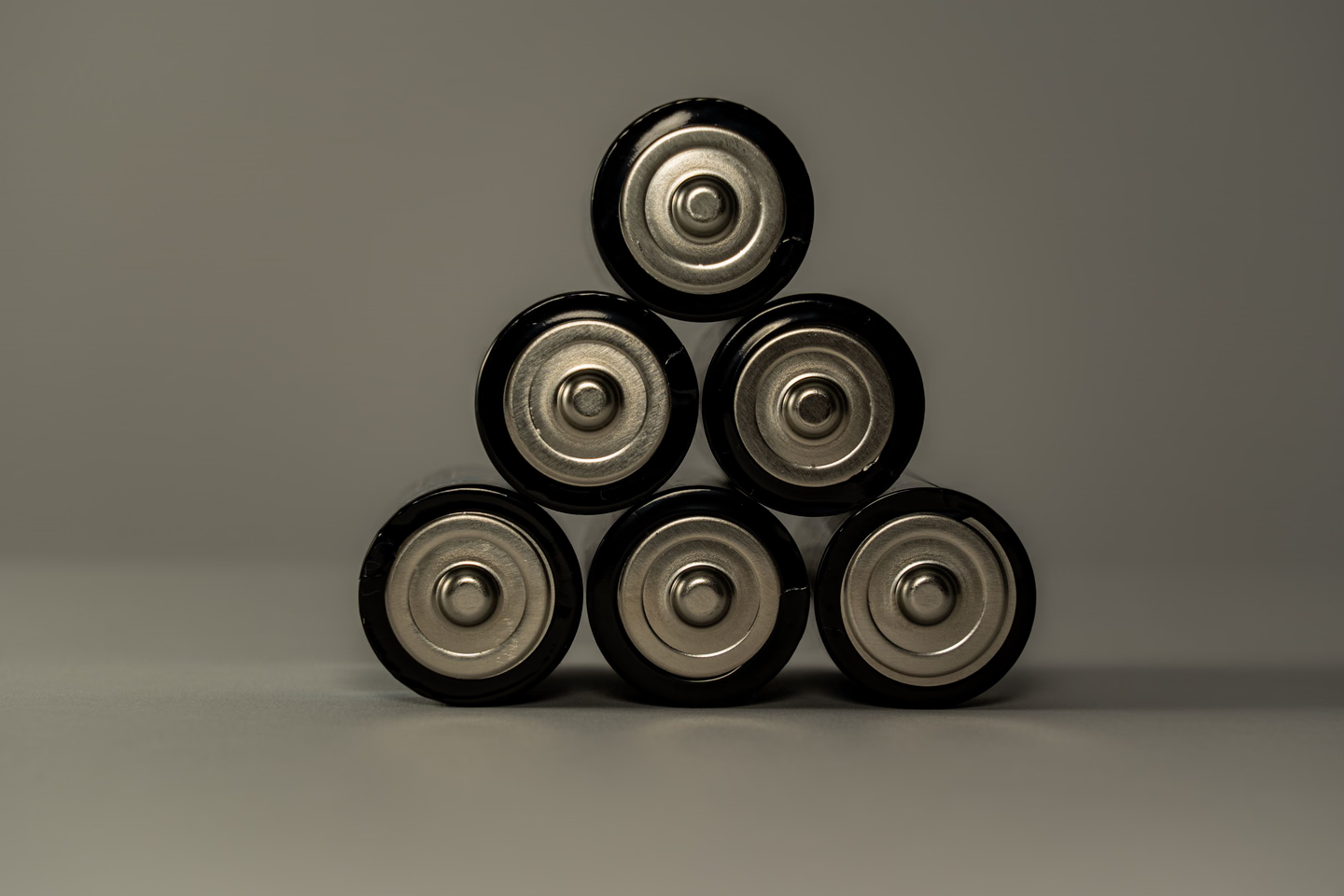
Every source agrees on this one:
- The Skelly manual: “If Skeleton is being stored while not in use, please remove battery in Remote Control.” The remote takes two AAA cells.
- The hearse manual: “Please remove batteries if their power is consumed or if the product is to be left unused for a long period of time.”
- Energizer: “Remove batteries from devices that will be stored for extended periods” (Energizer alkaline handbook, p. 13).
- Duracell: “Remove batteries from a device when it is not expected to be in use for several months,” because “Many devices don’t power off completely when switched off and, after time, may cause the batteries inside to leak” (Duracell FAQ).
Heat and swings are what hurt a stored alkaline cell, not cold. Energizer puts the recommended storage range at “-40° C to 50° C” (-40°F to 122°F). It says cells lose “approximately 3% of their capacity per year when stored at 20° C,” that “Cold temperatures will slow these reactions down and warm temperatures will increase these reactions,” and that “extreme temperature cycling can cause a failure of the battery seal integrity thereby increasing the potential for leakage.” Its do’s and don’ts add: “Don’t put batteries or battery-powered devices in hot places.” A spare pack still belongs indoors: Duracell recommends “room temperature in a dry environment” and says “refrigeration is not necessary or recommended.”
Store spares so they can’t touch. Energizer warns that “When unpacked batteries are mixed together, they can easily short-circuit each other,” and says not to “mix old and new batteries, or mix different types or makes of batteries.” Duracell’s version: store them “without the contacts touching.” If you find crust in a battery box while you’re pulling cells, the cleanup is in our battery corrosion section.

Ontel Battery Daddy Storage & Organizer Case with Tester
A double-sided case with slots for 76 AA, 72 AAA, 8 9-volt, 10 C, 8 D and 12 coin cells, per the listing, plus a tester. Each cell sits in its own slot, which is the point: Energizer warns that loose batteries mixed together can short each other.
“Lithium” on the label is not always lithium-ion. An Energizer Ultimate Lithium AA (L91) is a “Lithium/Iron Disulfide (Li/FeS2)” primary cell rated for storage from -40°F to 140°F, with a shelf life of “25 years at 21°C” (L91 datasheet). Rechargeable lithium-ion packs, such as the ones in some prop controllers and speakers, get stricter rules from the U.S. Fire Administration: “store lithium-ion batteries at room temperature when possible,” “Store spare lithium-ion batteries away from anything that can burn,” don’t leave them “in direct sunlight or keep them in hot cars,” and stop using any that show “an odor, change in color, too much heat, change in shape, leaking or odd noises” (USFA). Don’t throw lithium-ion packs in the trash; USFA says to “Recycle them at your local battery recycling location.”
Fog Machines: Clean, Flush, Store Empty
Chauvet added a maintenance section to its Hurricane 1000 manual in May 2025 (Rev. 4). It’s written for Chauvet’s machines, so check your own manual, but it’s the most specific storage procedure any maker we’ve read publishes:
- Unplug the machine, take the pickup hose out of the fluid tank, and put it in the bottle of Chauvet’s Fog Cleaner (FCQ).
- Plug it in and let it warm up.
- “Run the FCQ/CF250 through the product in a well-ventilated area for 60-90 seconds of continuous, full output.” Then: “DO NOT allow the product to run dry!”
- Move the hose to “a small bottle with distilled water (only use distilled water, not tap or any other water or liquid)” and run it “for at least 30 seconds to clear any remaining cleaning solution from the pump and heater.”
Then store it empty. The manual says “DO NOT leave the cleaning solution in the product,” “do not refill the tank with atmospheric fluid before storing the product,” and, in its safety notes, “Drain the tank before transporting or storing the product.” It also says not to leave fluid in the tank “for more than 10 days without use,” which rules out leaving it in until next October.
On clogs, the manual says: “Once a product is clogged, the cleaning procedure is unlikely to effectively clear the clog.” And: “Test-run the Chauvet atmospheric products monthly to achieve the best performance. Chauvet does not guarantee products will withstand storage for long durations, even if the cleaning process is followed.” Its safety notes also say “Clean the machine after every use,” so run the cleaner and water flush again after each monthly test.
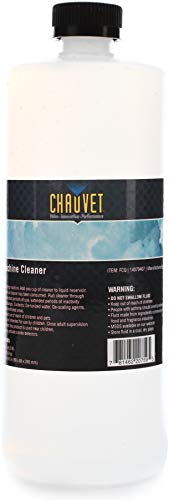
Chauvet Fog Machine Cleaner
Chauvet's own heater and pump cleaner, the fluid its manual's storage steps are written around. The listing gives the model number as FCQ, the name the manual uses. One quart.
Leftover fog juice goes back in its own capped bottle, not down the utility sink. Chauvet’s fog fluid safety data sheet says to “Store in a closed container away from incompatible materials,” lists those as strong oxidizing agents, acids and bases, and for disposal says “Do not discharge into waterways, sewers, basements or confined areas” (Chauvet FJU SDS). Keep the jug away from the pool chemicals and the bleach shelf. More on choosing and running machines is in the fog machine beginner’s guide.
Dry It Before You Pack It
The Deadwood manual’s cleaning instruction is short: “Wipe with a clean, damp cloth. If packing, allow 12.5 ft Giant Deadwood Skeleton to fully dry before putting back in the box.” Apply that to everything that spent October outdoors: foam tombstones, fabric ghosts, scarecrows, the reaper’s robe, and especially inflatables, whose fabric folds into itself when you pack it.
We couldn’t find an inflatable maker’s manual that gives a drying rule, so this part is our own practice: inflate it in the garage or a dry room and let it run until the fabric is dry inside and out, then deflate and fold it.
How fast mold starts is where the sources agree:
- The CDC’s advice after a flood is to “dry out your home fully and quickly (within 24-48 hours),” and it says to keep indoor humidity “no higher than 50%” (CDC).
- The EPA: “If wet or damp materials or areas are dried 24-48 hours after a leak or spill happens, in most cases mold will not grow” (EPA).
- The Library of Congress: “Once collections are wet, you may have as little as 48 hours before mold starts to grow” (LOC).
A sealed tote holds in whatever moisture went in with the prop. A desiccant canister in the bin is a cheap check: when the indicator changes color, the air in the tote is wetter than it should be.

Wisesorb Indicating Silica Gel Canisters, 100 g, 5 Pack
Five aluminum canisters of cobalt-chloride-free silica gel. The listing says the beads turn from orange to green once the surrounding humidity is above 50%, the same ceiling the CDC gives for a home, and that you recharge them in the oven for 3 hours at 250°F. One canister per sealed tote.
If you open a bin next year and find mold, the Library of Congress says “Active/growing mold looks fuzzy or slimy; do not disturb active mold,” and to wear “nitrile gloves and N95 masks or respirators” (LOC, mold). For hard plastic, the CDC says a bleach solution of “no more than 1 cup of household laundry bleach in 1 gallon of water,” and “Never mix bleach with ammonia or other cleaners.” The EPA warns that porous materials “may have to be thrown away if they become moldy,” which covers a lot of foam, fabric and cardboard.
Lights: Inspect Now, Not In October

Check every strand as it comes down. The two federal agencies don’t quite agree on what to do with a bad one:
- CPSC’s holiday safety sheet: “Check each set of lights, new or old, for broken or cracked sockets, frayed or bare wires, or loose connections. Discard damaged sets or repair them before using” (CPSC 611).
- The U.S. Fire Administration: “Inspect holiday lights each year before you put them up. Throw away light strands with frayed or pinched wires” (USFA).
USFA’s page drops the repair option. Either way, a damaged strand shouldn’t go back in the bin with the good ones, where you’ll plug it in without looking next fall.
Wind strands onto a reel instead of into a ball. It’s quicker to spot damage on a reel, and it comes off without the tug that pulls at sockets.

Bayco KW-130 Cord Storage Reel with Center Spin Handle
A 13-inch impact-resistant plastic reel with a center spin handle. The listing rates it for 150 feet of 16/3 extension cord, 125 feet of 14/3 or 100 feet of 12/3, so it takes a haunt's heavy cords as well as light strands.
Wreaths and swags crush in a tote. A bag with a rigid shape keeps the bristles and any glued-on skulls or ravens from getting flattened.

ZOBER Wreath Storage Bags, 36 Inch, 2 Pack
Two 420D Oxford fabric bags for wreaths up to 36 inches, with dual zippers, reinforced handles for hanging on a hook, and a card slot on the front for a label. The listing gives the material as polyester but doesn't say whether it's coated.
Where It Lives: Heat, Damp And Paper
The hearse manual goes further than “Keep away from heat and moisture,” warning against displaying it “near any heat source such as radiators, stoves, fireplaces” and using it near “a bathtub, laundry tub, kitchen sink, wet basement or swimming pool.” For anything that burns, USFA’s rule is “Keep anything that can burn at least 3 feet from all heat sources including fireplaces, wood stoves, radiators, space heaters or candles” (USFA). A cardboard carton of costumes and paper decor counts. USFA’s list doesn’t name furnaces or water heaters; check the clearance on the appliance’s own label.
Foam props have a heat ceiling of their own. Owens Corning rates its FOAMULAR XPS to a maximum service temperature of 165°F, which is why our graveyard guide keeps carved tombstones out of the attic. That figure is for XPS board; no pumpkin maker we found publishes a limit for carved polyurethane craft pumpkins, and our foam pumpkin guide covers how to pack them. Old plastic blow molds want a cool, dark spot too; our blow mold guide covers storing and handling brittle plastic.
Vintage paper and photos want better than the garage. The Library of Congress says works on paper want “A cool (room temperature or below), relatively dry (about 35% relative humidity), clean, and stable environment (avoid attics, basements, and other locations with high risk of leaks and environmental extremes),” and “Distance from radiators and vents” (LOC, paper). For photographs it’s “30-50% relative humidity,” “70°F or below,” away from “exterior walls,” with “RH fluctuations” under “5% within a 24 hour period” (LOC, photos).
Two LOC cautions for the enclosures:
- Among materials to keep away from collections, the Library lists “unstable chlorine-containing polymers (e.g. polyvinyl chloride (PVC), vinylidene chloride)” and “plywood, particle board, hardboard, and plastic laminates” (LOC, pollutants). Read the listing: some clear sleeves and wreath bags are PVC, and some garage shelving has particle board shelves.
- It says polyester film “readily produces an electrostatic charge that can lift powdery media such as pastel, charcoal, pencil, and flaking paint.” A chalky or flaking die-cut goes in an acid-free folder, not a polyester sleeve.
For photos, LOC lists “uncoated polyester, polyethylene, and polypropylene” as suitable plastics and says photo-safe materials must pass the “Photographic Activity Test (PAT).” The full care routine for die-cuts, postcards and honeycomb is in collecting vintage Halloween.

Lineco Archival Document Storage Box, 12.5 x 10.5 x 5 in
A gray clamshell box the listing describes as acid-free, lignin-free and buffered, the kind of document box the Library of Congress recommends for paper. Metal edges, adhesive-free corners, a pull string for sliding it off a shelf, and 12 letter-size archival folders inside.

BCW 8x10 Photo Sleeves
Clear polypropylene sleeves for 8 by 10 prints. The listing says they are acid-free, PVC-free and have passed the Photographic Activity Test, the standard LOC names. Good for a vintage print or poster reproduction; not for chalky or flaking pieces.
Mice, Moths And Silverfish

Autumn is when mice move in. UC Integrated Pest Management’s house mouse guide says they “frequently enter homes in autumn when nighttime temperatures become colder,” that they “can squeeze under gaps ¼ inch tall, and through openings 3/8 inch wide,” and that their nests are “made from finely shredded paper or other fibrous material.” It adds that mice damage “electrical wires and gas lines” and “can chew on the cords of appliances” (UC IPM, house mouse). A cardboard carton of costumes with prop cords coiled in it is nest material with a snack. Hard plastic totes with latching lids beat cardboard here, and the CDC’s cleanup guidance explains why the material matters: “Dispose of any cardboard boxes contaminated with urine or droppings. Plastic, glass, or metal containers can be disinfected.”
If you find droppings in the storage area, the CDC’s rules are specific (CDC, rodent cleanup):
- “Open all doors and windows for 30 minutes before cleaning to ventilate the space.” Leave while it airs out.
- “Don’t vacuum or sweep rodent urine, droppings, or nesting materials. This can cause tiny droplets containing viruses to get into the air.”
- Wear rubber or plastic gloves and spray the droppings with disinfectant or a bleach solution of “1.5 cups of household bleach in 1 gallon of water (or 1 part bleach to 9 parts water).” “Let it soak for 5 minutes.”
- “Use paper towels to wipe up the urine or droppings and cleaning product,” throw them “in a covered garbage can that is regularly emptied,” then “Mop or sponge the area with a disinfectant.”
- “Move storage boxes and containers with potentially contaminated items outside to a well-ventilated area exposed to direct sunlight.”
- “Launder potentially contaminated bedding, clothing, or stuffed animals with hot water and detergent.” Paper you can’t wipe down gets “several hours” outdoors in the sun, or “a minimum of three weeks” in a rodent-free room, with six weeks “strongly suggested.”
That rodent mix is stronger than the CDC’s mold mix above (no more than 1 cup per gallon). They are two different jobs on two different CDC pages; don’t swap them.
Costumes with wool, fur, feathers or leather attract clothes moths and carpet beetles. UC IPM says clothes moth larvae “will feed on synthetics or cotton blends if these fabrics also contain wool,” and carpet beetle larvae eat “wool, silk, leather, fur, hair brushes with natural bristles, pet hair, and feathers” (UC IPM, clothes moths; UC IPM, carpet beetles). For both, the rule is to make sure items are “clean and pest free” and put them “in an airtight container.” Two warnings from the same guides:
- Mothballs: “if these products come into contact with plastic buttons, hangers, or garment bags, they can cause the plastic to soften and melt into the fabric.” Costumes are full of plastic trim.
- Cedar: its oil “can kill small larvae, but it doesn’t affect large larvae. After several years, however, cedar loses this quality.”
If something is already infested, UC IPM gives freezing in a sealed bag below 18°F (“several days” for moths, “2 weeks” for carpet beetles) or at least 30 minutes at 120°F or higher, and says to “consider if cold or heat will damage the object” first. For latex masks and glued props, it probably will.
Silverfish and firebrats go after the paper. Penn State Extension says they “prefer dried beef, beef extract, dead insects, and other items high in protein,” but “can destroy cereals, books, papers, wallpaper, and other starchy items with their excrement.” Silverfish “are usually found in basements”; firebrats “prefer warmer temperatures (over 90°F) and are often near furnaces, hot water pipes, attics, and roofing shingles.” Its fix for the basement: “Use dehumidifiers in damp basements” (Penn State Extension).
Don’t pack leftover candy in with the decorations. UC IPM lists “chocolate, candies, and other confections” among what Indian meal moth larvae eat (UC IPM, pantry pests). Our leftover Halloween candy guide covers where it goes instead.
Totes, Shelves And The Attic Ladder

Buy one tote size and stick with it. Uniform totes stack, and the lids interlock. Sterilite’s page for the 18-gallon Latching Tuff1 (model 1525) calls it “cold and impact resistant” polyethylene that helps “protect stored items in garages, basements, attics,” gives the outside dimensions as 23 by 17 1/4 by 16 5/8 inches, and says its “Deep recessed lid supports stable stacking.” It does not give a weight limit. What it does say is “Use good judgment when stacking items, keep heaviest bin at the bottom” (Sterilite).
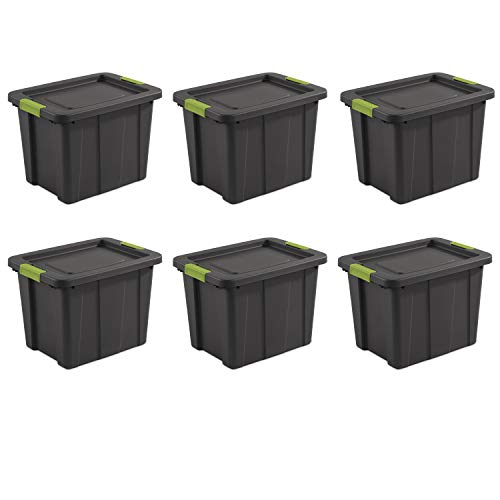
Sterilite 18 Gallon Latching Tuff1 Tote, 6 Pack
Six gray latching totes, 23 x 17 1/4 x 16 5/8 inches outside. Sterilite calls the polyethylene cold and impact resistant, and the recessed lids stack. Latched plastic keeps mice out better than a cardboard flap, though Sterilite doesn't call it airtight, so wool and feather costumes still go in a sealed bag inside. Six matching bins stack square.
Stacking has a federal standard behind it, written for workplaces rather than garages but worth borrowing. OSHA’s 29 CFR 1910.176(b) says containers “stored in tiers shall be stacked, blocked, interlocked and limited in height so that they are stable and secure against sliding or collapse,” and 1910.176(c) says storage areas should be free of materials that are hazards “from tripping, fire, explosion, or pest harborage” (OSHA 1910.176).
Shelving takes the tower off the floor, keeps bins off a concrete slab that can wick up water, and lets you pull the bottom bin without unstacking four. Check two numbers: the per-shelf load rating and the shelf depth. An 18-inch deep shelf holds a Tuff1 tote’s 17 1/4-inch width without overhang. Then check height: a Tuff1 stands 16 5/8 inches, and the listing below gives 1-inch shelf adjustment but no minimum gap between shelves. By our arithmetic, four 17-inch gaps plus the shelves themselves use nearly all of a 72-inch post, so measure before you count on five full tote levels.

UltraDurable 5-Tier NSF Steel Wire Shelving, 48 x 18 x 75 in
Steel wire shelving with five 48 by 18 inch shelves, adjustable in 1-inch steps. The listing rates it at 800 pounds per shelf and 4,000 pounds total on its leveling feet (500 pounds total on wheels). Eighteen inches deep fits an 18-gallon Tuff1 tote with no overhang. Open wire, no particle board.
If the bins go up an attic ladder, the tote counts toward the ladder’s rating. OSHA’s portable ladder card says “Do not exceed the maximum load rating of a ladder. Be aware of the ladder’s load rating and of the weight it is supporting, including the weight of any tools or equipment,” and to “Always maintain a 3-point (two hands and a foot, or two feet and a hand) contact on the ladder when climbing” (OSHA ladder quick card). You can’t keep three points of contact while carrying an 18-gallon tote in both arms. Hand it up to someone, or haul it on a rope.
Frequently Asked Questions
Can I leave the batteries in if the prop is switched off? No. Duracell says many devices “don’t power off completely when switched off,” and the Skelly and hearse manuals both say to take them out for storage.
Is a cold garage bad for batteries? Not for alkaline cells. Energizer’s recommended storage range goes down to -40°F. The trouble is heat and repeated hot-cold swings, which it ties to seal failure and leaks. The Skelly itself has a floor: its manual warns of damage below 0°F.
Should I store my fog machine with fluid in it so the pump doesn’t dry out? Not according to Chauvet. Its manual says to run cleaner, then distilled water, and “do not refill the tank with atmospheric fluid before storing the product.” It asks for a monthly test run instead.
Do I have to keep the huge Skelly box? The manual tells you to store it “in its original packing,” and SVI’s parts policy excludes transit damage. Keep it.
Are cedar blocks enough for costumes? UC IPM says cedar oil kills only small moth larvae and “loses this quality” after several years. An airtight container does more.
Related Resources
Before next season, the 2026 store animatronics guide covers how much space each giant takes, and the best Halloween animatronics and best Halloween inflatables roundups list props worth the shelf space. The weatherproofing guide covers cords and connections for the strands you kept, and the best fog machines roundup has replacements if the monthly test run fails.