Tombstone Workshop Part 2: Carving and Fume Safety
Every heated foam tool comes with instructions. This lesson takes each tool’s own manual as the starting point, then covers our method for lettering and relief carving. The foam is XPS, the dense insulation board our front-yard graveyard guide explains how to choose. The guide also covers the basic hot knife technique, which isn’t repeated here.
Which Foams a Hot Tool Can Touch
Three makers agree on the one rule that matters.
- Hot Wire Foam Factory says its tools “will cut EPS, XPS, PE, EVA, and EPP Foams,” and that “Some foam, such as PU foam used in upholstery and acoustic treatment, cannot be cut with hot wire” (Hot Wire Foam Factory, Precision Engraver). Its foam FAQ says polyurethane “beads off on the hot wire and gives off toxic fumes” (foam FAQ).
- Woodland Scenics prints on its cutter’s instruction sheet: “CAUTION: Some foam products, such as polyurethane foam, may emit toxic fumes when heated. Use in ventilated area” (Woodland Scenics instructions).
- Proxxon’s manual for the Thermocut table cutter says “With the PROXXON THERMOCUT you can cut polystyrene in a clean and safe way,” and names nothing else (Proxxon Thermocut 115/E manual, hosted by George Fox University).
Polystyrene only, then: XPS or EPS. Never polyurethane (upholstery, acoustic or expanding spray foam), and never foil-faced polyiso board.
The Tools, by Maker
Table hot wire: Proxxon Thermocut
A table cutter holds the wire vertical, so every edge comes out square. Proxxon’s manual gives a “Max. cutting height: 5 1/2’’ (140 mm)” and a “Throat: 13 3/4’’ (350 mm).” Two consequences for tombstones:
- Cut before you laminate. A stack of three 2-inch sheets is 6 inches, taller than the wire. Cut each sheet to the outline first, then glue the stack. The same goes for any stone thicker than 5-1/2 inches.
- The throat limits the reach. The wire can only get 13-3/4 inches in from the edge of the board. That’s plenty for footstones, shoulders, relief pieces and letters cut from thin sheet, but you’ll cut the outline of a 2 by 4 foot stone with a hot knife.
The manual’s cutting notes are practical:
- Heat. “For simple, straightforward cuts you use a high temperature, for complicated shapes a lower temperature. Please note that too high temperatures will cause untidy edges.”
- Melting at the exit. “The wire has a higher temperature at the exit side of the workpiece, which may cause surface melting. To prevent this, the wire can be cooled by blowing on it.”
- Arcs. “Fix a drawing-pin at the center of the required circle on the working table with a piece of tape. Fix the workpiece onto the pin and turn the workpiece around the pin.” That is exactly how to cut a clean round tympanum or matching shoulders, within the throat’s reach.
- Cleaning. “Clean the wire and the bushing regularly to prevent unnecessary evaporation of polystyrene residue.”
Its safety list: “Provide good ventilation, when using the device,” “Observe the material suppliers safety instructions when cutting,” “Do not use the device near curtains or other combustible materials,” and “Do not leave the device unattended when it is switched on.”
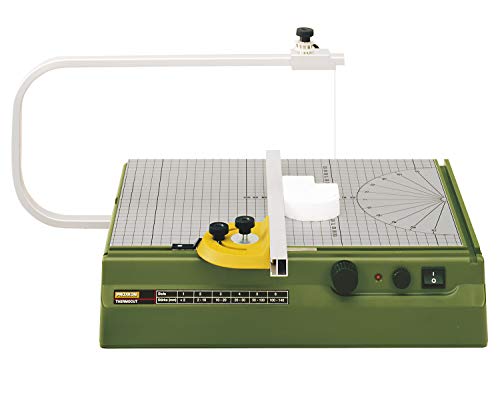
Proxxon Thermocut 115/E Hot Wire Foam Cutter, 37080
Table hot wire with a 5-1/2 inch cutting height and a 13-3/4 inch throat, per Proxxon's manual. Cut each foam sheet before laminating, and use the pin-pivot method from the manual for round tops and shoulders. Proxxon's manual scopes it to polystyrene only.
Spare wire is sold separately as Proxxon 28080; the manual warns to use only supplied or original Proxxon replacement wire, “otherwise the transformer can become overloaded.”
Handheld bow cutter: Woodland Scenics
A small bow cutter trims shapes out of thin sheet. Woodland Scenics’ sheet says the “Wire will only heat when Button is fully engaged,” and warns: “Do not leave Hot Wire Foam Cutter on for an extended period of time. Transformer may overheat,” and “Do not apply to a single contact point for an extended period - heat may be conducted to combustible materials that are not in sight.” It’s marked “Not suitable for children under 14 years!” The Woodland Scenics Hot Wire Foam Cutter is sized for model scenery, so on a full-size stone it’s a detail tool.
Engraver: Hot Wire Foam Factory
An engraver is a heated tip on a handle, and it’s the maker-backed tool for letters. Hot Wire Foam Factory’s instructions: “Allow approximately 30 seconds for the engraving tip to reach operating temperature,” then “Move the heated tip gently across or into the foam. Do not force the tool.” Its warnings: “Engraving Tools may remain hot for several minutes after being switched off,” “never place an operating tool directly on a surface where the heated element could cause damage, an electrical short, or a fire,” and “Disconnect the Power Supply whenever the equipment is left unattended.”
Two tombstone builds in the maker’s own gallery show what it’s for. Eduardo Talbert of Monster Tutorials “used the Precision Engraver to cut out the lettering on the tombstone and add cracks” (Hot Wire Foam Factory gallery, Animated Tombstones). Spencer Till, who builds a yearly “Pet Cemetery” haunt, found that “XPS cuts and engraves slower than EPS with Hot Wire tools which allows you to do finer and finer details” (Hot Wire Foam Factory gallery, Cemetery Haunt Props).

Hot Wire Foam Factory Crafters Deluxe 2-in-1 Engraving Tool and Sculpting Tool Kit
An engraving tool and a sculpting tool with six wire shapes, plus the power supply both need. The engraver cuts letters and cracks; the sculpting wires scoop out the background around a raised skull or urn. Hot Wire Foam Factory rates its tools for EPS and XPS, never polyurethane.
Hot knife
The graveyard guide covers the hot knife and its technique. The Hot Wire Foam Factory’s general rules carry over from its engraver page: “Let the heat do the cutting,” and if “thin strands or ‘hairs’ of foam form along the cut, you may be moving the tool too quickly.”
Rotary tool and rasp
Talbert “used a Dremel to carve out the eyes and engrave the teeth of the skull” on his tombstone. This lesson gives no speed setting for rotary tools: check your tool maker’s own speed chart before you carve foam. A rotary bit or a rasp makes dust instead of smoke, which changes the safety question (see below).
Carving Letters: Our Method
This is how we cut lettering, not a maker’s procedure.
- Practice on an offcut. Cut the name once on scrap from the same board. Every sheet engraves a little differently.
- Outline, then clear. Run the engraver along both edges of each stroke, then clear the middle. A single pass down the center makes a round-bottomed groove that reads as a line of melted foam.
- Keep one depth. Aim for grooves about 1/4 inch deep on the name and a little shallower on the verse. Deeper grooves on a 2-inch sheet weaken the letter’s thin edges.
- Move steadily. Pausing melts a pit. If you have to stop mid-stroke, lift the tip.
- Raised letters are carved down, not glued on. For a raised name, cut away the background around each letter to the depth you want. For a raised panel, like the “oval raised tablet” of Lewis Goodwin’s 1809 stone at Burial Hill, glue a thin sheet on the face and letter it.
Relief Skulls, Faces and Urns: Our Method
Real carvers cut into one thick stone. In foam it’s easier to build up.
- Layer it. Cut the outline of a skull, winged face or urn from a 1/2 or 1 inch sheet, round its edges, and glue it onto the face of the stone. A second smaller layer makes the brow and cheekbones.
- Carve the details into the layers. Eye sockets, a nose triangle and a row of teeth go in with the engraver or a rotary bit. Burial Hill’s earliest faces were “skull-like figures with large oval eyes, some with triangular noses and large teeth” (Old Burial Hill nomination), which is a good first skull.
- Stipple the background. Captain Thomas Davis’s 1785 stone has “stippling in the background of the tympanum.” Touch the engraver tip into the foam hundreds of times around the carving. The dotted field makes the smooth relief stand out.
- Carve for low light. The National Park Service tells cemetery surveyors to photograph stones “under conditions when the high contrast of light and shadow will give sharpness and clarity to inscriptions and sculptural relief” (NPS, National Register Bulletin 41). A light low to the ground does the same thing to foam. Undercut the edges of a relief slightly so each one throws a shadow.
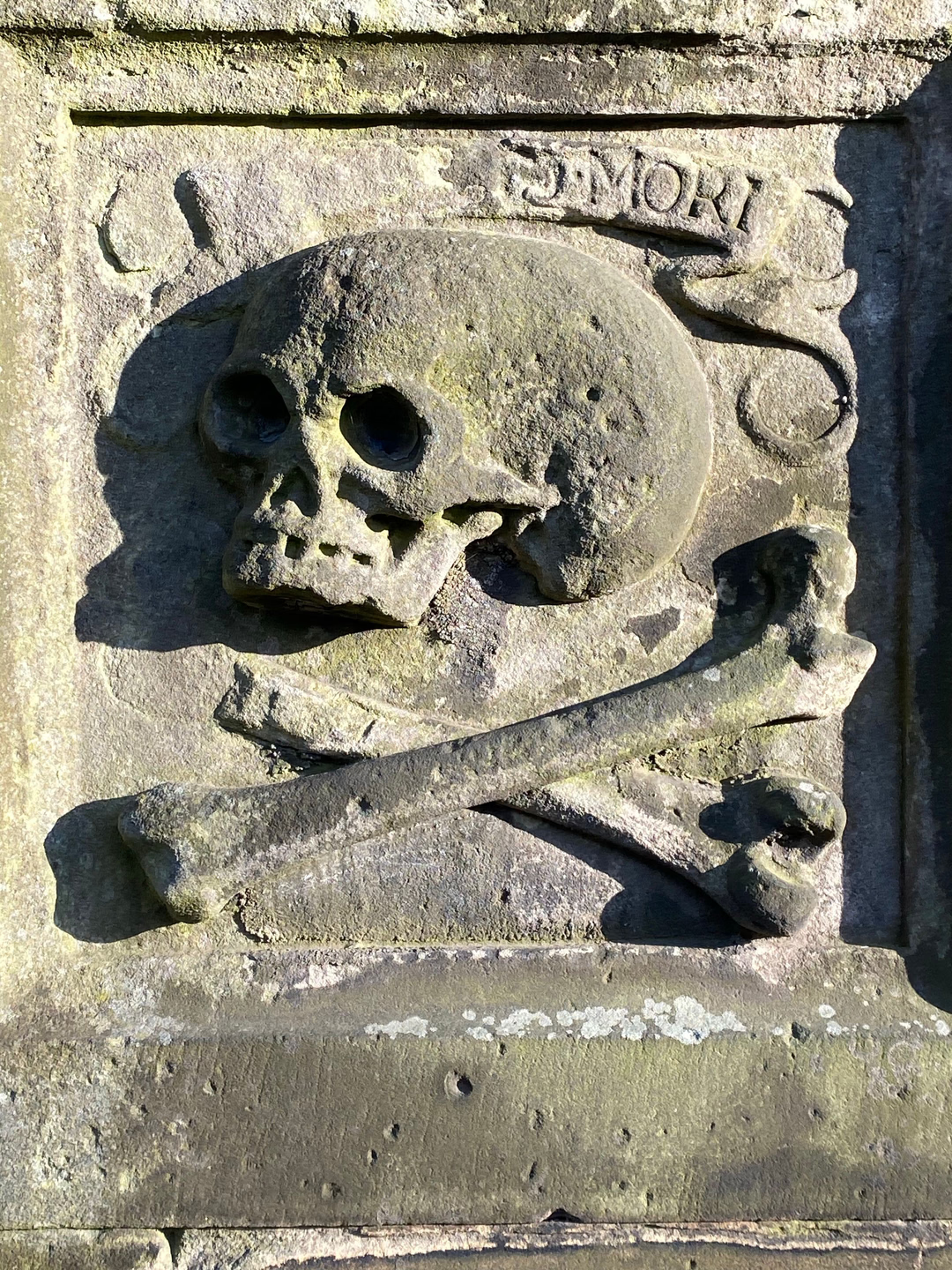
For a movie-themed stone, the same methods carve a crescent moon, a bat or a lightning bolt. Keep to generic motifs rather than a film studio’s character likeness.
What the Smoke Contains
Sources disagree, and the graveyard guide’s fume section sets out the basic disagreement between Hot Wire Foam Factory and Harvard’s fab lab. Here is the rest of the evidence.
The foam maker’s own list. Owens Corning’s safe use instruction sheet for FOAMULAR and FOAMULAR NGX lists the board’s hazardous decomposition products: “Water, Carbon dioxide (CO2), Carbon monoxide, Styrene, Aldehyde,” with “Small quantities of hydrogen fluoride, hydrogen chloride, fluorine and chlorine” possible, and “Other undetermined compounds could be released in small quantities.” A note adds that FOAMULAR NGX products “will not release any quantities of hydrogen fluoride, hydrogen chloride, fluorine and chlorine” (Owens Corning FOAMULAR safe use instruction sheet, rev. April 2022). The sheet doesn’t say at what temperature or in what amounts, so it doesn’t tell you what a hot wire at cutting heat produces. It does split the product line: the hydrogen fluoride and hydrogen chloride note applies to FOAMULAR, not FOAMULAR NGX, so check which one your board is labeled.
The tool maker’s view. Hot Wire Foam Factory’s FAQ says “the smoke that you may encounter while cutting EPS foam is primarily CO2 and water vapor,” and the FAQ’s writer describes a personal practice: “I always try to cut in well ventilated areas and use a fan when I’m not.”
Styrene, the compound people worry about. The NIOSH Pocket Guide sets a recommended exposure limit for styrene of 50 ppm as a time-weighted average, with a short-term limit of 100 ppm, and lists symptoms including irritation of the eyes, nose and respiratory system, headache and dizziness (NIOSH Pocket Guide: Styrene). The EPA’s hazard summary gives the “odor threshold for styrene is 0.32 parts per million (ppm)” and says “Acute (short-term) exposure to styrene in humans results in mucous membrane and eye irritation, and gastrointestinal effects” (EPA Styrene Hazard Summary). On cancer, the same EPA sheet records both that “IARC has classified styrene as a Group 2A, probably carcinogenic to humans” and that “EPA does not have a carcinogen classification for styrene.”
Our reading of those two numbers: the odor threshold is well under 1 percent of the NIOSH limit, so you can smell styrene long before you reach it. Smelling it doesn’t mean you’re overexposed. It’s a signal to improve the airflow.
The lab rule. Harvard’s Graduate School of Design fab lab requires “Local exhaust ventilation” with the snorkel “within 6 inches of the source of the contaminant, in this case, the top of the wire,” says to keep “the wire temperature at the minimum necessary to cut the foam,” and to “Wear a respirator with organic vapor and particulate pre-filter cartridges if discomfort or adverse effects are experienced” (Harvard GSD Fab Lab SOP). Its PPE list also calls for safety glasses.
What that adds up to at home
- Cut outdoors or in an open garage, with a fan behind or beside you pulling the smoke away from your face.
- Run every tool at the lowest heat that cuts, as Harvard’s lab requires. Proxxon’s manual is less strict: a high temperature for simple, straight cuts and a lower one for complicated shapes, with the warning that too much heat causes untidy edges. A tool that smokes heavily is running hotter than the cut needs.
- Keep your face out of the plume. Hunching over an engraver for an hour of lettering is the closest you’ll get to it.
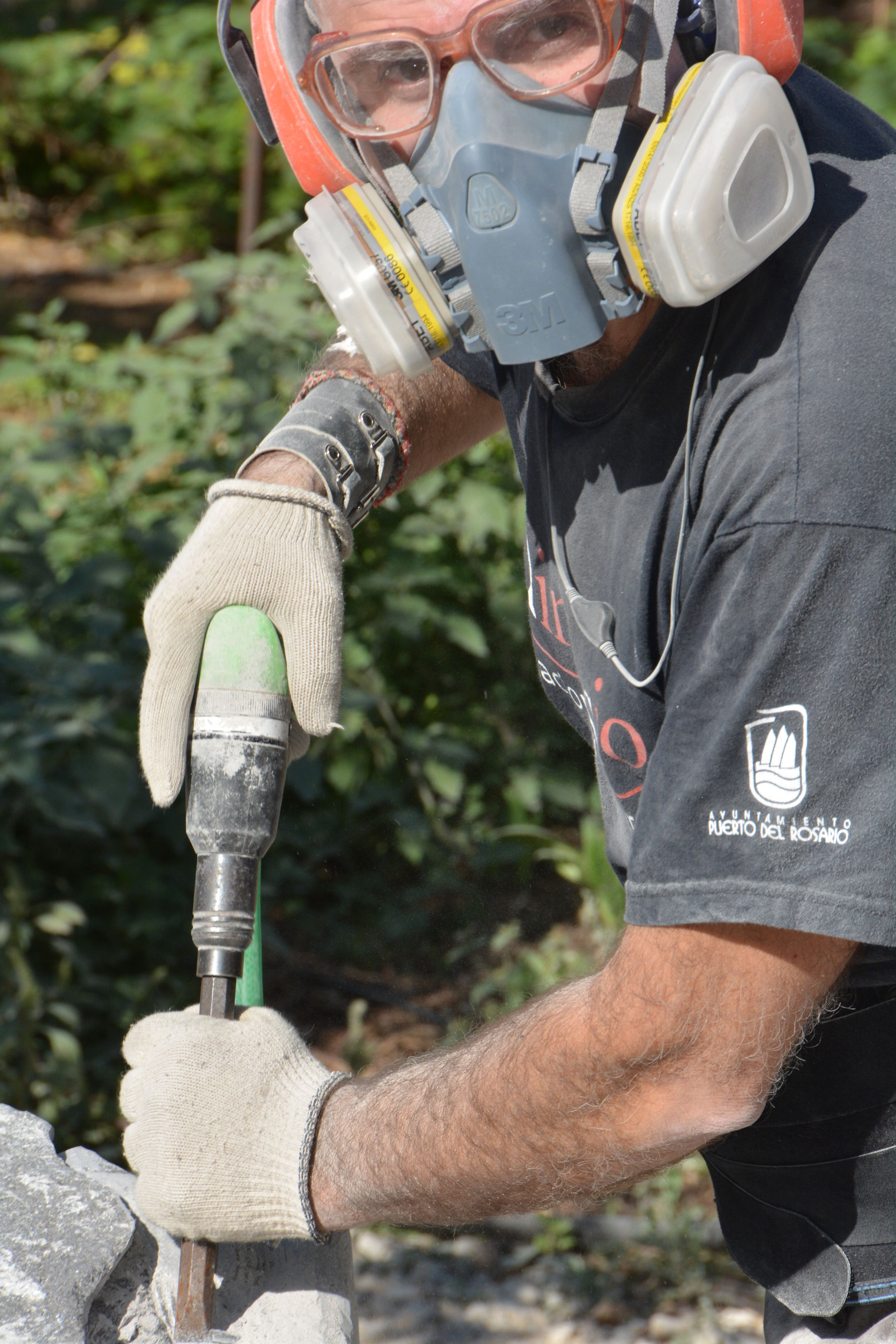
- If the smell bothers you, stop, or wear the respirator Harvard’s lab names: organic vapor cartridges with particulate prefilters.
- Wear safety glasses, which Owens Corning’s sheet also lists.
- Talbert “used water and a heat gun to add a stone texture to the foam.” None of the sources above covers heat guns, which can run hotter than a cutting wire. Read the heat gun’s own manual, use its lowest setting, and treat the smoke at least as cautiously as hot-wire smoke.

3M OV/P100 Multipurpose Respirator 65021, Medium
NIOSH-approved half mask with organic vapor cartridges and P100 particulate filters, the combination Harvard's fab lab names for hot-wire cutting when the smoke bothers you. The P100 filters also cover rasp and sanding dust.
Dust from rasps and sanding
The makers disagree about foam dust too. Hot Wire Foam Factory’s FAQ goes furthest: “EPS dust particles are dangerous carcinogens. A dust mask is an absolute necessity when dust particles are present.” Owens Corning’s sheet treats its XPS as an article with “No hazardous components,” but still says “Avoid creating dust” and to “Wear safety glasses with side shields (or goggles).” Rasp and sand outdoors, wear eye protection and a particulate mask, and vacuum the beads up rather than sweeping them into the air.
Fire
Owens Corning’s product data sheet states plainly: “This product is combustible” (Owens Corning FOAMULAR 150 data sheet). Every tool maker above warns about heat reaching nearby material. Work on a clear bench, rest hot tools on their stands, unplug them when you walk away, and sweep up shavings before you switch anything on again.
Next: Part 3: Coating and Weathering covers the coats that turn carved foam into stone, and how to age it the way a real stone ages.
Put It to Work
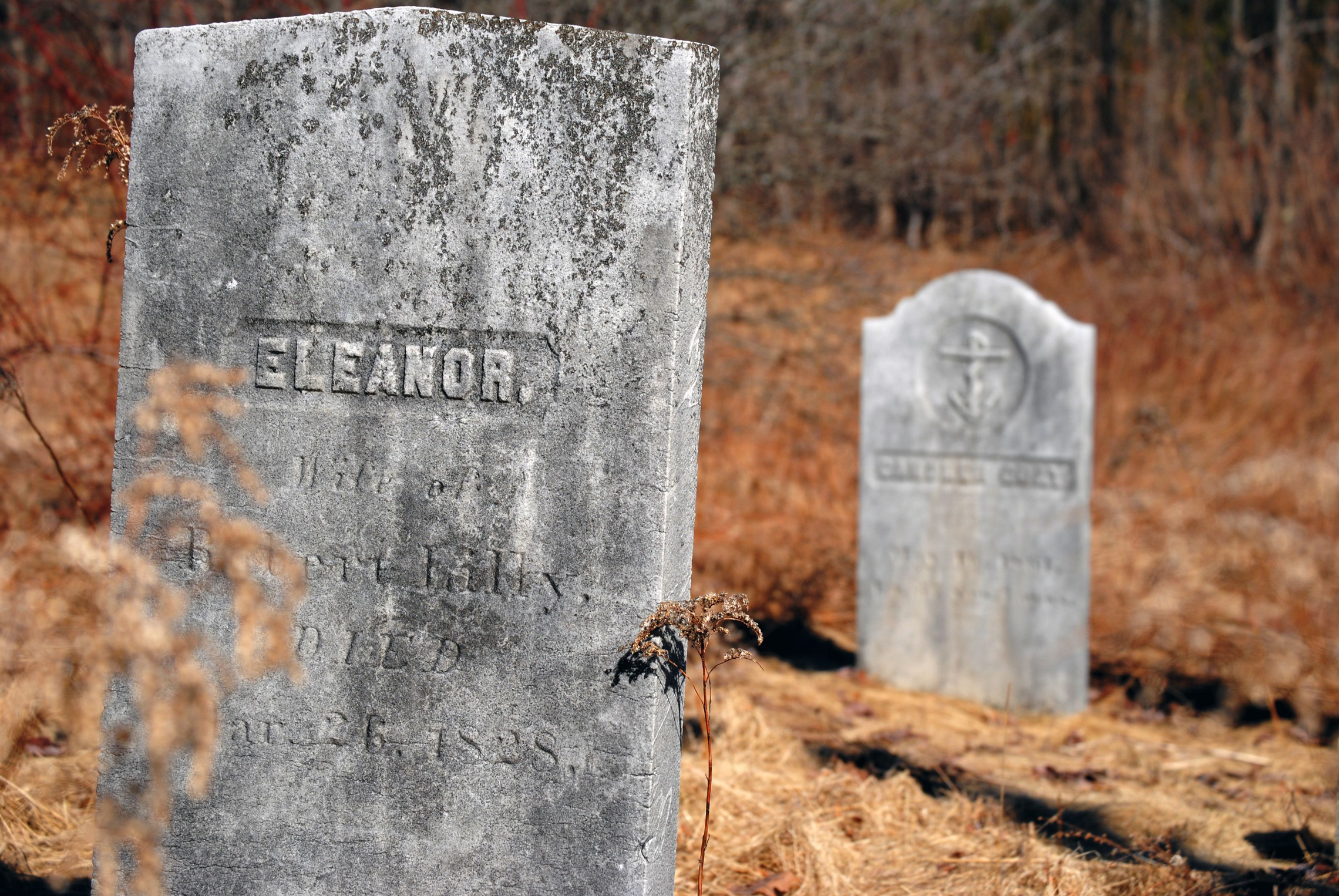
How to Build a Front-Yard Graveyard That Looks Genuinely Old
Foam tombstones that survive October, paint that won't melt them, anchoring that won't impale anyone, and the lean and clutter of a real colonial burying ground.

Mannequins and Dressed Props: How to Make a Figure Look Real
Store mannequins, dress forms, skeletons and PVC frames compared, plus padding a tiny display body into real clothes, heads and hands, Rit dye by fiber, painting plastic, blood on fabric, lighting a face and keeping a dressed figure alive outdoors.

How to Build a Pirate Cove Yard Haunt
A skeleton crew, a wrecked bow, a smoking cannon and a lit treasure chest: where the pirate look really comes from, what the Dead Water ship's manual forbids, how to duct fog into a cannon, LED-only lanterns, a blue sea without water, and shanties that aren't pirate songs.