Tombstone Workshop Part 3: Coating and Weathering
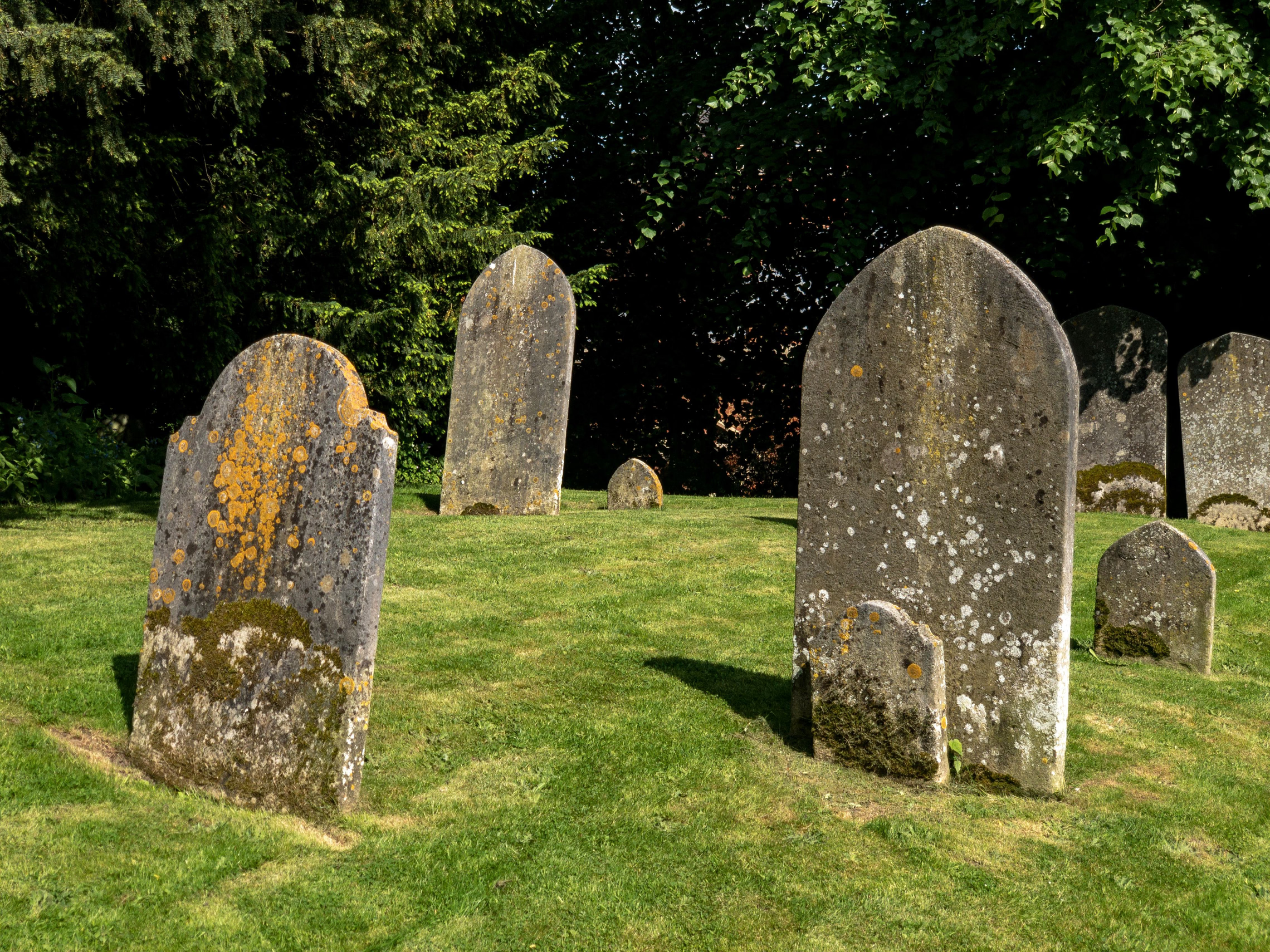
Carved foam still looks like foam. The coat on top is what makes it read as stone, and the weathering decides which stone and how old. Our front-yard graveyard guide covers the paint basics: solvent-free only, which Krylon products to avoid, and Drylok as a hobbyist base coat. This lesson adds a coating the foam-tool maker makes for exactly this job, and a closer look at how real stones age.
A Stone Coat Made for Foam
Drylok is a masonry waterproofer that haunters use on foam. The maker doesn’t recommend it for anything but bare masonry. Hot Wire Foam Factory’s Exterior Foam Coat is one of what the foam-tool maker calls its “concrete coatings,” sold for foam, and the maker says the finished coat “is fire-resistant, weatherproof, and suitable for below-grade applications” (Hot Wire Foam Factory, Exterior Foam Coat). Its FAQ describes the result as looking and feeling “like stone” and lists Exterior Foam Coat among “our concrete coatings” (coating FAQ).
The maker’s instructions, in the order you’ll need them:
- Prep. “If using extruded foam (ie Blueboard or Pinkboard) roughen the surface with coarse sandpaper.” Sand outdoors with a dust mask on (see Part 2).
- Temperature. “Use when temperatures are between 40°F (4°C) and 100°F (38°C).”
- Mix. “By volume 3 parts Exterior Foam Coat to 1 part water or Boost.”
- Apply. “For best strength, apply at least 1/4” (6 mm) thick.” A thin first “scratch coat” makes the next coat easier to apply, and on XPS the FAQ is specific: “We recommend applying a scratch coat with Boost added to it when you coat XPS foam because it is very smooth and difficult to get the wet foam coat to stick.” Boost is the maker’s liquid fortifier, mixed in place of water.
- Timing. Working time is about 1.5 to 3 hours. The coat reaches “approximately 80% of its strength” in 12 to 24 hours, “depending on temperature and humidity,” and fully cures in about 3 to 5 days. Lightly misting the surface “on and off for 24 hours will increase strength.”
- Texture while it sets. “The product goes on rough and is not sandable. Finish the surface as it is setting up.” The FAQ suggests “a stucco brush or trowel” for larger projects.
- Protection. “Appropriate eye, skin, and respiratory protection must be worn during application and handling,” and “Use a certified respirator (e.g., NIOSH-approved) during all sanding operations.”
- Sealing. The FAQ says “latex house paint will protect against rain and UV rays on any of our coatings,” and “Smooth Coat and Exterior Foam Coat have the same resistance properties as concrete. Concrete sealers can also be used.”
How much it takes
The maker’s coverage table puts a 25 lb box at 18 square feet at 1/4 inch thick, or 72 square feet at 1/16 inch. Our graveyard guide sizes a 2 by 4 foot stone at about 18 square feet for both faces and the edges. So by our arithmetic, one full-size stone coated all over at the maker’s recommended 1/4 inch takes the whole 25 lb box, before the water. A thinner 1/16 inch coat covers about four stones. The thick coat also makes the stone much heavier, which helps in wind and matters when one falls over: anchor it as Part 4 describes.

Hot Wire Foam Factory Exterior Foam Coat, 25 lbs
One of the foam-tool maker's concrete coatings, rated fire-resistant and weatherproof. Rough up XPS with coarse sandpaper, lay a thin scratch coat mixed with the maker's Boost as its FAQ recommends for XPS, then mix 3 parts powder to 1 part water or Boost and texture it as it sets, because it can't be sanded. At the maker's 1/4 inch, a box coats about 18 square feet: one full-size stone.
Spencer Till, whose foam graveyard appears in the maker’s gallery, sprays his coat on with an air gun: “Exterior Foam Coat and Boost make these look like real tombstones; it also makes them waterproof and resistant to any of the elements” (Hot Wire Foam Factory gallery, Cemetery Haunt Props).
Two things never go on bare foam. The FAQ warns “Resin will melt polystyrene foam,” and Owens Corning lists “Amines,” “Esters” and “Hydrocarbons” as materials incompatible with its XPS (Owens Corning FOAMULAR safe use instruction sheet). Many solvent paints, clear coats and adhesives contain chemicals from those families, but the list isn’t complete: acetone, a ketone, is in none of them, and the graveyard guide’s FAQ names it among the solvents that eat polystyrene. Keep every solvent product off bare foam.
If you use Drylok instead
Sika’s current data sheet for Drylok Original (August 2026) adds a few facts to the guide’s: it comes in White and Gray, it’s “Tintable,” its appearance is a “Sandy texture,” and it weighs 12.7 pounds per gallon (Sika, Drylok Original data sheet). At the first-coat rate of 75 square feet per gallon, that’s roughly 3 pounds of wet coating on a full-size stone per coat, by our arithmetic. Store the can “between 50° F (10°C) and 85°F (29°C)” and away from direct sunlight, since Sika says “Extreme heat or freezing temperatures can damage the product.” A can left in a cold garage over winter is suspect.
Dark Stones and Sun
A near-black slate stone is the scariest color and the riskiest for the foam. Owens Corning’s data sheet for FOAMULAR 150 is specific about why. For boards lying flat in the sun, it says to turn “the print side down so the black print does not show to the sun which may at times act as a solar collector, raising the temperature of the foam under the print to an unacceptable level.” It calls for “a final finish covering or temporary white opaque covering to avoid possible damage when dark (non-white) surfaces are used over” the board, and says not to cover stored board “with dark colored (non-white), or clear (non-opaque) coverings and leave it exposed to the sun,” naming “temporary tarps, clear polyethylene” among them. If the board is “improperly covered, and exposed to the right combination of sun, time and temperature,” the sheet warns, “deformation damage may occur rapidly.” The board’s maximum service temperature is 165°F (Owens Corning FOAMULAR 150 data sheet).
Owens Corning is writing about construction, not Halloween props. Our reading for a graveyard:
- A thick cement coat puts a layer between the dark paint and the foam. Thin paint on bare foam doesn’t.
- Keep the darkest stones out of a south-facing, full-sun spot against a wall or fence, where heat builds up.
- Never store stones under clear plastic or a dark tarp in the sun, wrapped or not. Store them as the guide’s storage section describes.
A Palette That Survives Outdoors
Golden Artist Colors tests its paints outdoors for mural use, and its advice translates directly to painted stones. On the company’s Just Paint site, Michael Townsend writes that “Pigments rated ASTM Lightfastness II are completely suitable as artist grade paints, but should be avoided for any exterior use,” that fluorescents are “an obvious exclusion,” and that “Exposure to mild acids can turn Ultramarine Blue chalky white, making it inappropriate for outdoors.” For the most stable colors, “iron oxides reign supreme”: the earth colors (yellow ochre, raw and burnt sienna, raw and burnt umber) are “extremely stable and reliable pigments for mural use,” as is Chromium Oxide Green, and Golden recommends its own Titanium White as “an extremely durable pigment” (Golden, Selecting the Best Exterior Mural Pigments). Golden adds that the transparent iron oxides “are every bit as stable.”
That list is a weathering palette:
| For | Golden’s stable choice |
|---|---|
| Grime washes and rain streaks | Raw umber, burnt umber, transparent brown iron oxide |
| Rust stains and warm sandstone | Burnt sienna, red oxide |
| Orange and yellow lichen | Yellow ochre, yellow oxide, raw sienna |
| Green algae and moss | Chromium oxide green |
| Pale lichen and highlights | Titanium white |
One caution from the same article: “For best results we always suggest creating your mural with dense, opaque paint layers regardless of color.” A weathering wash is thin by design, so it’s the layer most likely to fade. Put the durability in an opaque exterior latex base coat and treat the washes as the part you touch up.

GOLDEN High Flow Acrylics, Raw Umber, 4 fl. oz.
An ink-thin acrylic whose single pigment, PBr7, is a natural iron oxide: raw umber, one of the earth colors Golden calls extremely stable for outdoor murals. Dilute it with water for grime washes and rain streaks over a cured base coat. Golden's exterior advice covers the pigment, not this product line specifically.
Weather It the Way Real Stones Weather
The National Park Service’s Preservation Brief 48 describes what happens to real markers (NPS Preservation Brief 48). The graveyard guide already covers the difference between slate, marble and sandstone. These are the patterns to paint:
- Streaks, not an even gray. “Discoloration on markers will usually appear uneven and in streaks” (p. 8). Run your darkest wash from the top edge and out of the bottom of carved letters, where water runs.
- Rain erosion above, crust below. Brief 48’s photo of a limestone marker shows “surface loss in areas exposed to rainwater and gypsum crust formation below,” while the sandstone marker beside it “displays uniform soiling” (p. 4). On a pale stone, soften and lighten the top where rain hits and paint a dark, rough band lower down.
- A splash line at the base. Bare ground at the foot of a marker “in a heavy rain, can cause soil splashing that may result in staining” (p. 6). Stipple a band of soil color along the bottom few inches.
For the streaks themselves, Spencer Till’s method from the maker’s gallery: “I wet the tombstone lightly using a mister and use a turkey baster and black latex paint mixed with water. When you put the turkey baster at the top and squeeze out the black paint (mixed with water 50/50), it will look just like aged rain streaks.” He then goes back “with a very light greenish-white acrylic paint and, using a dry brush, lightly bring out the textures of the wording and other details.”
Lichen and Moss
Where it grows
Brief 48 says “Overgrown vegetation creates wet, shaded areas and fosters biological growth,” and that “Microorganisms such as algae, fungi, and lichens may affect grave markers. Microorganisms hold in moisture and some produce acids. With acid-sensitive materials such as limestone and marble, the result is surface erosion” (pp. 6, 7). So paint green growth low, on the shaded side and in the carved recesses where water sits.
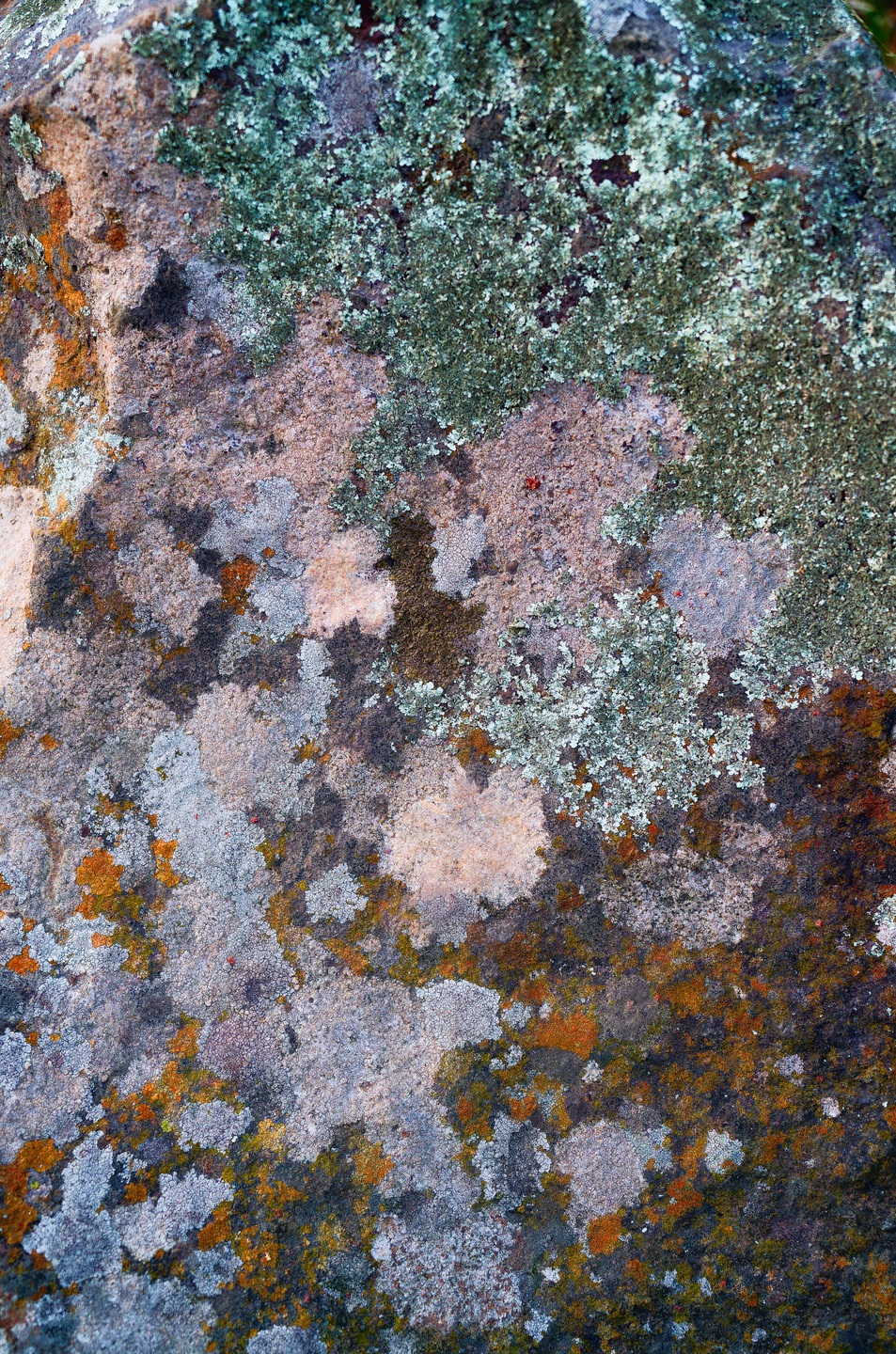
Lichen isn’t only a shade plant. The Missouri Department of Conservation says orange sunburst lichens “can be very common on sunny rocks and tombstones” and are “typically orangish or yellow orange,” with “a circular, foliose growth pattern” (Missouri Department of Conservation, Orange Sunburst Lichens). Firedot lichens “occur in sunny locations on cement sidewalks, gravestones, mortar, and limestone boulders” (MDC, Firedot Lichens). The sunny face of the stone gets the orange.
What it looks like
Shenandoah National Park’s lichen page lists “black, white, orange, yellow, red, brown, and green” as common colors, and three forms: flat against the surface (crustose), leafy (foliose) and branched (fruticose). It also says lichens “grow extremely slowly, adding only 0.1 mm to 10 mm of growth per year” (NPS, Shenandoah: Lichens). Iowa State University Extension, writing mostly about lichens on trees, says instead that “Many lichens grow rapidly when exposed to full sunlight,” and lists “tombstones” among the places they grow (Iowa State Extension, Lichens). The two don’t agree on speed. Either way, heavy lichen means an old stone, so a stone dated last year should be clean.
Our method for painting it: stipple rounded, overlapping blotches with a stiff brush, starting with a pale gray-green, then smaller orange or yellow rosettes on the sunny side, then a few dark specks. Keep each blotch roughly circular.
Does lichen damage stone?
The sources disagree, and it matters for how you tell the story. Brief 48 lists lichens among growths whose acids erode limestone and marble. The Missouri Department of Conservation’s lichen page says “it’s not a simple issue,” that “many people cause greater damage to old gravestones in efforts to remove lichens, by scraping or by applying harsh chemicals,” and that “There is evidence that in some cases, the lichens might actually protect the stone from deterioration from the weather” (MDC, Lichens).
Reindeer lichen grows on the ground, and craft moss bleeds
Acadia National Park names Cladonia stellaris the “Star-tipped reindeer lichen” and describes “reindeer lichens of the genus Cladonia growing among mosses on the ground” (NPS, Acadia: Lichens). A reindeer lichen growing on the ground belongs at the foot of a stone, not on its face, so tuck craft reindeer moss into the grass at the base rather than gluing it to the stone.
The maker’s own warnings apply outdoors. SuperMoss says “Our dyed mosses run the risk of color transfer, especially when wet,” and that “Exposure to the elements such as the sun, UV light, and heat will cause color fading” (SuperMoss product page; SuperMoss FAQ). Dyed moss touching a pale painted stone can stain it green in the first rain. Keep it off light-colored paint, or seal it away from the surface.
Till takes a different route: “I use a hobbyist green grass to create sections that look like moss growing on the tombstone. To make sure that stays on permanently, I spray the entire tombstone with 2 coats of exterior dead flat polyurethane.” He sprays over his cured cement coat. Solvent clear coats never go on bare foam, as above.
Next: Part 4: Sunken Graves and Mounting sets the finished stones into the ground, with the grave shapes that tell a visitor how old each burial is.
Put It to Work
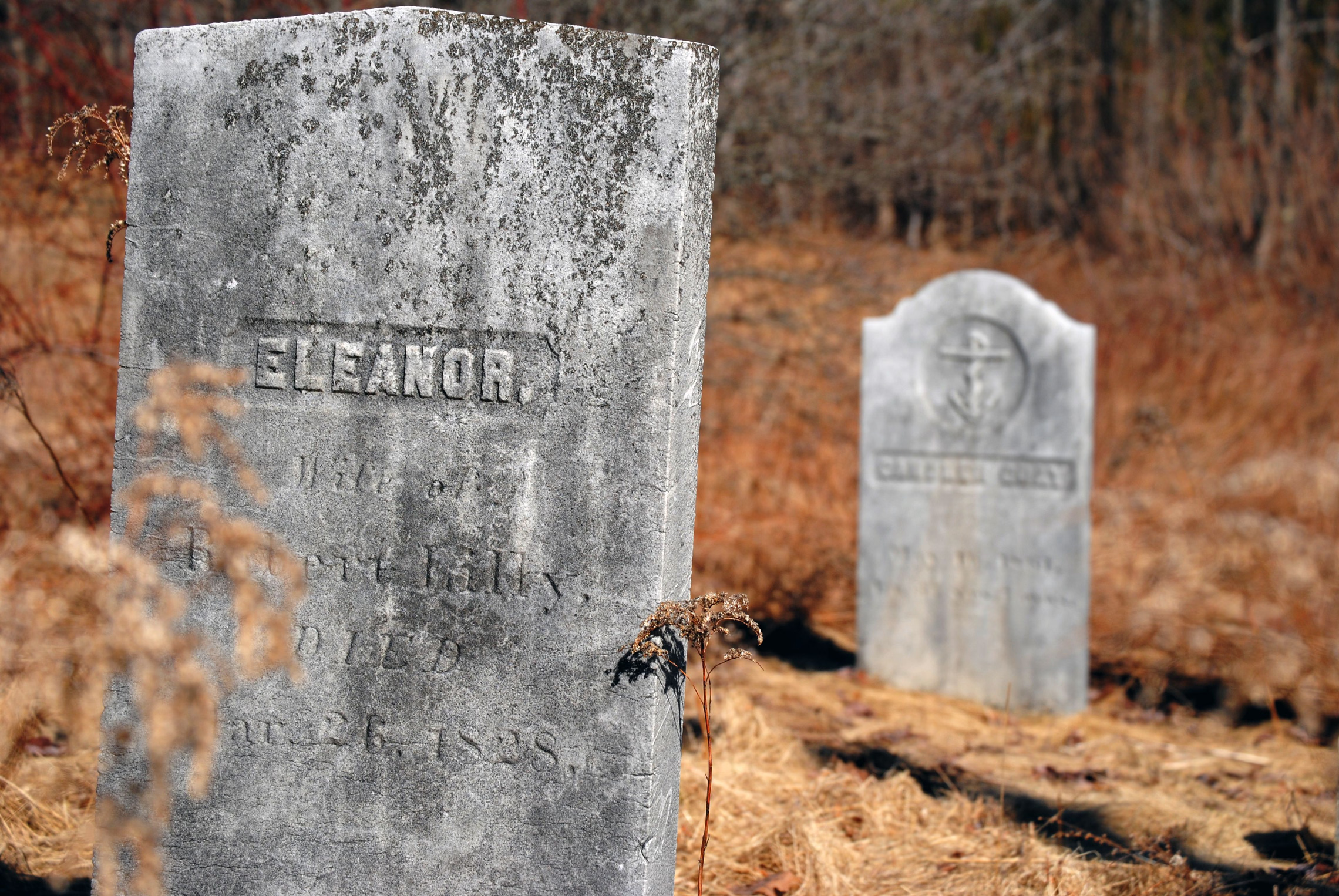
How to Build a Front-Yard Graveyard That Looks Genuinely Old
Foam tombstones that survive October, paint that won't melt them, anchoring that won't impale anyone, and the lean and clutter of a real colonial burying ground.

Mannequins and Dressed Props: How to Make a Figure Look Real
Store mannequins, dress forms, skeletons and PVC frames compared, plus padding a tiny display body into real clothes, heads and hands, Rit dye by fiber, painting plastic, blood on fabric, lighting a face and keeping a dressed figure alive outdoors.

How to Build a Pirate Cove Yard Haunt
A skeleton crew, a wrecked bow, a smoking cannon and a lit treasure chest: where the pirate look really comes from, what the Dead Water ship's manual forbids, how to duct fog into a cannon, LED-only lanterns, a blue sea without water, and shanties that aren't pirate songs.