Most porches have steps, and a kid who uses a wheelchair can’t climb them. The instinct is to rent or build a ramp. For one night of strangers, that is usually the wrong fix. The simpler move is to bring the candy down to where everyone already is: the bottom of the steps, the driveway or the end of the walk.
Hanging decorations between waist and head height are the ones a white cane misses. A dim, purple porch is harder going for a kid with low vision. Strobes and flicker bulbs land on the ages when photosensitive epilepsy usually starts. A “may contain” line on a candy wrapper is voluntary, so its absence tells you nothing. And the Halloween font on your yard sign is exactly the kind of lettering sign guidance tells designers to avoid.
The numbers below come from the US Access Board’s guides to the 2010 ADA Standards and its public right-of-way rules. Those are written for public buildings and sidewalks, not private homes, and nothing here is a legal requirement for your porch. We use them as a yardstick, the way our guide to decorations and the neighbors uses the sidewalk rules.
On language: we follow the CDC’s guide to communicating with and about people with disabilities, which lists “Person who uses a wheelchair” in place of “wheelchair bound,” and adds: “If you are unsure, ask the person how he or she would like to be described. It is important to remember that preferences can vary.”
Bring the Candy to the Walk
A ramp only helps when it is gentle. The Access Board’s ramp guide sets “1:12 maximum” for running slope, one inch of rise for every foot of ramp, and adds that “Providing the least possible slope below the 1:12 (8.33%) maximum offers better usability for a wider range of users” (Access Board, ramps). The house code asks the same of one kind of built ramp: in the 2021 International Residential Code, “Ramps serving the egress door required by Section R311.2 shall have a slope of not more than 1 unit vertical in 12 units horizontal (8.3-percent slope).” Other ramps, and sites where 1:12 is technically infeasible, may go as steep as 1 in 8 under the same section (IRC 2021, R311.8.1).
Do that math on a porch. One 7-inch step needs 7 feet of ramp at 1:12. Two steps, 14 inches, need 14 feet. EZ-ACCESS makes its SUITCASE Singlefold ramp in “2’, 3’, 4’, 5’, & 6’” lengths (EZ-ACCESS), and the incline chart in its instructions puts a 7-inch rise on the 6-foot ramp at 5.6 degrees, steeper than the 4.8 degrees it lists for the 7-foot length that 1:12 calls for.
The instructions are the bigger obstacle (SUITCASE instructions). Among the warnings:
- “Only use the ramp with a qualified helper and always use a lap belt.”
- “Before use, refer to your mobility equipment’s owner guide for acceptable ramp usage, including proper slope/incline, chair direction, etc.; never exceed its recommendations.”
- “Ensure that the ramp is securely anchored before each use.” The temporary method means drilling “¼” holes into the upper landing” for the pins.
- “Do not use the ramp if its surface is covered with ice, snow, dirt, leaves, or other debris.”
That is a tool for one known user, their own chair and a helper who knows both. A host setting a ramp out for whoever rolls up can’t check each chair’s owner guide, and a porch in late October is covered in leaves. So our method is to move the station instead:
- Put a table at the bottom of the steps, or on the driveway, on concrete or asphalt. The Access Board’s surfaces guide says “Hardened materials such as concrete, asphalt, tile, and wood are sufficiently firm and stable,” and “Most loose materials, including gravel will not meet these requirements unless properly treated” (Access Board, surfaces). Lawn, mulch and gravel are out.
- Leave room to pull up and leave. The Access Board’s minimum clear space in front of an element is “30″ by 48″,” and turning space “can be provided in the shape of a circle or a “T”.” The same guide notes that “A three-point turn is common when using scooters and other motorized devices that have a larger turning radius” (Access Board, clear floor space). We keep a 5-foot square of open pavement in front of the table.
- Set the bowl at a child’s reach. The Access Board’s guide to operable parts includes an “Advisory Reach Range for Children,” which it says “can be followed when operable parts are designed for use by children.” The figure’s own description gives “16 inches to 44 inches (9 to 12 years); 18 inches to 40 inches (5 to 8 years); 20 inches to 36 inches (3 & 4 years)” (Access Board, operable parts). A candy bowl isn’t a control, but the numbers work as a target: keep the bowl’s rim between 20 and 36 inches off the ground so the youngest kids can reach in, and set it at the front edge of the table, not back across it. The same guide lowers the reach whenever the arm has to go over something deep.
- Stay on the porch if you like. The scary display can stay up there as the backdrop, with you walking down to the table. Or sit at the table all night.
A candy chute is another way to bring treats down: a length of wide cardboard mailing tube or PVC pipe run down beside the steps, ending at bucket height next to the bottom step. Keep it off the handrail itself, so the rail stays free for anyone who needs it. We found no ready-made chute on Amazon, so it’s a DIY job. Make sure the bottom end doesn’t stick out into the walk (see the next section).
The Path: Width, Surface and What Hangs Over It
The Access Board’s accessible route is at least 36 inches wide, and “can reduce to 32″ at points, such as doorways, for a maximum distance of 24″” (Access Board, accessible routes). Public sidewalks get more: the right-of-way rules set pedestrian routes at “48 inches (1220 mm) minimum, exclusive of the width of any curb” (Access Board, PROWAG R302.2). We use 48 inches, the same width our yard haunt guide uses, because on Halloween the walk carries a chair, a parent beside it and a cluster of kids coming the other way. Treat 36 inches as the narrowest pinch point you allow, never the whole path.
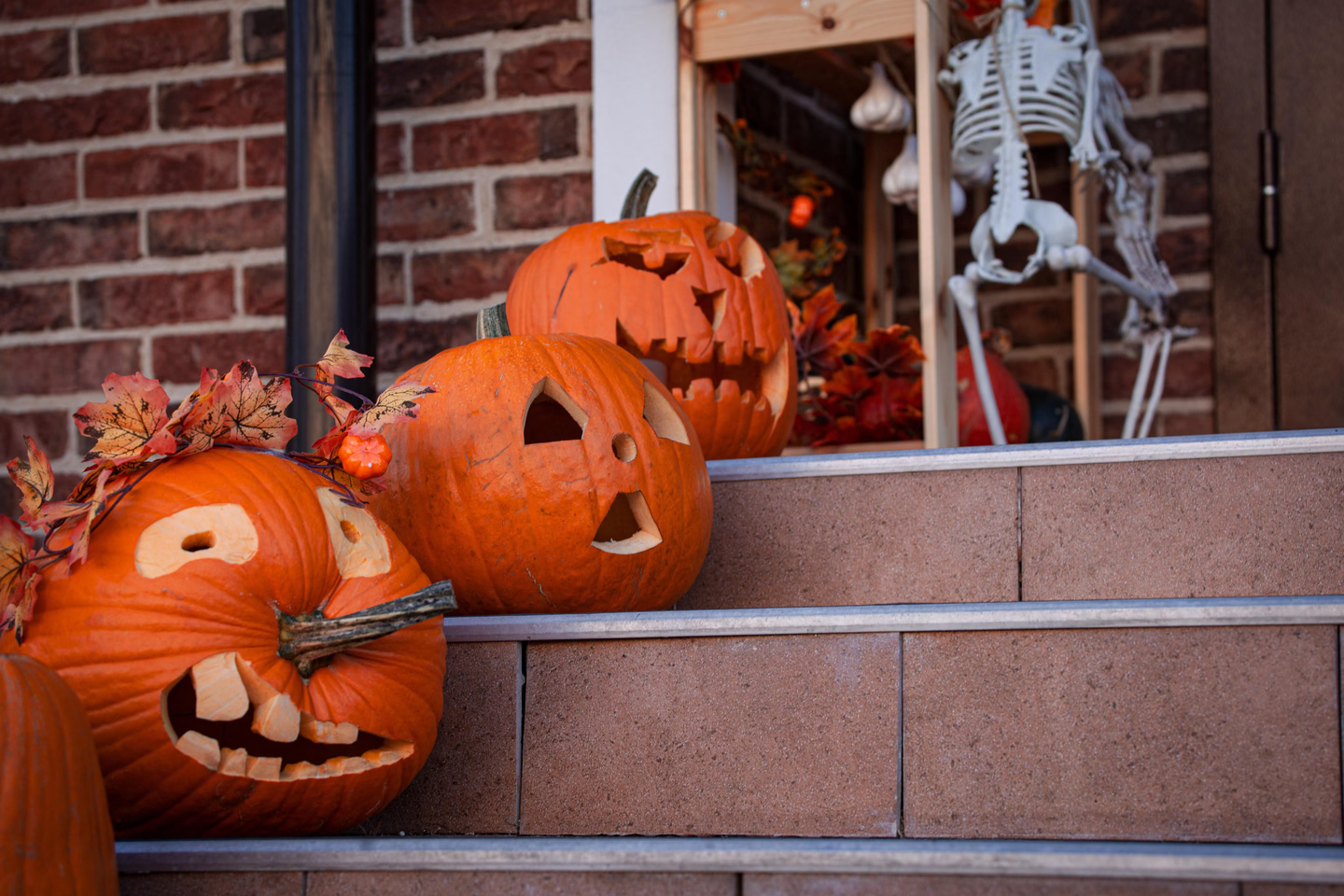
Falls are already a Halloween injury. The CPSC’s estimate of 3,200 Halloween-related emergency room visits a year puts 25 percent down to “falls while putting up or taking down decorations, tripping on costumes or walking while trick-or-treating,” and it asks hosts to “remove obstacles from lawns, steps and porches when expecting trick-or-treaters” (CPSC). On the route to your table:
- Lips and thresholds. “Changes in level can be up to ¼″ without treatment or ½″ if beveled with a slope no steeper than 1:2. Changes in level above a ½″ must be treated as a ramp or curb ramp” (Access Board, surfaces). A raised edge where the walk meets the driveway, or the threshold at a front door you want people through, is where a rubber threshold ramp earns its place.
- Cords, stakes and guy lines go under a cover or off the route.
- Leaves get swept before dark and again partway through the night.
- Fog stays off the walk. It hides every one of the items above.

EZ-ACCESS TRANSITIONS Angled Entry Mat, Black, 1 Inch
A recycled-rubber threshold ramp for a raised doorway or an offset where two surfaces meet. EZ-ACCESS makes it from 1/2 to 2-1/2 inches in quarter-inch steps and says it can be trimmed or notched to fit, with anchoring hardware included. Measure your lip first and order that height; it's for a threshold, not a step.
EZ-ACCESS rates the mat at “850 lbs.” and describes it as “naturally slip-resistant” (EZ-ACCESS). Its own product page showed a regular price of $50 for the default size; Amazon prices vary by height.
What hangs over the path
A white cane sweeps low. The Access Board guide on protruding objects: “People with vision impairments often travel closely along walls which can provide wayfinding cues sometime called a ‘shoreline.’” And: “Those with leading edges that are within cane sweep (27″ high maximum) or that provide minimum headroom clearance (80″ minimum) do not pose hazards and can protrude any amount” (Access Board, protruding objects).
So a tombstone, a pumpkin or a crate on the ground is found by the cane. A ghost hung from the porch ceiling at 5 feet, a bat on fishing line, a dangling spider or a sagging cobweb strand is not. Everything between 27 and 80 inches above the walk either goes higher than 80 inches, comes down below 27, or moves off the path. Objects on posts with leading edges in that band “cannot protrude more than 12″ into circulation paths,” and the guide limits how far anything mounted on a wall can stick out. A skeleton arm reaching off the porch rail into the walk is exactly what it’s describing.
The porch railing and the house wall are the shoreline. Keep props off the stretch of it that leads to your table.
Light the Way, Not the Strobe
A moody porch works against kids with low vision. MedlinePlus lists “Night blindness (not being able to see in low light)” among the common types of low vision, and its tips for anyone with some vision include “Brighter lights” (MedlinePlus). The National Eye Institute puts it as “Use brighter lights at home or work” (NEI).
That doesn’t mean floodlighting the display. Light the path and the candy table with steady warm white, and keep the colored uplights, the orange bulbs and the dark corners behind it, on the scenery. Our porch guide now makes the same exception to its swap-the-bulb advice.
Check every path light’s modes before you stake it. Plenty of solar Halloween stakes ship with several modes, some of them flashing, and cycle through them each time you press the switch. For the route itself, we pick lights that only do steady-on. Solar path lights are markers, not illumination: they show where the edges are. Light the walk and the candy table itself with a steady porch light or a plug-in flood aimed down at the path.

DOESLAG Solar Pathway Lights, Warm White, 12 Pack
Edge markers for the walk. The listing claims 3000K warm white and 'Steady Dusk-to-Dawn Lighting' with 'no extra modes or settings to manage,' so nothing on the path can end up flashing. It also lists a maximum of 10 lumens per light, so they mark the edges without lighting the walk: pair them with a steady porch or flood light. At 16.22 inches tall with the stake, per the listing, they sit well inside cane sweep.
Strobes, flicker and the trick-or-treat age range
The Epilepsy Society: “Most people who develop photosensitive epilepsy are between the age of 7 and 19 years old,” and “Between 3-30 hertz (flashes per second) are the common rates to trigger seizures” (Epilepsy Society). Epilepsy Action gives “between 10 and 25 flashes per second” as the most likely range, and flags light that “Takes up at least 10% of the area that you can see” and “Lasts for at least half a second.” Its list of everyday triggers includes “Sunlight through trees, hedges, or railings, especially if seen from a moving vehicle” (Epilepsy Action). A strobe or flicker bulb behind porch balusters chops into the same kind of bars, in our reading.
Our rules for the approach: no strobes, no flicker-flame bulbs, no lightning effects and no color-cycling lights on the route or pointed at it. If you run an effect elsewhere in the yard, put a sign at the start of the walk and a way around it, as in our haunted hallway guide. Our lightning effects guide covers flash rates and burst lengths in detail. If a child is caught by a flash, Epilepsy Action’s advice is to “Cover one eye with the palm of your hand straight away.”
Quiet Hours and a Gentle Mode
Some kids come up the walk with no interest in being scared. The CDC’s list of characteristics seen in autistic children includes “Has unusual reactions to the way things sound, smell, taste, look, or feel,” “Gets upset by minor changes” and “Lack of fear or more fear than expected,” with the caveat that “children with ASD may not have all or any of the behaviors listed as examples here” (CDC). CDC’s monitoring network puts it at “About 1 in 31 (3.2%) children aged 8 years” (CDC data). MedlinePlus adds that autistic people “may also have difficulty tolerating sensory stimuli such as loud noises or bright lights,” and that “Some people with ASD do not speak at all, while others use language fluently” (MedlinePlus Genetics).
What we do with that:
- Run a quiet first hour. Fog, sound, jump-scare animatronics and lighting effects stay off from dusk until the littlest kids have been round, then come on. Post the time on your sign.
- Give yourself a gentle-mode switch. Put the loud props on one smart plug or a power strip at your chair, so you can kill them when you see a kid hanging back at the curb, and bring them back after.
- Don’t make anyone say “trick or treat.” A kid who holds out a bucket and says nothing gets the same candy as the loudest pirate.
- You may see a blue bucket. Some families use one as a signal that their child may not talk. Our view is simpler: treat every quiet kid that way, so nobody needs a bucket color to get patience.
- Talk to the kid, not the parent, and keep it short: “Take one” or “Candy or a toy?”
The Teal Bowl and Allergy-Safe Handling
FARE’s Teal Pumpkin Project asks households to put out non-food treats and a teal pumpkin: “Place a teal pumpkin in front of your home to indicate to passersby that you have non-food treats available.” It says “one in 13 children has a food allergy,” and asks you to keep “your food treats and non-food treats in separate bowls.” Two more points from the same page: “some brands of moldable clay contain wheat,” and “try to choose latex-free items, as there are children who have latex allergies” (FARE). FARE also lists who else it helps, including children with diabetes, celiac disease and feeding tubes.
FARE’s own ideas list includes “Whistles, kazoos, or noisemakers” and “Coins.” We skip both. Noisemakers undo the quiet hour above, and the FDA’s Halloween advice for parents of very young children is to “remove any choking hazards such as gum, peanuts, hard candies, or small toys” (FDA). Stickers, glow sticks, pencils, bookmarks and mini notepads are all on FARE’s list, but not all of them suit every age. The glow sticks below carry a manufacturer’s recommended age of 3 years and up, and pencils are no toddler treat either, so keep stickers in the bowl for the littlest kids and hand the rest to older ones.

Teal Pumpkin Trick or Treat Bucket, 8.5 Inch
An 8.5-inch plastic teal pail. On the candy table it's the second bowl FARE asks for, and its color marks the non-food side from the sidewalk.

Greingways Halloween Pumpkin Stickers, 300 Pieces
Three hundred stickers at about 2 cents each, from FARE's own list of non-food treats. The listing disagrees with itself on material (the bullets say vinyl, the spec table says paper), and it says nothing about latex, so check the adhesive if a latex allergy is in your house or on your street.

JOYIN Glow Sticks Party Pack, 100 Count
Glow sticks top FARE's non-food list, and the CPSC says carrying one can help brighten the walkways for trick-or-treaters. The pack comes with connectors for bracelets and necklaces; those are small, so hand connectors only to older kids.
For the candy bowl: the FDA says allergen labeling shows the allergen in parentheses after an ingredient or in a “contains” statement. It calls “may contain” and “produced in a facility” lines advisory statements, and adds: “Such statements are not required by law” (FDA). No “may contain” line doesn’t mean no cross-contact. Hand out only commercially wrapped treats, in the original wrappers, so a parent can read them. Our candy planning guide covers allergy-friendly candy and how much of the teal bowl to stock.
Kids Who Hear or See Differently
A deaf kid won’t hear “come on up” from a dark porch, and a mask hides your mouth. The National Institute on Deafness and Other Communication Disorders notes that “ASL is a language completely separate and distinct from English,” that “ASL users ask a question by raising their eyebrows, widening their eyes, and tilting their bodies forward,” and that “9 out of 10 children who are born deaf are born to parents who hear” (NIDCD). So a kid may use ASL, lip-read, use a hearing aid or implant, or none of these, and the parent may not sign.
- Face the kid, with your face lit and your mask pushed up. A raised eyebrow and a tilt toward the bowl reads as a question.
- Point and hold out the bowls. A card on the table with “Candy” and “Toys” over the two bowls answers the only question that matters.
- Don’t rely on a sound cue to tell kids a prop is about to move.
For kids who are blind or have low vision, MedlinePlus separates blindness, “you have lost all or most of your sight,” from low vision, where “you have some vision, but the vision loss makes it hard to do everyday activities” (MedlinePlus). Since MedlinePlus defines blindness as losing “all or most” of your sight, many kids who are called blind may still see some light and contrast. So on the porch:
- Say what’s in the bowls and bring the bowl to their hands.
- Use a bowl that contrasts with the table: a white or teal bowl on a black cloth, not a black cauldron on a black cloth.
- Let them take their time. Feeling for a favorite is fine.
Signs That Say What to Expect
A sign at the end of the walk lets families decide before they commit: “Candy table at the bottom of the steps,” “Flashing lights on the porch: go right for the quiet table,” “Teal bowl: no food,” “Quiet hour 6 to 7.”
The Access Board’s sign guide is written for permanent building signs, but its rules for reading them apply here (Access Board, signs). Characters must be “conventional form (prohibited: italic, oblique, script, highly decorative or other unusual forms),” with “Light-on-dark or dark-on-light contrast between characters and the background” and a “Non-glare finish.” That rules out the dripping and scratchy Halloween fonts, including Creepster, which we use on some of our own printables. Save those for the decorative signs. For a sign that tells people something, use plain bold lettering, black on white.
Size scales with distance. The guide’s minimum is “5/8″ + 1/8″ per foot of viewing distance above 6’,” so a sign meant to be read from 15 feet needs letters at least 1-3/4 inches tall. We go bigger than that for a dark yard.

IKAYAS Blank White Yard Signs with Stakes, 18 x 24 Inch, 2 Pack
Two white corrugated plastic blanks with metal stakes, for the plain black-on-white information sign. Print large bold letters and mount them, or letter them by hand with a wide black paint marker. Corrugated plastic also has a sheen, so stand the sign where the path lights won't glare off it.
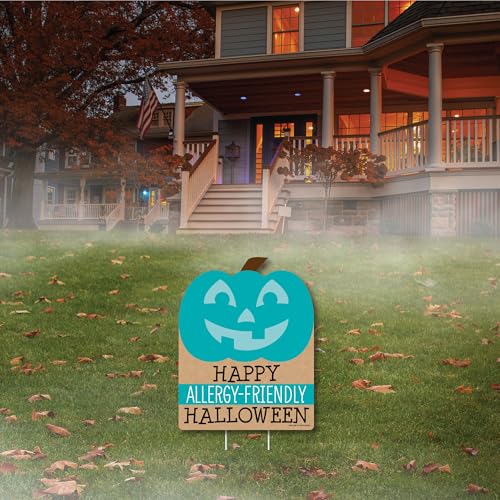
Big Dot of Happiness Teal Pumpkin Yard Sign
A printed teal jack-o'-lantern on corrugated plastic with two stakes. The pumpkin reads from the street; the small lettering on its kraft-colored panel doesn't, so pair it with a plain sign.
Weatherproofing, lamination and H-stakes are in our guide to yard signs that survive a month outdoors.
Costumes Built Around Chairs
Some of the best costumes on any street are built around a wheelchair: a pirate ship, a car, a dragon. Magic Wheelchair describes itself as “a nonprofit organization that builds epic wheelchair costumes,” and builds them “at no cost to families” (Magic Wheelchair).
When one rolls up, compliment the costume the way you would any other. The CDC’s language guide asks us not to portray people with disabilities “as inspirational only because of their disability,” and lists “Has overcome his/her disability, is courageous” among phrases to avoid. “Awesome ship” is the right response. “You’re so brave” isn’t.
Setup Checklist
A week out
- Pick the candy station: bottom of the steps, driveway or end of the walk, on concrete or asphalt.
- Plan the bowl at the table’s front edge, rim between 20 and 36 inches off the ground.
- Measure any lip or threshold on the route; anything over 1/2 inch needs a threshold ramp or a different route.
- Check every path light for flashing modes.
- Buy non-food treats without noisemakers, coins or small toys, and read labels for latex and wheat.
- Make the information sign in plain bold black-on-white letters.
Setup day
- Clear a 48-inch path, 36 inches at the narrowest pinch.
- Leave a 5-foot square open in front of the table.
- Move every hanging prop above 80 inches, below 27, or off the path.
- Pull railing and wall props back from the route.
- Run or cover cords; pull stakes and guy lines off the walk.
- Light the path and table steady warm white; aim colored lights at the scenery.
- Take strobes, flicker bulbs and lightning off the approach, or sign a way around them.
- Put effect props on one switch within reach of your chair.
Halloween night
- Sweep leaves before dark and again partway through.
- Fog, sound and scares off for the quiet hour.
- Two bowls: candy and teal, with a “Candy / Toys” card.
- Mask up on your head, face lit, talking to the kid.
Frequently Asked Questions
Should I set out a portable ramp for trick-or-treaters? Usually not. One porch step needs about 7 feet of ramp at the ADA’s 1:12, and the EZ-ACCESS SUITCASE instructions say to use the ramp only with a qualified helper and a lap belt, anchored, and never covered in leaves. Put the candy at the bottom of the steps instead.
Does the ADA apply to my front porch? No. The ADA Standards cover public accommodations and public facilities, not a private home’s porch on Halloween. We use the Access Board’s numbers as a practical yardstick.
How high should the candy bowl be? The Access Board’s advisory reach range for children runs from 20 to 36 inches for ages 3 and 4, reaching to 44 inches by ages 9 to 12. Put the bowl at the front edge of the table with its rim between 20 and 36 inches, so the youngest trick-or-treaters can reach in.
Which Halloween decorations are hardest for a kid with a cane? Anything hanging or sticking out between 27 and 80 inches above the path: ghosts from the porch ceiling, bats on line, cobweb strands and props reaching off a railing. A cane finds things on the ground.
What goes in the teal bowl? Non-food items from FARE’s list, such as stickers, glow sticks, pencils and bookmarks. Skip noisemakers and coins, choose latex-free items and avoid moldable clay that may contain wheat.
Related Resources
For the teal bowl’s numbers and allergy-friendly candy, see how much Halloween candy to buy. The Halloween party safety guide covers trip hazards and allergies once guests are inside. Keep the porch display behind your station with the porch decorating guide, and plan lighting for the whole walk with the outdoor decorating guide.