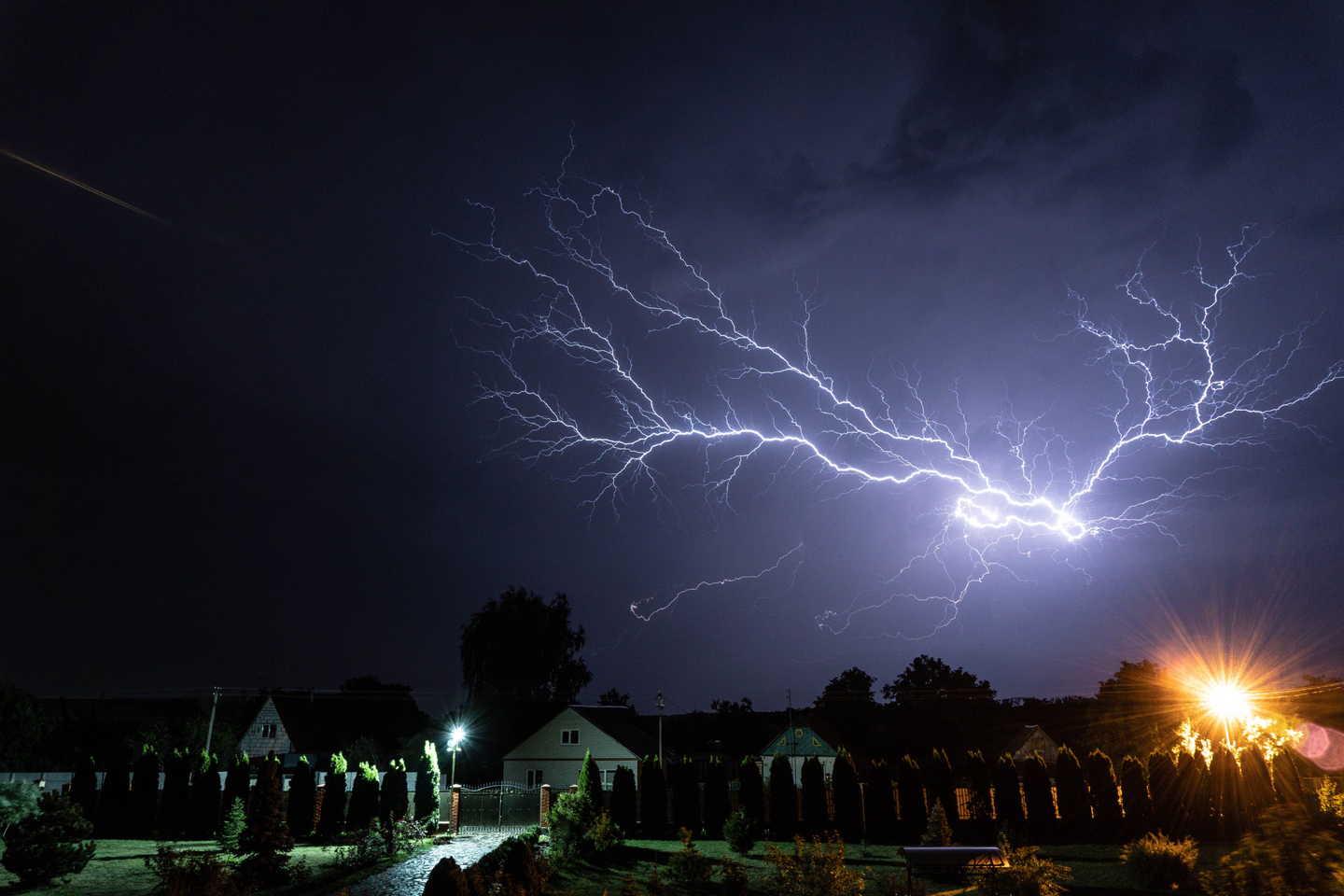
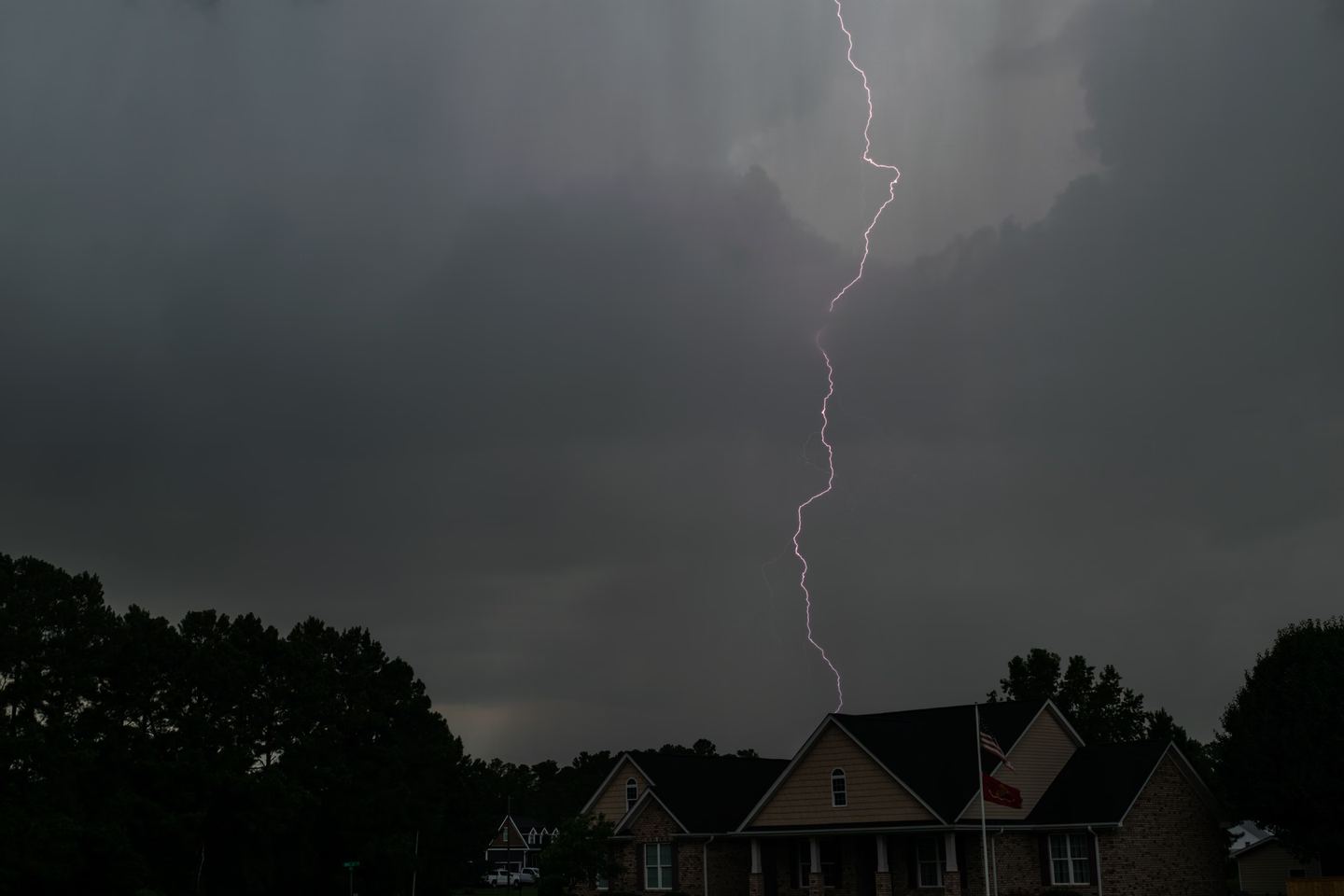
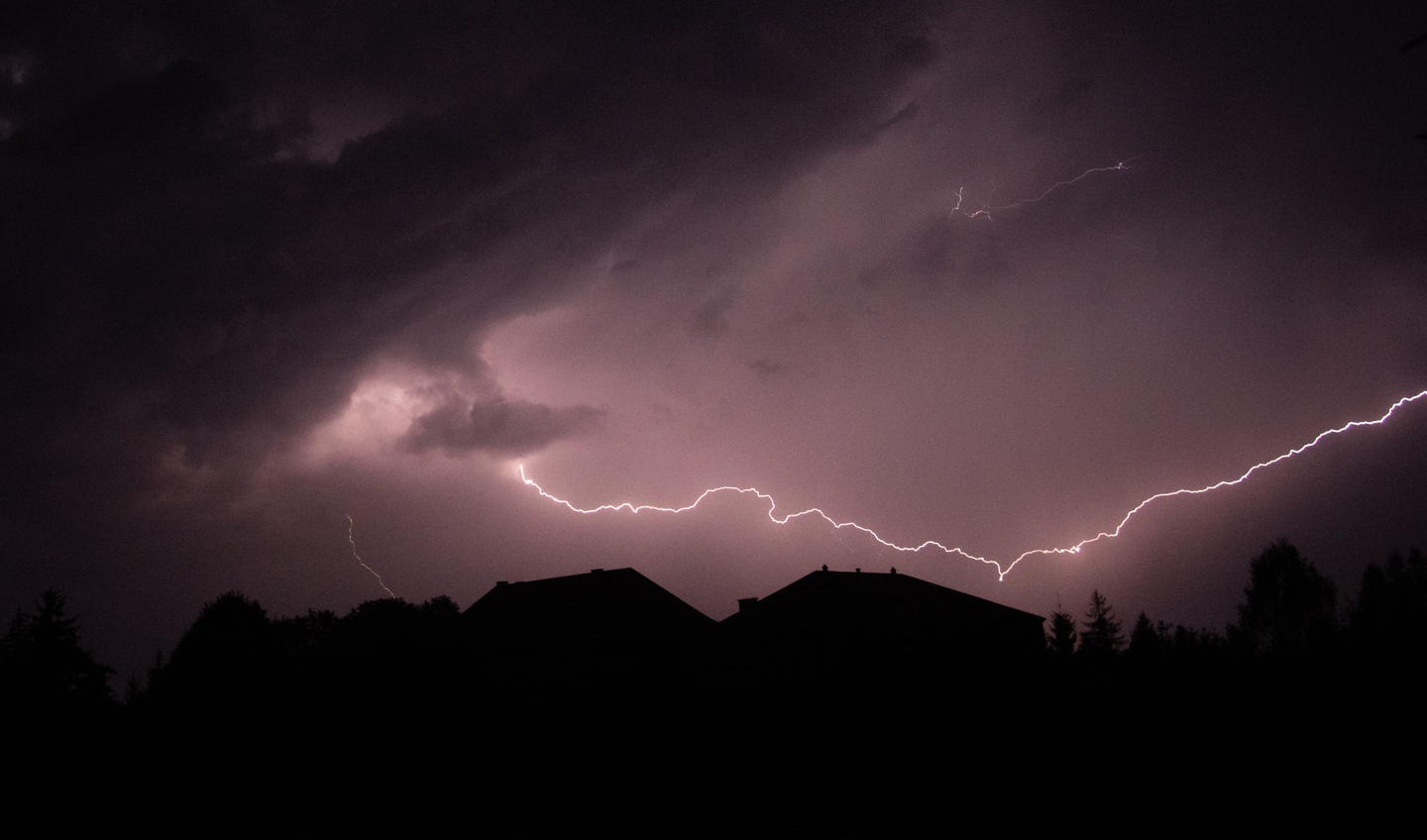
Most fake lightning is a strobe blinking at a steady rate, and it looks like a strobe blinking at a steady rate. Real lightning is irregular. A flash comes in a stuttering burst, then nothing for a while, then a rumble that arrives late.
What Real Lightning Looks Like
The National Weather Service’s lightning science pages describe a flash as several events stacked together:
- It flickers. “Typically, a negative flash of lightning will be comprised of an initial stepped leader/return stroke followed by 2 or 3 subsequent dart leaders/return strokes,” and “Multiple return strokes will cause the lightning to flicker.” Some flashes have “more than a dozen return strokes” (NWS, dart leaders).
- It’s fast. “All of this happens in a fraction of a second,” the same page says, and it “cannot be discerned by the human eye which is overwhelmed by the bright return stroke.” NOAA’s JetStream adds that after a return stroke “there is a pause of about 20 to 50 milliseconds” before the next leader, and that each later stroke usually carries less current and lasts less time than the first (NOAA JetStream).
- Some of it glows instead. Flashes with continuing current “give the appearance of a continuously illuminated channel, as opposed to flickering.” The NWS says these are “sometimes referred to as hot lightning,” and return-stroke-only flashes are “cold lightning” (NWS, continuing current).
Then the sound. The NWS is specific about what thunder tells you (NWS, thunder):
- “A sharp crack or click will indicate that the lightning channel passed nearby. If the thunder sounds more like a rumble, the lightning was at least several miles away.”
- “It takes the sound of thunder about 5 seconds to travel a mile.”
- Thunder “can be heard for a distance of only about 10 miles.”
For a haunt, that means:
- Flash in bursts, not a beat. Two to four quick pops, then darkness for seconds. Pops that close together flicker at the rates epilepsy charities flag as seizure triggers, so read the photosensitivity section before you copy nature exactly.
- Mix in a longer glow now and then. A flash that swells and holds for a moment is the “hot lightning” the NWS describes.
- Match the timing to the sound. A crack arrives with the flash. A rumble comes several seconds after it, so for distant thunder the flash should lead.
Most sound-activated controllers get the third one backwards for a rumble. They fire the lights from the thunder track, so light and sound always land together, which is what a nearby strike looks like. That’s fine for cracks. For a rolling rumble, you need a controller with a delay, a sequenced show, or a track built with the gap already in it (see thunder audio below).
Controllers, From Cheap To Serious
A lightning controller is a box that switches or dims plug-in lights in time with a sound or a program. The tiers below run from a battery kit to a pro unit. Every spec is the maker’s own claim.
Battery kits and “thunder strobes”
The least expensive option is a battery strobe with a thunder speaker built in. The ones we checked on Amazon were out of stock, and a unit like this flashes at whatever rate its knob sets, so it’s a blinking light with a soundtrack.
A small LED effects kit gets closer to real lightning, because it runs patterns instead of a steady rate:

Prop And Scenery Lights Storm Lightning Simulation Light Kit, 9 Volt
Three small 7800 K cool-white LED heads on a splitter, driven by a controller with six flash patterns, three speeds and a loop mode that runs through all six. Runs on a 9-volt battery. The listing says it's for small props and dioramas, and the beams are narrow, so it suits a window box, a cloud prop or a shelf scene, not a whole room.
Perfect Storm 2.0: the sound-activated box
Morris Costumes’ Perfect Storm 2.0 plugs into the wall, and your lights plug into it. Its instruction sheet says:
- Plug it “into any 15 amp. 120 volt outlet.”
- “It is important the total lights you are using DO NOT exceed more than 1000 watts of power.” Go over and “a reset fuse in the back… will trip.”
- There are two ways to feed it sound. Put one speaker “next to the external microphone” (the second speaker “can be placed across the room, or even outside, with the sound on that speaker at a higher volume”), or run a 3.5 mm cable from a phone or MP3 player into its audio input, which disables the microphone. The cable isn’t included.
- A round sensor knob on the front sets how readily the lights fire.
The manual also says you can run “other music or party CD’s” through it, which tells you what the microphone is: a sound trigger, not a thunder detector. That’s our inference, but it follows. In a loud party room, use the cable input so guests’ screams don’t fire the lights.

Morris Costumes Perfect Storm 2.0 Lightning and Thunder Effects Machine
Flashes up to 1,000 watts of lights in time with its thunder CD (over an hour of effects, per the listing) or any audio you feed it by microphone or 3.5 mm cable. The listing says it works with incandescent and LED lights, is not recommended for fluorescents, and is for indoor use.
A box like this needs a bright light to switch. A halogen work light is the usual partner, and two 500-watt lamps is the Perfect Storm’s limit. Halogen lamps run very hot, so aim them at a ceiling or wall with nothing flammable nearby, and never tuck one behind a curtain.

Rocky Mountain Goods 500-Watt Halogen Work Light with Stand
A 500-watt halogen flood on a stand, with tempered glass, a wire lens guard and a 5-foot cord. Halogen is an incandescent lamp, which is what the dimming controllers below were built around. One of these uses half a Perfect Storm's 1,000-watt budget.
FireFly FF-151 and PicoStorm: haunt-grade dimmers
The next step up dims the lights in proportion to the sound instead of just switching them, which gives the flicker a shape.
Lights Alive FireFly FF-151 ($239, sold direct per Lights Alive’s product page). From its manual:
- Maximum power handling: up to 2,000 watts in lightning mode and up to 1,000 watts in dimming mode.
- Electrical requirement: “120 volts, 60 Hz, up to 20 amps (depending on lights connected).” A full 2,000-watt load is more than a 15-amp household circuit carries, so size the lights to the outlet, not the box.
- “Even though this is a single channel device, you should ALWAYS USE STEREO CABLES.”
- LEVEL: “If it is set too low, sound will not trigger ‘lightning’. If it is set too high, the lights will be on constantly during most ‘lightning strikes’.” THRESHOLD: “Set too high, the lights will always glow.” The manual’s method: turn it up “until your lights just begin to glow, then back it down a step or two.”
- A dimming mode “is used when you wish to simulate a power failure,” so the room’s lamps can sag during a strike instead of flashing.
The product page says the box includes the manual and a thunder CD “composed by Virgil Franklin,” and that manuals, audio tracks and bonus music also come on a USB flash drive.
Fright Ideas PicoStorm ($239.99, sold direct by its maker, per Fright Ideas’ product page), a PicoFX preloaded with a thunder and lightning scene. From Fright Ideas’ PicoFX Quick Start:
- The label reads “POWER INPUT: 120V, 60HZ, 10A MAX. OUTPUTS: 500 WATTS MAX EACH, INCADESCENT ONLY!” (their spelling), with two outputs and an internal 10-amp fuse.
- Audio is MP3 on an SD card that “must be 32GB or less and formatted FAT16 or FAT32,” out through a line-out jack to powered speakers.
- It has a trigger input for a motion sensor, and PIR sensors “can take up to a minute to ‘warm up.’”
- “USE ONLY THE ORIGINAL 10 AMP POWER CORD.” Other cords “may fit, but if they aren’t rated for 10 amps they could catch on fire!”
FireFly FF-371: the one that can delay the flash
The FF-371 ($649 on Lights Alive’s product page, listed out of stock with more promised before Halloween) is Lights Alive’s three-channel unit: two lightning channels plus a dimmer, “a maximum of 3,000 watts” (again, more than one household circuit carries, so size the lights to the outlet), built-in audio, and “both timed and random” triggering. It’s the only controller here whose maker says “the lightning flash can precede the thunder as in real life.” Its “hysteresis” setting adds “a selectable delay on the decay of the LED,” so an LED fades over a few milliseconds instead of snapping off. Lights Alive recommends its own ProLight 400, an LED it says it “designed specifically for lightning simulation.”
LED or halogen? It depends on the controller
The makers disagree, and each is describing its own hardware:
| Controller | What its maker says about LEDs |
|---|---|
| PicoStorm / PicoFX | “We do NOT recommend using LED lights. They do not dim fast enough.” The Quick Start adds: “Dimmable LED bulbs almost always look horrible.” Incandescent only |
| FireFly FF-151 / FF-371 | Supports incandescent, halogen and “many dimmable LEDs,” and recommends its own ProLight 400 |
| Perfect Storm 2.0 | Listing says incandescent and LED compatible, not recommended for fluorescents |
On a PicoStorm that means halogen. On a FireFly, a dimmable LED can work, and the ProLight is the maker’s pick. Fluorescents are where the manuals differ most. The PicoFX sheet says fluorescents and other non-dimmable loads on its dimming outputs “may damage the PicoFX or your device,” and can only be run with an output set to ON/OFF, which won’t flicker. Lights Alive lists “some dimmable compact fluorescent bulbs” as supported. The Perfect Storm listing doesn’t recommend fluorescents. Our own caution: for lightning, skip fluorescents entirely.
Pro strobes: ADJ Mega Flash DMX
A xenon strobe is brighter than any of the above, and it can be a lightning source if something else decides when it fires. ADJ’s Mega Flash DMX is an “800W” strobe, per ADJ’s product page, with two DMX channels (speed and dimming) and a built-in microphone for sound-active mode. The manual gives a “flash rate range of 1 to 15 flashes per second” and three rules worth knowing before you plan a four-hour night:
- Duty cycle: “the unit should not run for 15 minutes continuously. After 15 minutes of continuous use, allow the unit to cool for about fifteen minutes.”
- “This unit is intended for indoor use only, use of this product outdoors voids all warranties.”
- “Allow about 6” (15cm) between this device and a wall.”
Left on its own speed knob, it’s a steady strobe. Drive it from a DMX program (see xLights) so it fires in irregular bursts.

ADJ Mega Flash DMX Strobe Light
ADJ rates it at 800 watts (the Amazon title says 750 W; the maker's page, manual and the listing's own bullets say 800). Two DMX channels for speed and dimming, 1 to 15 flashes per second, and sound-active mode. Indoor only, and ADJ's manual limits it to 15 minutes of continuous running before a 15-minute cool-down.
Where To Put The Lights
Don’t point a lightning light at people. Point it at a big pale surface and let the bounce do the work.
- Indoors: aim the lamp at the ceiling or a wall. The whole room flashes, nobody gets a lamp in the eyes, and the source stays out of sight. A whole-room flash also fills a guest’s entire field of view, which matters for photosensitive guests.
- In a window: put the light inside, behind a sheer or a light curtain, so the whole window blooms white from the street. This is the easiest setup for an indoor-only controller, because nothing electrical goes outdoors. The window displays guide covers backlighting and silhouettes that pair well with it. Use an LED head here, not a hot halogen.
- Room lamps: on an FF-151 in dimming mode, the house lamps can dip during the storm, the “power failure” effect from the manual.
- Outdoors: keep the controller indoors or in a dry enclosure. Only heads built for weather go outside. Chauvet’s Shocker Panel FX IP, for example, is rated “IP66” with a “0 to 20 Hz” strobe, per Chauvet’s spec sheet (most of that range sits in the seizure-trigger band, see photosensitivity), where the Mega Flash and Perfect Storm are both indoor only.
Thunder Audio
The site’s Sound Mixer includes a thunder loop alongside rain and wind, all from Freesound under CC0. Play it from a phone or laptop, run the headphone output into a controller’s audio input, and the controller will flash on its peaks.
For your own tracks, check the license on each clip. Freesound’s FAQ says that with the “zero” license “you can do pretty much what you want with the sound”; with “attribution” “you should always mention the original creators”; and with “noncommercial” “you can’t earn any money” from what you make. For a nearby-strike crack, Fission9’s Thunderclap is CC0, 13.5 seconds of stereo, recorded, the uploader says, about 1.6 to 1.7 km (about a mile) from the strike, with loud cracking at the start.
Match the track to the timing:
- Crack: flash and sound together. Any sound-activated box does this.
- Rumble: the flash first, the rumble seconds later. With a sound-activated box, edit the track so a short, sharp transient (which fires the lights) comes several seconds before a quiet-onset rumble (which barely does). Tune the controller’s sensitivity so the rumble doesn’t re-trigger it. This is our method, not a maker’s, so test it before guests arrive.
- Speakers: controllers with a line out, like the FF-151 and PicoFX, want wired powered speakers. The FF-151 manual’s rule applies to those cables too: stereo, not mono.
Smart Bulbs
Philips Hue doesn’t have a lightning effect built in. Hue’s iOS release notes list the effects it has added (candle, fireplace, prism, sparkle, glisten, opal, cosmos, underwater, enchant, sunbeam), and none is lightning, thunder or storm. Hue Labs, where Hue’s experimental formulas lived, “closed on June 25th, 2024.” Per Hue’s own notice, automated formulas already installed “continue to run as is, but you won’t be able to edit them,” and “Manually activated formulas are no longer accessible.”
A smart bulb can still hold the cool, dim wash between flashes.
Sequencing A Storm With xLights
If you run DMX fixtures, xLights is the precise option. It describes itself as “a free and open source program that enables you to design, create and play amazing lighting displays through the use of DMX controllers, E1.31 Ethernet controllers and more,” running “on Windows, OSX and Linux,” with “beat-tracking built into xLights.”
In practice that means you load the thunder track, then place each flash on a timeline by hand: a three-stroke burst here, a long glow there, a rumble five seconds behind a distant flash. Nothing fires unless you put it there, so you set the flash rate yourself. You’ll need a USB DMX interface or an E1.31 controller between the computer and the lights, and DMX fixtures such as the Mega Flash.
Photosensitivity: Realism Versus Seizure Risk
Faithful lightning and seizure safety pull against each other. NOAA puts the pause between return strokes at about 20 to 50 milliseconds, so the pops inside a realistic burst come a few tens of milliseconds apart. That’s a flicker rate inside the band the charities below name as the most likely trigger. And bouncing a flash off the ceiling, the placement this article recommends for comfort, lights the whole room, which fills a guest’s entire field of view.
What the sources say:
- Epilepsy Society (UK): around 3% of people with epilepsy have photosensitive epilepsy. “Between 3-30 hertz (flashes per second) are the common rates to trigger seizures,” and lights that flash “between 16 and 25 times a second” are the most likely trigger. It notes the UK Health and Safety Executive recommends strobes “in clubs or at public performances” flash at “a maximum rate of four Hertz” or less, Ofcom limits TV to three flashes a second, and “Christmas lights and strobe lights are not covered by UK law.”
- Epilepsy Action (UK): 3 to 5 in every 100 people with epilepsy are photosensitive. It puts the most likely range at 10 to 25 flashes per second, with some people reacting from 3 up to 60. A flashing light is more likely to trigger a seizure if it is very bright, “Takes up at least 10% of the area that you can see,” and “Lasts for at least half a second.” It singles out changes from strong red to a very different color, like blue.
- Jordan and Vanderheiden (2024), a peer-reviewed paper in ACM Transactions on Accessible Computing (PMC): photosensitive epilepsy affects about 1 in 4,000 people. At 3 Hz only 3% of people with it showed a photoparoxysmal response, rising to nearly 90% at a peak of 16 Hz. The 1997 Pokémon broadcast that sent 685 children to hospital was “A sequence of 12 Hz alternation between large red and blue fields,” a color flicker rather than a white strobe.
None of these sources gives a safe rate for a home haunt. The HSE’s 4 Hz is club guidance, Ofcom’s 3 per second is for television, and Epilepsy Action says some people react at 3. We won’t invent a safe number either.
Our own advice, built on those figures but not taken from any of them:
- Keep each burst well under half a second. That’s the one mitigation with a number behind it: Epilepsy Action lists flashing that lasts at least half a second as a risk factor. Follow each burst with seconds of dark.
- Offer a gentle mode. When guests may be photosensitive, switch to single flashes or the slow “hot lightning” glow, with no multi-pop flicker at all. On a sound-activated box, that means a track of single claps or slow swells; in xLights, it means drawing single flashes.
- No red strobing, and no red-blue cycling. Skip color-changing “lightning” modes on RGB fixtures.
- Warn and give a way around. Post a sign before the room or window with lightning effects, offer a route that skips it, and have a way to switch the effect off fast.
If someone is affected, both charities give the same advice: cover one eye completely with your hand and turn away. Don’t close your eyes; Epilepsy Action says that “could cause a flicker effect.”
Outdoor Electrics
The controllers above are mostly indoor boxes, so the usual outdoor setup is a controller inside and cords running out to weather-rated heads. The CPSC says to “Check outdoor lights for labels showing the lights have been certified for outdoor use and only plug them into a ground-fault circuit interrupter (GFCI)-protected receptacle or a portable GFCI,” and to “Check each extension cord to make sure it is rated for the intended use… Do not use cords with cuts or signs of fraying” (CPSC).
OSHA’s flexible cord guidance explains why the connections matter: “When a cord connector is wet, electric current can leak to the equipment grounding conductor.” It lists the hard-service and junior hard-service cord types (S, ST, SO, STO and SJ, SJO, SJT, SJTO) and recommends watertight or sealable connectors.
A portable GFCI at the indoor outlet protects everything downstream of the controller. The one below is rated 15 amps, which at 120 volts is 1,800 watts, so keep the controller’s total load under that, whatever the box itself can handle:
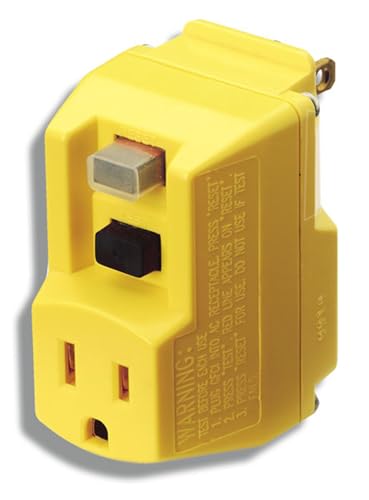
Southwire Portable GFCI Plug, Single Outlet, 120V/15A
A plug-in GFCI adapter, UL listed and CSA certified per the listing, which says it cuts power in 25/1000 of a second when it detects a ground fault. The listing rates it for indoor use, so plug it into the wall inside, then plug the controller into it.
Cord ratings, sealing connections and where GFCIs go are covered in more depth in weatherproofing Halloween decorations.
Frequently Asked Questions
Can I just set a strobe to slow for lightning? No. A fixed rate reads as a strobe. Lightning is irregular bursts with dark between them.
Can I leave a lightning controller outside? Not the Perfect Storm or the Mega Flash, which their makers rate for indoor use only. Keep the box inside and run weather-rated heads out on a GFCI.
Can Philips Hue do lightning? Not in the Hue app. Hue Labs, which had experimental formulas, closed on June 25, 2024.
Related Resources
Plan the rest of the room’s light in the Halloween lighting guide and the Lighting Your Haunt masterclass, including fixture types. For the audio side, the Sound Design for Haunts masterclass covers syncing sound with scares, and the best Halloween sound effects and best Halloween lighting roundups list speakers and fixtures. Build the storm soundtrack in the Sound Mixer, and see window displays for a storm framed in glass.