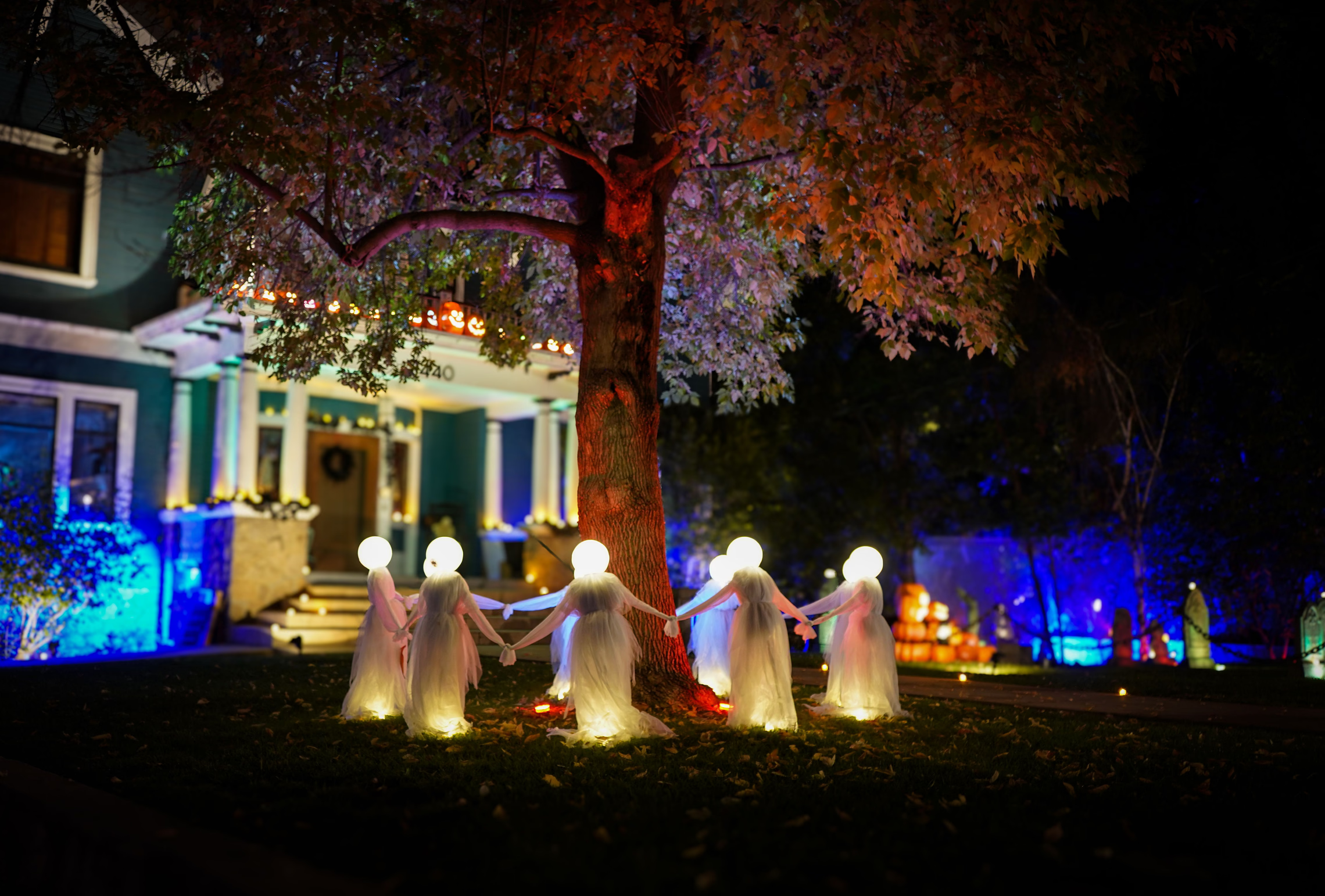
A Halloween display runs into other people’s rules in four places: the HOA’s covenants, sound after dark, light that lands on someone else’s house, and props that spill onto the sidewalk. Each has actual rules behind it, and they are narrower and more specific than most yard haunters assume. The fifth question, how gory is too gory, has no rule behind it at all.
None of this is legal advice. Codes change, and your city and your association’s documents are what apply to you. We quote the text so you can see what it says and go read your own.
HOA Rules: What State Law Protects, and What It Doesn’t
The Census Bureau counted “around 21.6 million of the nation’s 86.6 million owned households” paying a condo or HOA fee in 2024, and Arizona, Florida and Nevada among the states with “higher proportions” of fee payers (Census Bureau, 2025).
Several states limit what an association can ban. We read the statute text for three of the biggest HOA states. None of these sections mentions Halloween or seasonal decorations.
Texas. Property Code §202.018 bars an association from prohibiting “one or more religious items the display of which is motivated by the owner’s or resident’s sincere religious belief.” The association can still ban a religious item that “threatens the public health or safety,” sits on common property, or “contains language, graphics, or any display that is patently offensive to a passerby for reasons other than its religious content.” The flag section is §202.012, which covers the US flag, the Texas flag and armed forces flags (Texas Property Code ch. 202). It was numbered §202.011 when it passed in 2011 and was redesignated in 2013; today’s §202.011 is about roofing shingles.
Florida. Statute §720.3045 says an association “may not restrict parcel owners or their tenants from installing, displaying, or storing any items on a parcel which are not visible from the parcel’s frontage or an adjacent parcel, an adjacent common area, or a community golf course” (Fla. Stat. §720.3045). That protects the backyard nobody can see. A front-yard display is exactly the case it leaves out. The flag section, §720.304, lets a homeowner fly up to two “portable, removable flags, not larger than 4 1/2 feet by 6 feet” from a fixed list: US, Florida, military branch, POW-MIA and first responder flags (Fla. Stat. §720.304).
California. Civil Code §4706 says no governing document can “limit or prohibit the display of one or more religious items on the entry door or entry door frame” (Civ. Code §4706). The companion section, §1940.45, lets the association still restrict items with a combined size “greater than 36 by 12 square inches” and anything “obscene or otherwise illegal” (Civ. Code §1940.45). The flag section, §4705, protects the US flag only, and it specifically excludes a flag “made of lights, paint, roofing, siding, paving materials, flora, or balloons” (Civ. Code §4705).
Our reading: in the Texas, Florida and California sections we read, a secular Halloween display that the street or the neighbors can see has no statutory shield. (Florida’s §720.3045 would cover one tucked away where nobody can see it.) A skeleton, a tombstone or a 12-foot reaper out front is governed by your association’s covenants and rules, like a paint color or a basketball hoop.
What an HOA holiday rule may include
The Community Associations Institute (CAI), a national organization for HOA boards and managers, publishes a guide for boards writing a holiday and religious display rule. It says such a rule “may include the start date and end date of when decorations may be displayed, hours when lights and displays in yards or balconies may be on, and specifics regarding size, sounds, and placement.” Its advice to residents is to “Know your community association’s rule before putting up your holiday decorations and religious displays” and to “Ask your board for clarification if you have a question about the rule” (CAI, Homeowners Guide for Holiday & Religious Displays).
CAI’s Halloween tips for associations name the complaints a board is likely to hear: “Aside from decor, increased crowds, noise, and parking are top safety concerns” (CAI HOA Resources). The same page says to “Refer to your CC&R’s to know the rules on parking,” so if your walkthrough draws cars, check that section too.
What we’d do, in order:
- Read the documents. The declaration (CC&Rs), the rules and regulations, and any architectural guidelines. Search them for “holiday,” “seasonal,” “temporary,” “decoration,” “sign,” “lighting” and “nuisance.”
- Ask in writing if anything is unclear or your display is big, tall or loud. Email the manager or board with dates, hours, and a sketch or photo.
- Keep the reply. A written “yes” from the board is what you point to when a neighbor complains in week three.
Noise: What Cities Actually Limit
“Check your local noise ordinance” is useless advice until you see how different those ordinances are. Here are four, from the city codes.
| City | Rule | When | Measured where |
|---|---|---|---|
| Sacramento, CA | 55 dBA exterior standard; 50 dBA at night | 7 a.m. to 10 p.m.; 10 p.m. to 7 a.m. | On the residential property receiving the noise |
| Los Angeles, CA | Illegal if audible in excess of 150 feet from the property line in a residential zone, or more than 5 dB over ambient on another occupied property | Any time | 150 ft out, or at the neighbor’s property |
| Austin, TX | No sound equipment audible beyond a residential property line; 75 decibel cap on sound audible beyond it | Audibility ban 10 p.m. to 10 a.m. | Audibility at the property line; the code doesn’t say where the 75 dB is measured |
| Phoenix, AZ | No radio or instrument played so as to annoy or disturb people nearby | “Particularly” 11 p.m. to 7 a.m. | No number set |
- Sacramento (City Code §8.68.060) lets the noise exceed the standard for part of each hour: +5 dBA for 15 minutes, +10 for 5 minutes, +15 for 1 minute, and never more than +20. Then every limit “shall be reduced by five dBA for impulsive or simple tone noises, or for noises consisting of speech or music” (Sacramento City Code). Our arithmetic for a haunt soundtrack at night: no more than 45 dBA for more than 30 minutes in any hour, and never above 65 dBA, measured at the neighbor’s. The limits rise if the street is already louder than that.
- Los Angeles (Municipal Code §112.01) covers “any radio, musical instrument, phonograph, television receiver, or other machine or device for the producing, reproducing or amplification of the human voice, music, or any other sound” (LAMC §112.01). Under subsection (b), a thunder track still audible more than 150 feet down the block in a residential zone is a violation.
- Austin (City Code §9-2-5) says “A person may not use sound equipment that produces sound audible beyond the property line of a residence in a residential area between 10:00 p.m. and 10:00 a.m.” A separate section, §9-2-3, bars noise “audible to an adjacent business or residence between 10:30 p.m. and 7:00 a.m.” (Austin City Code ch. 9-2).
- Phoenix (City Code §23-14) lists “The playing of any radio, phonograph or any other musical instrument in such a manner or with such volume, particularly between the hours of 11:00 p.m. and 7:00 a.m., as to annoy or disturb the quiet, comfort or repose of persons” in any dwelling nearby (Phoenix City Code §23-14).
85 decibels is not the neighbor limit
You’ll see 85 dBA quoted as a “safe” or “legal” number. It’s a workplace hearing-damage figure. OSHA’s rule of thumb is that “If you need to raise your voice to speak to someone 3 feet away, noise levels might be over 85 decibels (dBA),” and its permissible exposure limit is “90 dBA for all workers for an 8 hour day” (OSHA, occupational noise). Sacramento’s nighttime limit for music, 45 dBA, is 40 decibels below 85, and decibels are logarithmic.
The same trap runs the other way with props. Our animatronic triggers guide quotes manuals asking for sound “over 90 decibels” to set a prop off. That’s how loud a noise has to be to trigger it, not how loud the prop is.
Distance does more than the volume knob
OSHA: “In open space, for every doubling of the distance between the source of noise and the worker, the noise is decreased by 6 dBA.” Our arithmetic from that rule: a speaker reading 80 dBA at 10 feet is about 74 at 20 feet, 68 at 40 and 62 at 80. House fronts and fences reflect sound, so a real yard won’t follow the curve exactly, but moving a speaker from the property line to the porch and aiming it back at your own house can cut what the neighbors hear as much as turning it down.
To check, measure. NIOSH’s Sound Level Meter app is “Free to download,” “only available on iOS devices,” and “Accurate within ± 2 dBA” (NIOSH SLM app). NIOSH gives no Android version because it can’t verify accuracy across Android phones. Stand at the property line, or better, the edge of the neighbor’s yard, at the hour you plan to shut down.
Sound-activated props are the hard case, because passersby trigger them, not you. The manuals give you almost no way to run them continuously (always-on modes), which also means a thunder box on a sidewalk can fire at 2 a.m. when a dog walker goes by. Put it on a timer that cuts power at your quiet hour. For aiming and placement, see directional audio.
Light: Trespass, Strobes and the Bedroom Across the Street
DarkSky International defines the problem: “Light trespass occurs when artificial light spills beyond the property where it is intended and onto neighboring properties or into natural areas.” Its suggested fixes for a neighbor’s light are “shielding the fixture, redirecting the light, reducing brightness, or adding motion sensors” (DarkSky, my neighbor’s lighting).
Some cities regulate outdoor lighting closely, and their codes show what the concerns are. Flagstaff, Arizona, which its code says became “the world’s first International Dark Sky City” in 2001, has an outdoor lighting code that reads like a list of haunt effects (Flagstaff Zoning Code div. 10-50.70):
- Fixtures “shall be located, aimed, and shielded so that the direct illumination from the fixture shall be confined to the property boundaries of the source.”
- Prohibited: “laser source lights,” and “Any lighting device located on the exterior of a building or on the inside of a window which is visible beyond the boundaries of the lot or parcel with intermittent fading, flashing, blinking, rotating or strobe light illumination.”
- The holiday exception lets “low-Lumen output holiday decorations” run unshielded and all night “from November 15th to January 15th.” October isn’t in that window. Temporary lighting, “for example, holiday decorations,” can be approved by permit.
If your city has no lighting code like this, light is a courtesy question. Our rules for it: aim spotlights into your own facade, trees or ground, never across the street. Then walk to the neighbors’ front windows and look back at your house after dark.
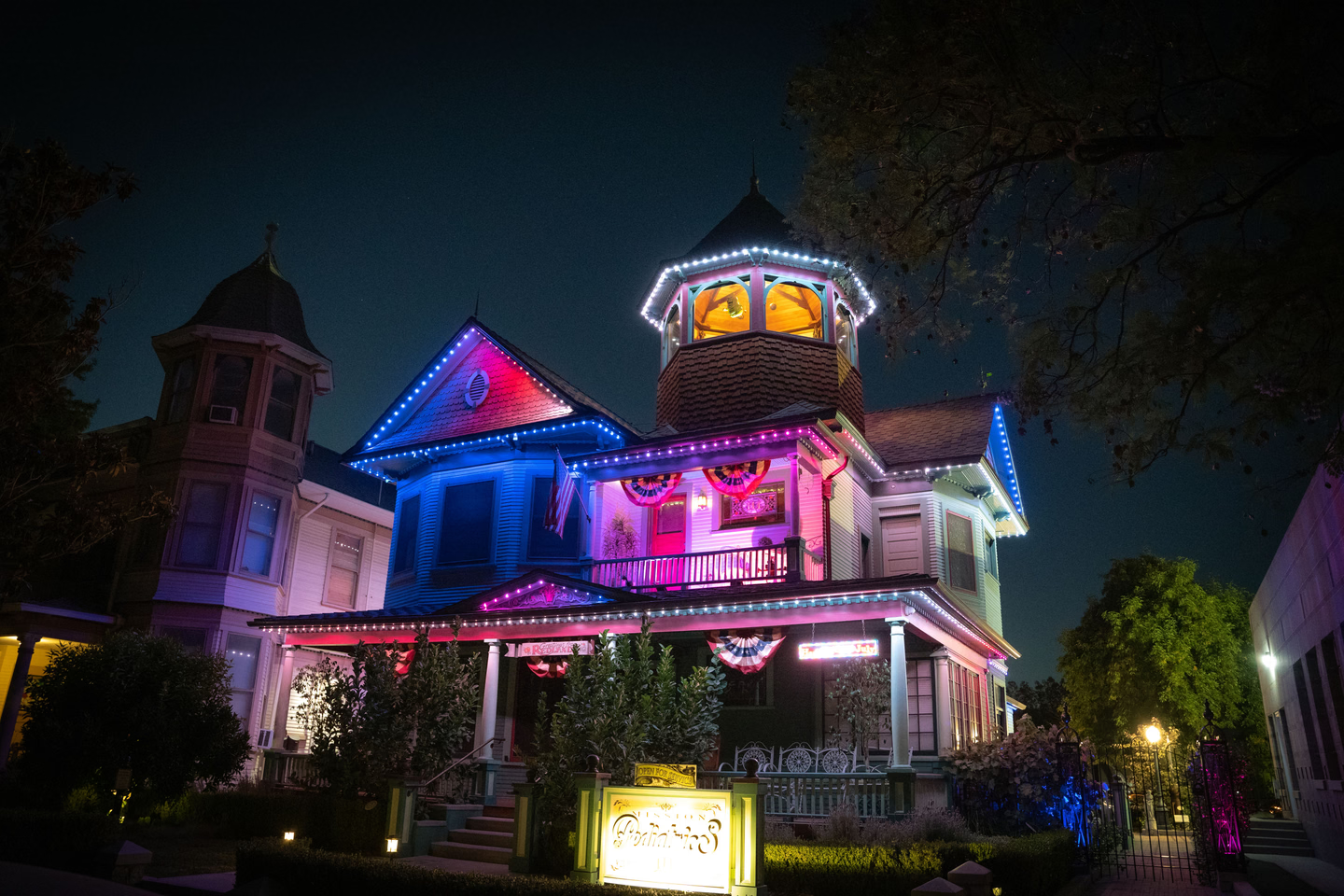
Two effects need more than courtesy, and we’ve covered both already:
- Lasers. The FAA can ask you to adjust or shut off a display that affects pilots, with civil penalties if you refuse. See aircraft, wind and streetlights before any beam leaves your yard.
- Strobes and lightning. Epilepsy Action’s risk factors include a flash that “Takes up at least 10% of the area that you can see.” See photosensitivity. A front window blooming white is seen from the sidewalk and from the houses across the street, by people who never chose to watch it. Our advice: keep street-facing effects slow, or shut them off after trick-or-treat hours.
Sidewalks, Streets and Fog
The sidewalk in front of your house is usually public right of way, not your yard. Sacramento’s code, for one example: “No person shall obstruct, or cause to be or obstructed, any sidewalk by erecting, placing or maintaining signs, posts, structures or other obstructions of any kind.” The city can remove an obstruction “8 hours after notice,” or without notice if it’s “an immediate threat to the public health, safety, or welfare” (Sacramento City Code §12.24.020).
For how much room people need, the US Access Board’s accessibility guidelines for public rights of way say “the continuous clear width of pedestrian access routes shall be 48 inches (1220 mm) minimum” (US Access Board, PROWAG R302.2). That’s a design rule for the agencies that build sidewalks, not a homeowner rule. We use it as the yardstick anyway: if a stroller, a wheelchair or a knot of kids in costume can’t pass with 4 feet clear, the prop is in the way.
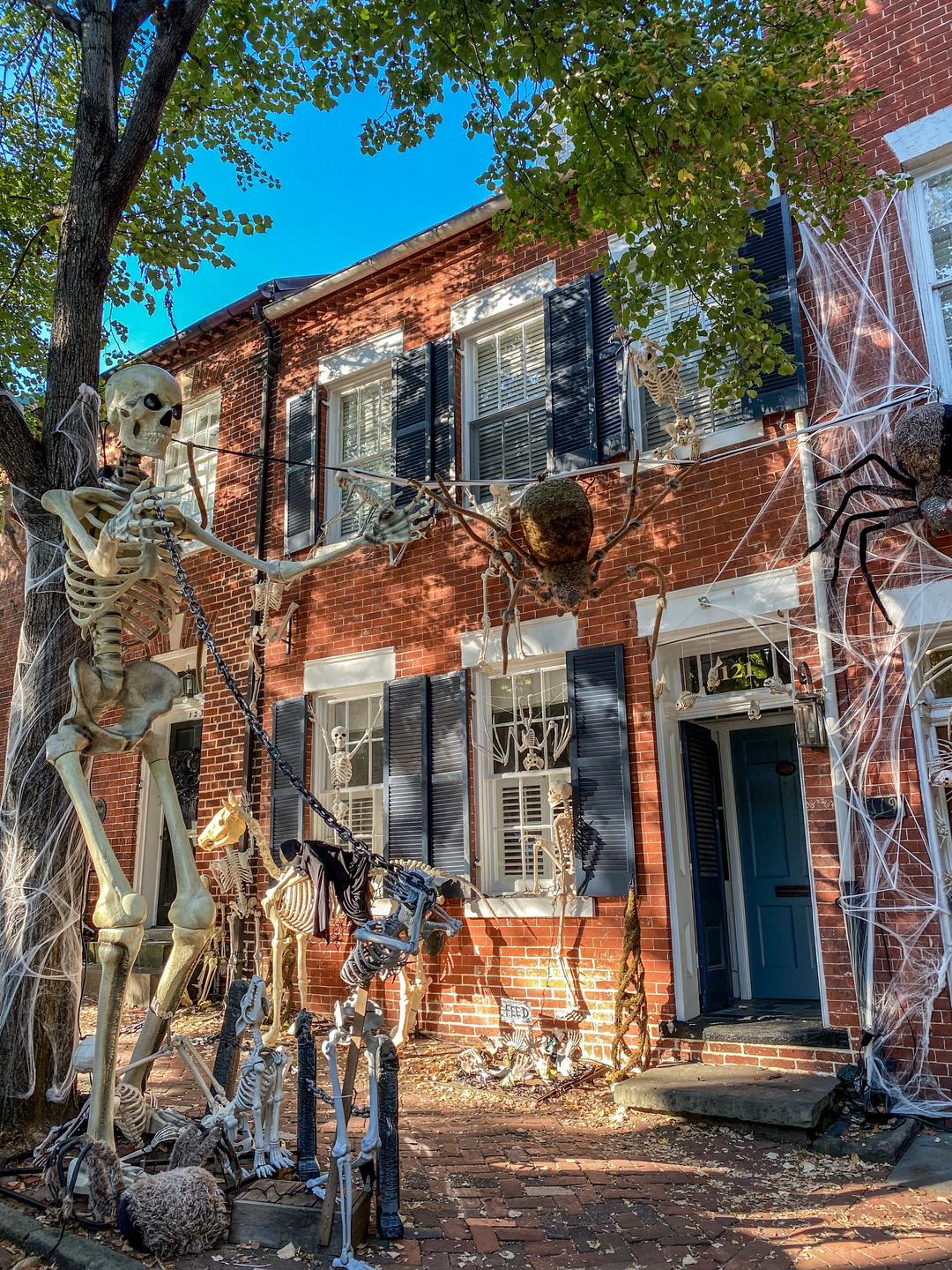
The CPSC’s Halloween advice to “remove obstacles from lawns, steps and porches when expecting trick-or-treaters” applies doubly when the lawn is part of a walkthrough (CPSC, 2022). Cords across the sidewalk are both an obstruction and a trip hazard. Run them on your side.
Fog is the one we see go wrong. No regulator we could find addresses a fog machine’s output drifting over a road, so this is our advice: keep machine fog on your lawn. Place the machine so the wind carries fog away from the street, shut it off if it rolls into traffic, and never run it across a driveway people are pulling out of. Our fog machine beginner’s guide covers placement.
Fire Rules That Double as Neighbor Rules
The best-sourced “lights off at night” rule is a fire rule. The CPSC’s decoration safety sheet says “Turn off all lights on trees and other decorations when you go to bed or leave the house. Lights could short and start a fire.” The same sheet says “Use no more than three standard-size sets of lights per single extension cord” (CPSC, Holiday Decoration Safety Tips). The CPSC also says to plug outdoor lights only “into a ground-fault circuit interrupter (GFCI)-protected receptacle or a portable GFCI” (CPSC, 2013).
Halloween fires cluster in the evening. The US Fire Administration counted an average of about 9,200 fires, 25 deaths and 100 injuries a year over October 30 to November 1 in 2017 to 2019, “peaking from 6 to 7 p.m.” (USFA). That’s trick-or-treat hour, when your yard has the most people in it.
A timer makes the bedtime rule automatic, and a fixed shutoff is also the easiest answer to a neighbor who asks “how late is this going to run?”

BN-LINK Outdoor 7-Day Programmable Timer Outlet, 2 Outlets
Up to 8 on/off programs, set to the minute, so lights and sound can stop at 9:30 on school nights and later on the 31st. A backup battery holds the schedule through a power cut, and it has a weather cover. Plug it into a GFCI-protected outlet.

BN-LINK Outdoor Light Timer, Dusk + Countdown, 2 Grounded Outlets
A dial instead of a program: on at dusk, off after 2, 4, 6 or 8 hours. The listing says to hang it vertically and at least 2 feet off the ground to keep rain out.
For cord gauges and load math, see power and extension cord safety, and for stakes and wind, weatherproofing outdoor decorations.
How Far Is Too Far?
No statute or city code we read sets a limit on gore. The closest language is in the Texas religious-display law, which lets an association ban a religious display that is “patently offensive to a passerby for reasons other than its religious content.” It applies only to religious items. For everything else, the limit is your HOA’s covenants if you have one, and your neighbors’ patience if you don’t.
So this is a norms question, and what follows is our opinion.
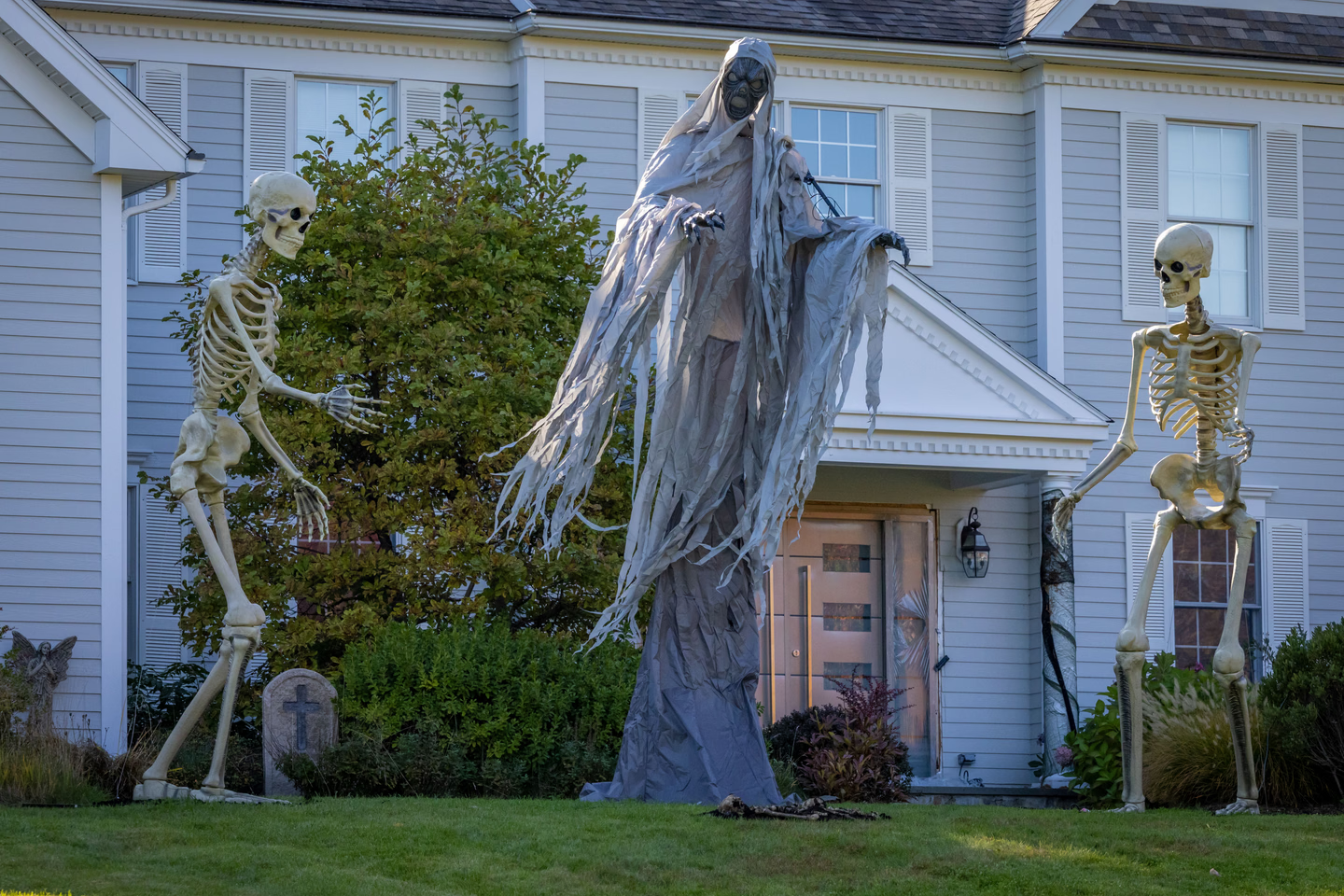
- The front yard is for everyone who walks past. Kids on the way to school see it for a month, not only on the 31st. Skeletons, reapers, monsters, graveyards and fog all belong out front. Graphic gore goes in the backyard, the garage or the walkthrough, where people chose to go.
- Nothing that looks like a real emergency. A body in the street, a “victim” slumped in a parked car, a fake injured person near the curb. Someone driving past at night can’t tell, and a 911 call or a swerve is on you.
- Nothing that looks like a real crime or real people. A generic zombie is Halloween. A scene that reads as a specific real-world tragedy, or as a threat aimed at a neighbor, isn’t.
- Scale the scare to the hour. Jump scares and loud cues during trick-or-treat hours, ambient only after. Our neighbor-friendly versus going all out section has the middle path.
Telling the Neighbors
None of this is required anywhere we looked, but it prevents most complaints before they start. Our version:
- A short note to the houses on either side and across the street: the dates the display is up, the hours lights and sound run, the night of any walkthrough, and your phone number.
- The shutoff time on the note should match the timer.
- If you’re in an HOA, mention that the board approved it, if it did.
The phone number is the part that matters. A neighbor who can text you “it’s a bit loud tonight” doesn’t need to call the city.
Frequently Asked Questions
Can my HOA make me take down Halloween decorations? Usually, if its covenants or rules say so. The sections we read protect religious items (Texas; California, on the entry door), certain flags (all three states), and in Florida, items no one can see from the frontage, neighbors or common areas. A Halloween display the street can see isn’t on those lists.
How loud can my Halloween sound effects be? It depends entirely on your city. Sacramento sets 50 dBA at night, minus 5 for music, measured at the neighbor’s property. Austin bans amplified sound audible past a residential property line from 10 p.m. to 10 a.m. Los Angeles counts sound audible 150 feet from your property line as a violation. Look up your own city’s code by name.
Is there a law about what time Halloween lights have to go off? Not in the city codes we read. Flagstaff’s lighting code lets low-lumen holiday decorations stay on all night only from November 15 to January 15, which leaves out October. The CPSC’s fire-safety advice is to turn decorations off when you go to bed or leave the house, and a timer handles that.
Related Resources
Plan the layout with the yard haunt basics and the Yard Planner. If you’re opening a walkthrough to the public, running a home haunt covers fire marshal permits, the police, insurance and donations. See the outdoor decorating guide for zones and power. The Sound Design for Haunts masterclass and outdoor lighting techniques cover aiming sound and light at your own yard. For keeping props upright and off the sidewalk, see posing life-size skeletons and the front yard graveyard guide, and for the porch itself, jack-o’-lantern fire safety.