Lighting is the single most important element of Halloween atmosphere. Not props. Not costumes. Not fog. Lighting. You can throw a spectacular Halloween party with nothing but good lighting, and you can ruin a $2,000 prop display with bad lighting. This is the hill I will die on.
The difference between “some decorations in a room” and “a room that feels haunted” comes down to where the light falls and what color it is. Everything else is secondary. For an even deeper dive into color theory and fixture types, see our Lighting Your Haunt masterclass series.
Color Theory for Halloween
Colors aren’t just aesthetic choices. They trigger specific psychological responses, and you can use that.
Orange (2200K-2700K warm amber)
Orange is comfort and warmth with an edge. It reads as firelight, candlelight, autumn. This is your workhorse color. Warm amber light makes skin look healthy, food look appetizing, and rooms feel inviting. Use it in social spaces: the living room, the dining room, the bar area. Orange says “this is a party,” not “this is a haunt.”
Purple (405-420nm violet)
Purple creates unease. It’s unnatural. Your brain registers it as wrong for interior lighting because it doesn’t correspond to any natural light source. Purple is excellent for transition spaces (hallways, stairwells, entryways) where you want to signal that something has shifted. It also looks spectacular on fog (see our fog machine beginner’s guide and the fog effects gallery for inspiration).

LOHAS Purple LED Spot Lights, 2-Pack
5W waterproof purple spotlights with dusk-to-dawn sensor. Perfect for uplighting hallways, entryways, or backlighting fog outdoors.
Green (520-535nm)
Green is the color of sickness, poison, and things that glow when they shouldn’t. In small doses, a green uplight behind a prop or under a table creates a “mad scientist” or “toxic swamp” feel. Don’t flood a room with green unless that’s your specific theme, because green light makes food look revolting and people look ill.
Red (620-640nm)
Red is danger, blood, heat. A single red light source in a dark room is immediately threatening. Red is your accent, not your base. One red bulb in a hallway, one red spot on a focal prop, one red-lit window visible from outside. Red light is also gentler on night vision than white, so guests leaving a red-lit space still see fairly well in the dark. If you want them half-blind going into a scare zone, light the room before it bright white instead of red.
Blue (460-480nm)
Cool blue reads as moonlight, cold, death. Blue is an underused Halloween color. A single blue flood behind your house, or blue-tinted light through a window, creates an eerie nighttime-indoors effect. Pair blue with orange for a classic complementary color scheme that feels both warm and unsettling.
Blacklight (UV, 365-395nm)
Blacklight makes white and fluorescent materials glow. Teeth, white shirts, certain paints, tonic water (quinine glows blue), and laundry detergent all react to UV. Blacklight is a party trick, not a primary light source. Use it in one zone (a bar area with your Halloween cocktails, a craft station, a dance floor) for maximum impact.
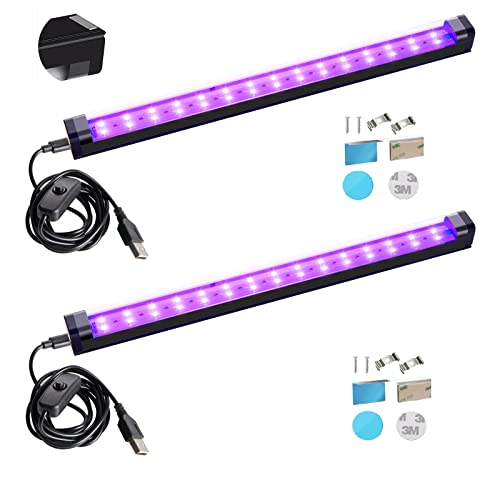
THLITURE Black Light Bar, 10W 1ft, 2-Pack
Compact magnetic-mount UV light bars. Stick them under a bar shelf or behind a prop for an instant blacklight zone without visible hardware.
Bulb Types Compared
| Bulb Type | Pros | Cons | Best For |
|---|---|---|---|
| LED color bulbs (smart) | Millions of colors, programmable, dimmable, cool to touch | Higher upfront cost ($8-15 each) | Living rooms, recurring setups |
| LED color bulbs (standard) | Cheap ($2-5 each), screw into any socket | Fixed color, no dimming | Single-room transformations |
| LED string lights | Versatile, safe, low power | Limited color options per string | Outdoors, table decor, porches |
| Incandescent amber | Beautiful warm glow, cheap | Hot, fragile, higher power draw | Table lamps, low-traffic areas |
| LED candles (flameless) | No flame; moving-flame models swing a plastic flame piece | Most flicker one LED behind a plastic flame; moving-flame ones cost more | Every room, especially around fabric, table settings |
| Color gel filters | Turn any white light colored, pennies per filter | Reduce light output significantly | Spotlights, clip lamps |
| LED flood stakes | Outdoor-rated, bright, focused | Fixed angle, visible hardware | Trees, house facade, yard props |
| Blacklight bulbs/strips | Unique UV effect | Poor general illumination | Bars, dance floors, bathrooms |
Placement Strategies
Where you place light matters more than what color it is. Here are the principles:
Kill the Overheads
This is rule number one. Overhead lighting (ceiling fixtures, recessed cans, fluorescent panels) is flat, even, and completely anti-atmospheric. Turn off every overhead light in your party space. All of them. If you need general illumination, use floor lamps and table lamps set to their dimmest setting with warm or colored bulbs.

Homemory Flickering Flameless Candles, Set of 5
Acrylic LED pillar candles with remote and timer. Realistic flicker mode replaces overhead lighting with atmospheric warmth. Gray finish suits a gothic theme.
Light From Below
Uplighting is your most powerful tool. A light placed on the floor pointing up at a face, a prop, a wall, or a tree creates shadows that fall upward, the opposite of every natural light source humans have ever known. Your brain reads this as wrong, and “wrong” is exactly what Halloween wants. Place LED puck lights or small floods on the floor behind furniture, at the base of trees, and inside foam pumpkins. A carved real pumpkin is wet inside, so it needs a submersible light instead; our jack-o’-lantern lighting guide covers which lights survive a porch night.
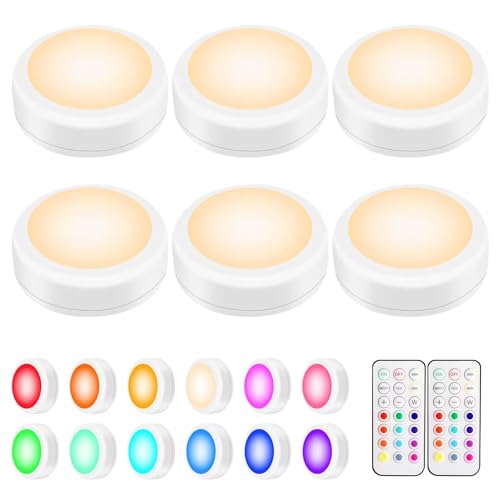
BLS RGB LED Puck Lights with Remote, 6-Pack
Battery-operated color-changing puck lights with dimmer and timer, up to 40 lumens each. Stick them behind props, under furniture, or inside foam pumpkins for instant uplighting. The listing names only indoor spots and gives no water rating, so keep them out of wet carved pumpkins and off open porches.
Use Pools, Not Washes
Don’t light a room evenly. Light specific areas and leave the rest dark. A bright pool of candlelight on a dining table surrounded by darkness is infinitely more atmospheric than the same room with every corner visible. Let guests wonder what’s in the shadows.
Create Depth with Layers
Place your dimmest lights in the foreground and your brightest light source in the background. This creates visual depth and draws the eye through the space. A bright light at the end of a dark hallway, for example, forces guests to walk toward it through shadow.
Backlight Fog
Fog without light behind it is just haze. Fog with a light source behind or beneath it becomes a glowing, rolling landscape. Point a colored flood directly into your fog output, or place a light source on the far side of a fog bank so guests see the fog silhouetted against the glow. Purple and green backlighting on fog is almost unfairly effective. Check our best fog machines roundup for machines that pair well with colored lighting, and see the fog effects gallery for backlit fog inspiration.
Indoor vs. Outdoor Lighting
Indoor and outdoor Halloween lighting follow different rules because the environments demand different things.
Indoors, you control every variable. You can kill all ambient light, place lights exactly where you want them, and protect electronics from weather. Indoor lighting can be subtle: a single candle’s worth of light in a bathroom, a dim purple glow in a hallway, fairy lights woven through a centerpiece. Think small and precise.
Outdoors, you’re competing with ambient light (streetlights, porch lights from neighbors, passing car headlights) and working at larger distances. Outdoor lighting needs to be brighter, bolder, and more directional. Colored floods pointed at the house, uplights on trees, and pathway lighting all need enough output to register against the environment. Solar-powered options save on wiring headaches but rarely produce enough light for a dramatic display. Hardwired LED floods connected to a timer are the reliable choice. Our porch decorating guide and outdoor decorating guide cover specific placement strategies for each space.

Ligency Smart Low Voltage RGBW Landscape Lights (4-Pack)
Four low-voltage RGBW spots on a single run. Colour changing means the same fixtures do orange in October and warm white the rest of the year.
Use our Lighting Designer tool to plan your lighting layout room by room.
Smart Bulb Programming
If you’ve invested in smart bulbs (Philips Hue, LIFX, Govee, Wyze), Halloween is where they earn their price. Here’s how to program them for maximum impact. See our best Halloween lighting roundup for top smart bulb picks.

Govee Smart LED Bulbs, 1000LM RGBWW, 2-Pack
Wi-Fi and Bluetooth smart bulbs with 16 million colors. Works with Alexa and Google Assistant for voice-controlled scene changes. 75W-equivalent brightness.
The Slow Transition
Set your living room bulbs to cycle slowly between deep amber and dim orange over 30-minute intervals. The change is gradual enough that guests won’t consciously notice, but the room will feel “alive.” Most smart bulb apps let you create scenes with transition times. Set the transition to 900-1800 seconds for a seamless drift.
The Lightning Strike
A single long flash reads as a camera flash, not lightning. The National Weather Service says a typical flash is a first stroke followed by “2 or 3” more, and that “Multiple return strokes will cause the lightning to flicker” (NWS). Smart bulbs are awkward for that: Philips Hue’s app has no lightning effect, and the Hue Labs formulas closed on June 25, 2024 (Hue). For flashes, a lightning controller behind a window or curtain does the job, and a smart bulb can hold the dim storm wash between strikes. Keep the flashing to short bursts with long gaps, for guests with photosensitive epilepsy. Our guide to Halloween lightning effects covers the controllers, thunder timing and flash-rate limits.
The Threshold Change
Set the hallway between your living room and bathroom to a different color than either room. Guests walk from warm amber through purple and into red (or whatever your bathroom scheme is). The color change as they move through the house reinforces the feeling that each room is a different world.
Zone Automation
Create a “Party Mode” scene that turns off all overheads, dims all smart bulbs to 15-30%, and sets each room to its designated color scheme. One button press transforms your house. Create a “Lights Up” scene for the end of the night that gradually brings everything back to normal over 10 minutes.
DIY vs. Professional Lighting
DIY lighting (colored bulbs, LED candles, string lights, clip-on floods) handles 90% of what most people need. The total investment for a well-lit party across 4-5 rooms runs $75-200, and you reuse most of it year after year.
Professional lighting (DMX-controlled fixtures, moving heads, intelligent floods, laser projectors) is for dedicated haunters who run yard haunts or host large-scale events. A basic DMX setup with a controller and 4-6 fixtures starts around $300-500. The learning curve is real, but the results are in a completely different class. If you’re interested in this path, start with a basic 4-channel DMX controller and four RGB par cans. Learn to program scenes and chases, then expand from there. Laser projectors are their own decision, because the beams only show up in fog or haze and bring eye-safety rules with them; see lasers and fog: is it worth it?
For most readers, the smart bulb route gives you 80% of the control of a DMX system at half the cost and a tenth of the complexity. Buy six smart bulbs, learn your app’s scene and automation features, and you’ll have a lighting setup that makes your neighbors think you hired a professional. See our lighting setups gallery for real-world examples of both DIY and professional rigs, and use the Lighting Designer tool to plan your layout room by room.