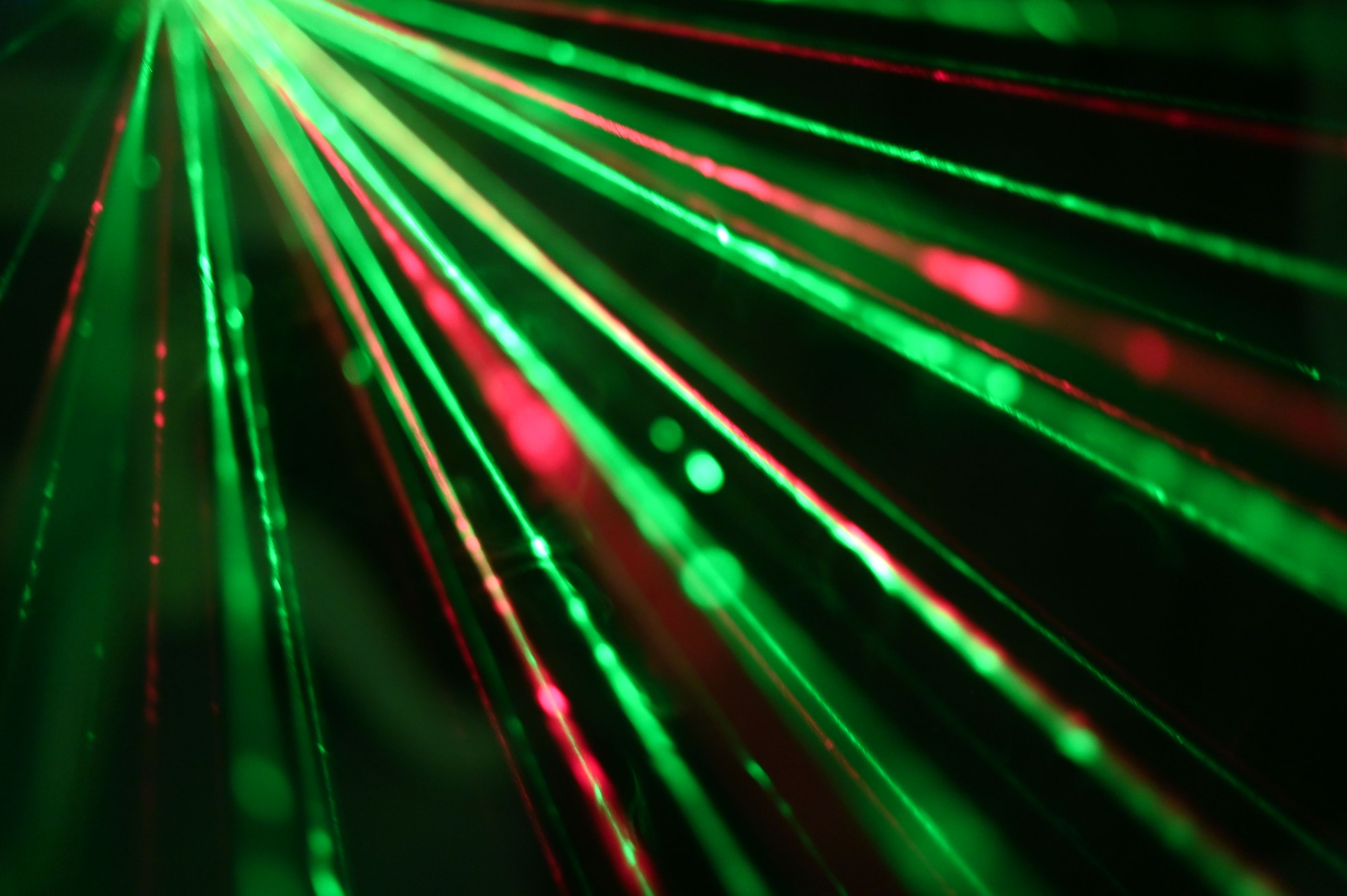
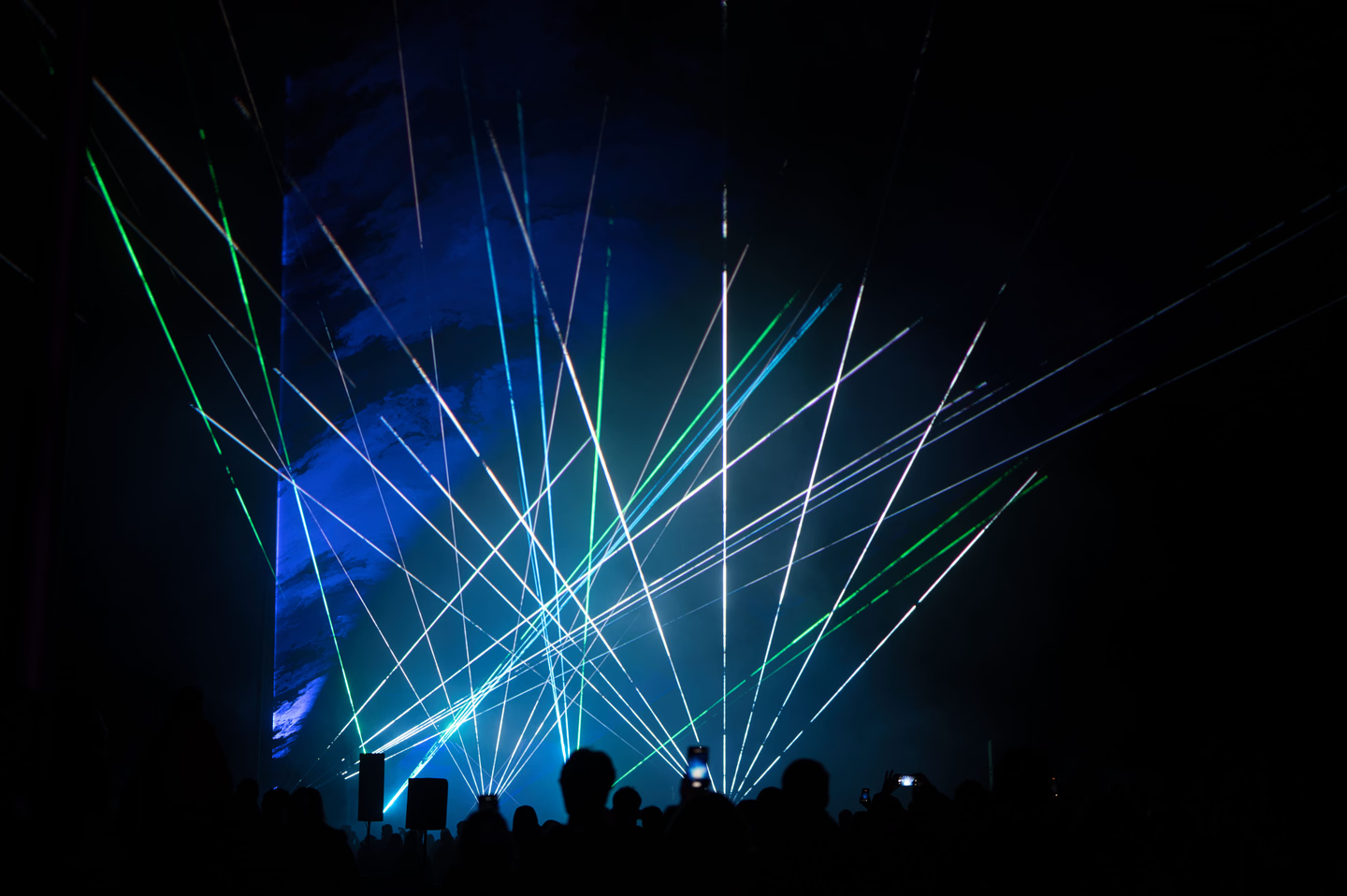
A laser in clean air draws dots on a wall and nothing in between. Add fog or haze and every beam shows up as a solid line of light. That’s the whole appeal, and it’s also where most of the trouble starts, because the effect people want most (a glowing sheet of green at knee height, or a spinning tunnel you walk through) puts laser light where guests’ eyes are.
The Verdict
Worth it when:
- The space is dark and sheltered. An indoor room, a garage, or a covered porch holds haze for hours. A breezy yard doesn’t.
- The beams stay over people’s heads, or land on a surface. Beams overhead in haze, or a starfield on the side of the house, give you most of the drama with none of the eye-level exposure.
- You’ll run haze all night. A hazer is a separate machine from a party fogger, and it’s what makes beams look continuous.
- You’re willing to rope off the swamp. A laser sheet viewed from outside a barrier is a great effect. A laser sheet people wade through isn’t one you should build.
Not worth it when:
- Guests, kids or pets will walk or crouch through the beams. More on why below.
- You’re near an airport, or the beams would point at the sky.
- The yard is windy or lit by streetlights and porch lamps.
- The plan involves an unlabeled high-power laser from an online marketplace, or a show laser that needs an FDA variance.
Why Lasers Need Fog
Laserworld, a laser show maker, puts it flatly: “It is definitely not possible to see any laser beams in the air without having particles in the air!” (Laserworld). The same page kills the lightsaber idea: a beam can’t stop in mid-air, so it keeps going until it hits something.
X-Laser, another maker, says “The more fog or haze is in the air, and the more even its distribution, the better the aerial effect will look” (X-Laser). Even is the important word. A fogger fires bursts, and between bursts the beams fade in and out.
Fog or Haze?
X-Laser’s comparison of the two fluids (most lines on their page start with “generally”):
| Fog | Haze | |
|---|---|---|
| Hang time | “dissipates (goes away) quicker than haze” | “hangs in the air much longer than fog” |
| Base | “water-based” | “Both oil-based and water-based versions are common” |
| Look | “whiter appearance while dispersing” | “less obvious in appearance while dispersing” |
| Movement | “rises faster than haze” | “stays lower to the ground than fog” |
| Residue | “leaves no residue or scent” | “Can leave residue or a scent, depending on if oil or water based” |

For lasers, haze wins indoors. Laserworld “recommends to use a haze machine for indoor beam shows to get the smoothest effect.” Haze doesn’t mean oil, either. Chauvet’s Hurricane Haze hazers are water-based according to its maker, Rosco says its V-Hazer fluid “won’t leave behind an oily residue” because of its “water-based composition” (Rosco), and Froggy’s Fog sells Faze Haze for “water-based Hazers” (Froggy’s Fog). Use the fluid your machine’s maker names, and don’t put haze fluid in a fogger or fog fluid in a hazer.
Running cost is where a hazer earns its price. From Chauvet’s spec sheets:
- Hurricane Haze 1DX (hazer): 1.5-liter tank, “4 ml/min,” 303 W (Chauvet DJ). By our arithmetic, a full tank runs about six hours of continuous haze.
- Hurricane Haze 2D (bigger hazer): 2.5-liter tank, “8.2 ml/min,” 533 W (Chauvet DJ), about five hours a tank.
- Hurricane 1000 (fogger): 1-liter tank, “20 ml/min” (Chauvet DJ). Run flat out, that tank lasts under an hour.
Haze can set off smoke alarms, like any fog, so read will a fog machine set off your smoke alarm before you fill a room.

Chauvet DJ Hurricane Haze 1DX
A compact water-based hazer with DMX and a front-panel display for standalone output control. Chauvet rates it at 4 ml of fluid a minute, a 1.5-liter tank and a two-minute heat-up, and the listing says a sensor stops the pump when fluid runs low. Chauvet designs it around its HFG haze fluid.

CHAUVET DJ High Performance Haze Fluid (HFG), 1 Gallon
Chauvet's water-based haze fluid, the one it names for the Hurricane Haze 1DX and 2D. The listing says it's for all water-based haze machines and is unscented and non-flammable. Not for use in a standard fog machine.
What the FDA Allows at Home
In the US, lasers sold for “demonstration, entertainment, advertising display, or artistic composition” are demonstration laser products, and the FDA limits them to Class IIIa: “5 milliwatts output power in the visible wavelength range from 400 to 710 nanometers” (FDA, laser light shows). The FDA’s own class table (FDA) reads, for the classes you’ll meet:
| FDA class (IEC) | FDA’s description |
|---|---|
| II (2) | “Hazard increases when viewed directly for long periods of time” |
| IIIa (3R) | “Depending on power and beam area, can be momentarily hazardous when directly viewed or when staring directly at the beam with an unaided eye” |
| IIIb (3B) | “Immediate skin hazard from direct beam and immediate eye hazard when viewed directly” |
| IV (4) | “Immediate skin hazard and eye hazard from exposure to either the direct or reflected beam; may also present a fire hazard” |
Above that line, a show needs a variance. Class IIIb and IV light shows require FDA approval under 21 CFR 1010.4, and “Your firm may begin to produce laser light shows only after receipt of a variance approval letter from FDA,” per the same laser light shows page. Class IIIb and IV show projectors “may only be sold by or to individuals or firms with current, approved laser light show variances” (FDA safety alert). So the multi-watt beam projectors in concert videos aren’t something to order online for the front yard. If you want that look for one night, rent it with an operator who holds a variance.
Milliwatts on a spec sheet don’t settle the class, either. Chauvet’s Scorpion Dual RGB ILS, a DJ beam laser, lists a 30 mW red, a 20 mW green and a 50 mW blue diode and is still sold as “Fully FDA compliant, variance-free” (Chauvet DJ). Its manual explains how: the unit uses “Class 3B levels internally” and splits them into multiple beams at “Class 3R levels,” each under 5 mW. The class follows what comes out of the aperture, which is why the label matters more than the diode. The same manual is also clear that variance-free doesn’t mean safe to point at people. More on that under what it costs.
What to check on any laser before it goes in a haunt:
- A class and a maximum output on the label. FDA’s advice: “Do not buy or use any laser that emits more than 5mW power, or that does not have the power printed on the labeling” (FDA, laser toys).
- Suspiciously bright blue or violet. “A blue or violet laser beam that appears as bright as a red or green laser is very likely to be a powerful laser that can cause immediate eye damage,” the FDA’s safety alert warns.
- Labels can be wrong. The American Academy of Ophthalmology reports that in FDA testing about 60% of sampled laser pointers put out more than their labels said, some at “10s or 100s of milliwatts.” Under 5 mW, the AAO says, a person hit in the eye “can blink or turn away without suffering an eye injury”; above it, “severe retinal damage may occur, even after momentary exposure” (AAO).
Where the Beams Can Go
The FDA’s guidance on Class II and IIIa light shows is Laser Notice 40, from 1987 (FDA/CDRH, Laser Notice 40). It opens with the rule everything else follows from: “Only Class I levels of laser radiation have no known hazard and these are the only exposure levels that are considered safe for direct exposure of people.” For Class II and IIIa it says:
- “These levels are hazardous to the eyes. No direct or reflected beams may be directed into audience areas or used to scan the audience in any way.”
- The CDRH recommends “the 3 meter (about 10 feet) vertical and 2.5 meter (about 8 feet) lateral clearance distances from audience area floors be used for Class II and IIIa laser light shows.”
- “It would be prudent to use a minimum beam height of 7 feet if it is not possible to achieve the standard laser light show clearance distances.”
In a house, that means beams live above 7 feet at the very least, and ideally above 10. In a room with an 8-foot ceiling there’s almost no room for aerial beams at all, which is the honest reason many home laser setups end up as projections on a wall or ceiling.
Reflections count as beams. The FDA says a beam hitting “shiny light switch face plates, mirrors and polished metal surfaces, will reflect off and still be hazardous to anyone in the room.” Haunts are full of these: antique mirrors, mercury glass, metallic spray paint, chrome candlesticks, glossy props, windows. Before guests arrive, trace where each beam will travel with the laser off, or with it on while you stay behind it and never look back toward the aperture, and move or cover anything shiny in the path. Laserland says people installing its effects “should wear wavelength-rated eyewear during alignment.”
Kids and pets. The FDA recommends Class 1 for children’s toy lasers, and adds that laser eye injuries “often do not cause immediate pain,” with vision loss that “may go unnoticed for days.” BlissLights, which makes Class 2 star projectors, still advises placing them “out of the reach of curious pets and small children so they don’t accidentally stare at the aperture” (BlissLights). Kids crouch, crawl and look straight into things, which is exactly what beam height guidance is written around.
The Laser Swamp
This is the effect that sells lasers at Halloween: a flat sheet of green light floating over a layer of ground fog, like the surface of a bog. Laserland, a laser module maker, gives the recipe (Laserland):
- Chilled fog first. “The ‘water surface’ illusion is really light scattered by a thin fog layer,” and “a low-lying fog machine (chilled fog) keeps the plane crisp at knee height.” Heated fog rises, so you need a chiller or a low-lying fog machine. See building a fog chiller.
- Line lasers, not dot projectors. “Mount green line lasers slightly above the fog plane, aimed level, and overlap several units for a seamless surface across the room.”
- Green. “Eye sensitivity makes a green plane look dramatically denser than red at equal power.”
A sheet at knee height is a beam plane at the eye level of every child who walks through it, every adult who bends down to look, and every dog. Laser Notice 40 says Class II and IIIa beams shouldn’t be “directed into audience areas,” and recommends a 7-foot minimum beam height where the full clearance can’t be had. Laserland’s own advice is to “Keep beam planes away from eye level, or use power levels appropriate for audience exposure per your local regulations.”
Ways to keep the look without the exposure:
- Rope it off, with room to spare. Build the swamp in a flowerbed, a fenced corner of the yard, or behind a barrier, and let guests see it from outside. Laser Notice 40’s lateral clearance is 2.5 meters (about 8 feet), so keep the barrier at least that far from the nearest edge of the sheet. A line laser fans out wide, so measure from the edge of the fan, not from the laser.
- Stop the beam on something. Put the lasers on the side nearest the viewers, aimed away from them, and let the sheet end on a fence, a wall or a dark backdrop at the back instead of crossing open ground.
- Raise it. A sheet over head height, above 7 feet and ideally 10, reads as a ceiling of light in haze instead of a swamp, and it’s the layout the FDA guidance describes.
The same roped-off sheet works as a sea around a shipwreck. Our pirate cove yard haunt pairs it with blue uplight and chilled fog as the waterline.
Plug-in “swamp” line lasers are now sold for Halloween. The one below is listed as Class II at 0.6 mW, the lowest-powered we found, which is what you want in a roped-off display. Treat its class as the seller’s claim and look for the label on the unit.
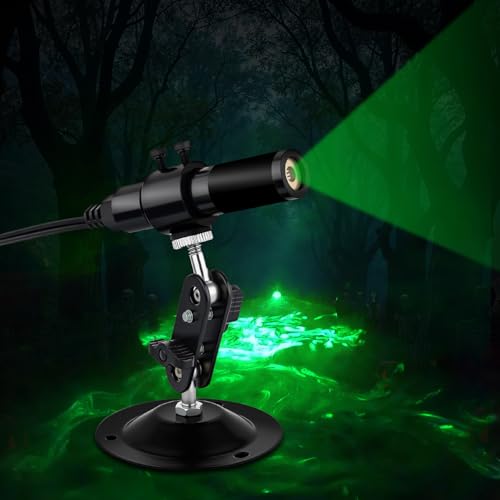
HoneyFair Green Laser Line Projector for Halloween Swamp
A plug-in green line laser sold for the laser swamp effect. The listing says IEC 60825 Class II at 0.6 mW, IP67 weatherproofing and 360° rotation, and that you'll need a separate low-lying fog machine. Use it in a roped-off bed or corner that guests view from outside, never across a path.
The Vortex Tunnel
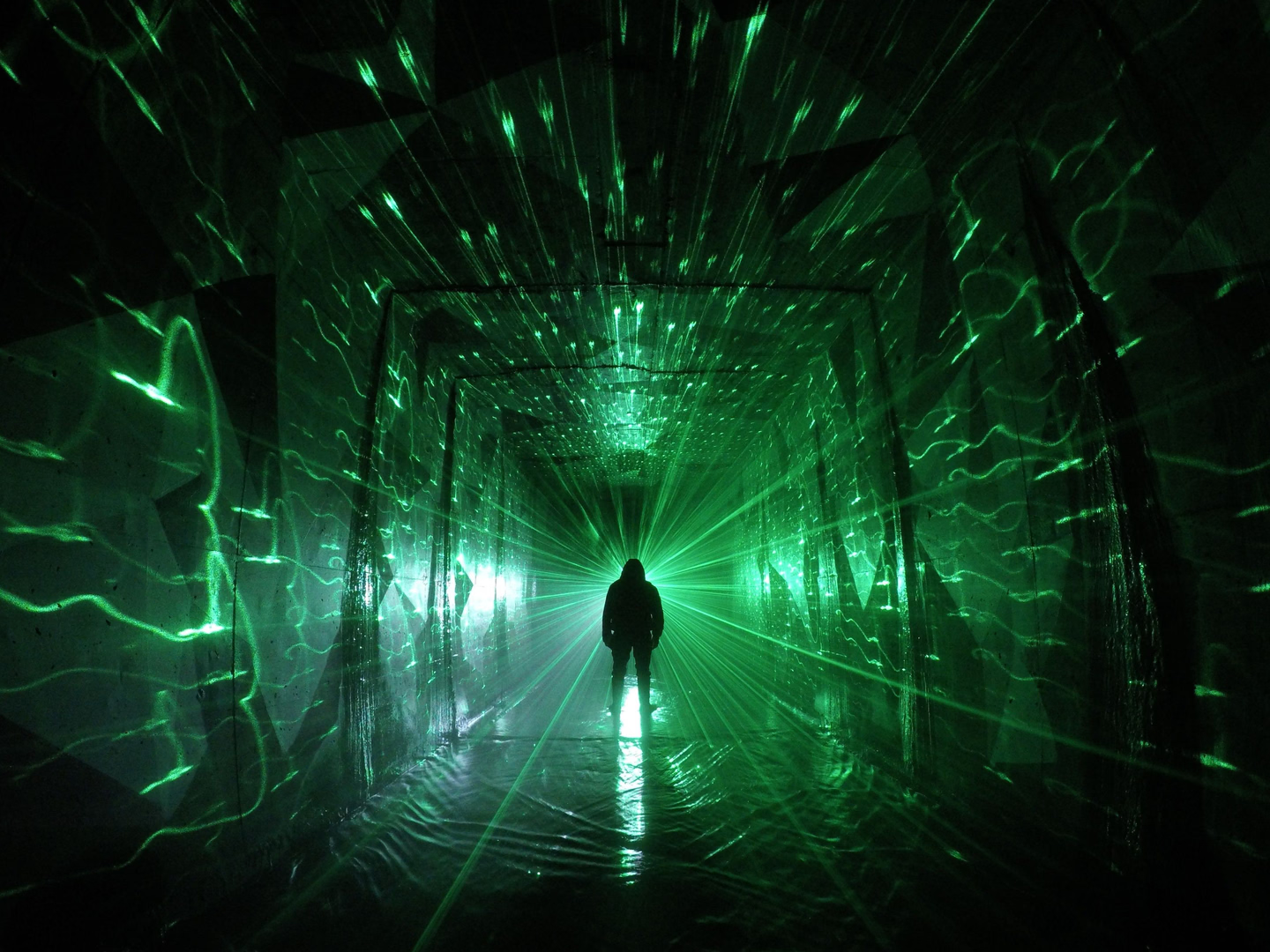
The other signature effect is a spinning cone of light people walk through. Laserland’s method: “A dot module aimed at a slowly spinning front-surface mirror sweeps a cone of light; fill the corridor with fog and visitors walk through a glowing tunnel. Motor speed sets the ‘spin’ of the vortex; a slight off-axis mirror tilt sets the cone width.”
The same conflict applies, and more so. A cone that surrounds a walking guest sweeps the beam across their face on every turn, which is what Laser Notice 40 means by using a beam “to scan the audience.” We wouldn’t build a walk-through laser tunnel at home. What works instead: put the spinning mirror at the viewers’ end of a corridor (or overhead, above 7 feet), aimed away from them, so the cone opens toward the far wall and ends on it. Guests watch from behind the source and never stand inside or in front of the cone.
If a laser runs a chase or scanning pattern at speed, or the fixture has a strobe mode (Chauvet’s Scorpion Dual RGB ILS lists a strobe of 0 to 27 Hz), check the flash rates in our lightning effects guide before you run it for guests.
Outdoors: Aircraft, Wind and Streetlights
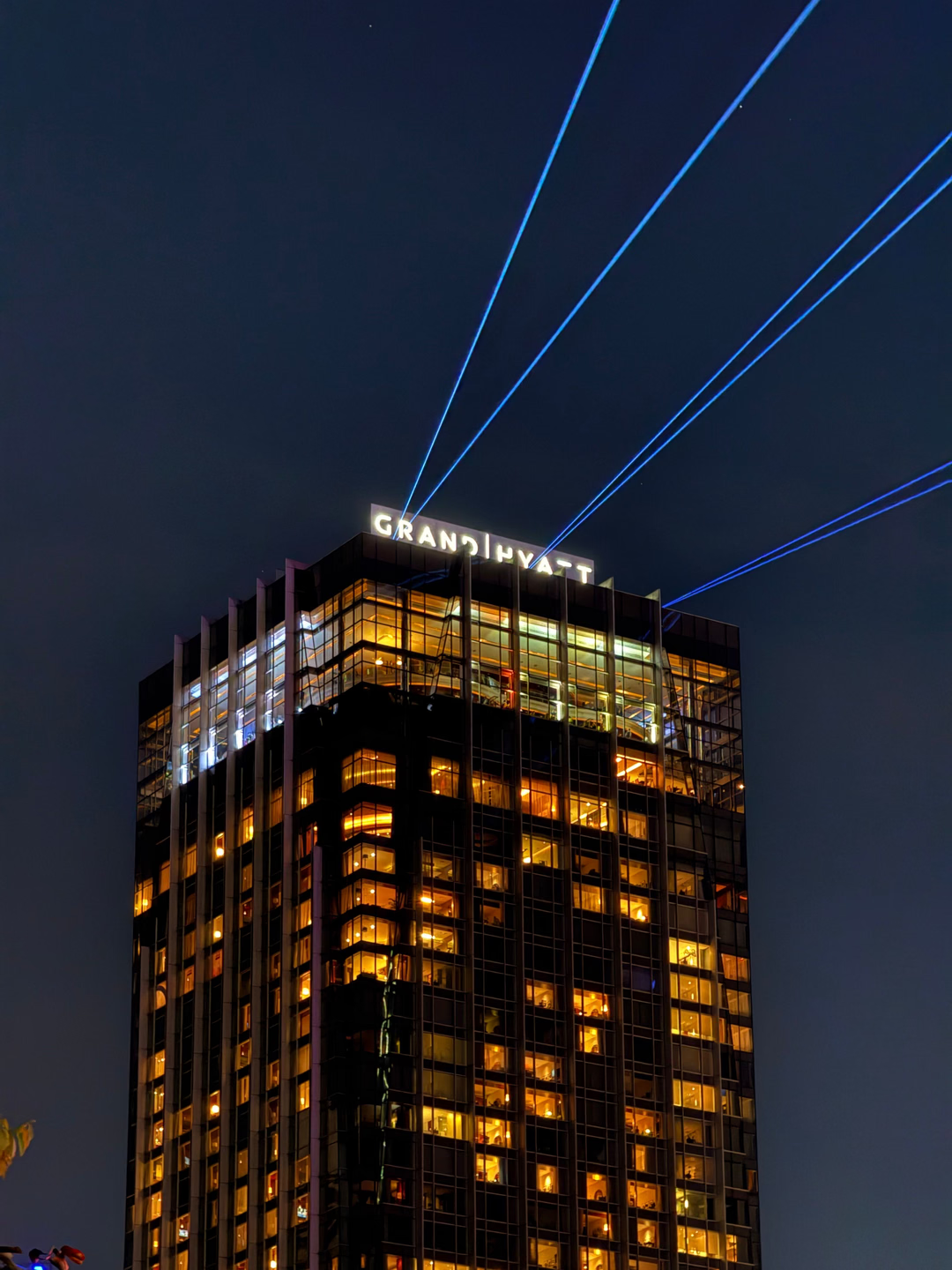
Outdoor lasers bring in a second regulator. The FAA has warned that “holiday laser-light displays can be dangerous for flights when aimed into the sky,” because “The concentrated laser beams reach much farther than homeowners may realize.” It says it “will ask homeowners with laser-light displays that affect pilots to adjust or turn off the displays. A refusal to do so could lead to a civil penalty” (FAA, 2020). For deliberately aiming at aircraft, the FAA “can impose civil penalties of up to $11,000 per violation” and “has imposed civil penalties up to $30,800 against people for multiple laser incidents.” Pilots reported 12,840 laser strikes in 2024 (FAA, laser incidents).
Telebrands’ manual for the Star Shower Motion, a consumer laser projector, is specific: “Lasers should not be projected at or within the flight path of an aircraft within 10 nautical miles of an airport. If your intended surface is within 10 nautical miles of an airport, lower the angle of the Star Shower Motion so that no lasers point into the sky” (Star Shower Motion manual). Our advice anywhere, not just near airports: aim every laser down at the house, trees or ground so each beam ends on a surface, and check the aim from the street after dark.
Two other things work against lasers outdoors:
- Wind. Rosco notes that outdoors, fog “might dissipate faster due to wind and other environmental factors” (Rosco). A beam effect that needs an even haze won’t hold on a breezy night. The fog mastery outdoor techniques lesson covers working with the wind.
- Ambient light. The Star Shower manual says the lights “may look dimmer if there are competing sources of light, like street lights and porch lamps.” Turn off your own porch light and aim away from streetlights.
The same manual says to plug in outdoors only “to a covered Class A GFCI protected receptacle,” and not within 10 feet of a pool.
What It Costs
Starfield projector, $40 to $100. A diffracted pattern of dots on the house or trees. It needs no fog, since the dots land on a surface, and a light haze adds faint beams near the lens. This is the laser buy we’d make first. Aim it so the pattern lands on the house above door height, and place it where nobody on the front walk or porch steps can look straight into the aperture or stand in the beam path.
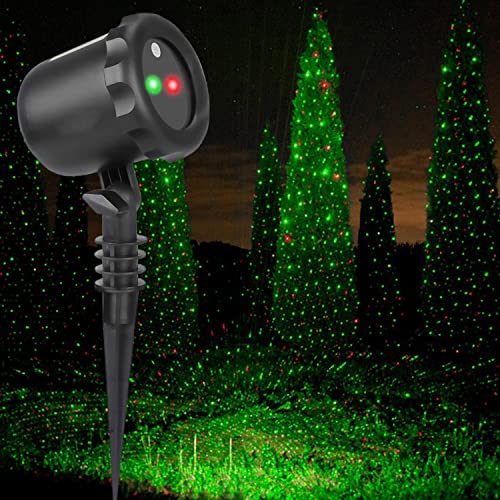
LEDMall Moving Firefly Red and Green Laser Light Projector
A red and green outdoor starfield projector with moving firefly and twinkle modes, a remote and a timer. The listing calls it a Class II garden laser projector with output under 5 mW. That's the seller's claim, and the two figures sit oddly together, so check the class and power on the unit's label. IP65, with a 49-foot maximum throw and a 20-foot cord. Aim it at the house or trees, not the sky.
Swamp line laser, $30 to $40 each, plus chilled fog. Laserland suggests several units overlapped for a seamless sheet. Add a low-lying fog machine or a DIY chiller from the best fog machines roundup.
Variance-free DJ beam laser: usually not for a house. A DJ laser like Chauvet’s Scorpion Dual RGB ILS (about $310) needs no variance, but its manual says to “ALWAYS set up and install all laser effects so that any laser light is at least 3 meters (9.8 feet) above the floor on which people are standing,” with “3 meters of horizontal separation” between laser light and the audience. It also says the unit is “for overhead mounting only,” should “Never” be left “running unattended,” and that “it is not legal to aim Class 3R lasers into areas where people can be exposed, even if the laser is aimed below people’s faces, such as at a dance floor.” A typical 8-foot ceiling can’t meet the first rule. If you have a barn, a high-ceilinged hall or a garage with a 12-foot ceiling, and can keep every beam above 9.8 feet and ending on a wall, it’s a real option paired with the hazer above. Otherwise, skip this tier.
Class IIIb or IV show laser: rent it. These need an FDA variance to sell, buy or run as a show, and X-Laser, which sells them, says approval takes about four weeks through its own variance kit and “as long as 8 weeks” otherwise (X-Laser). Hire a laser company with a variance, and they handle the aim and the clearances.
Is Breathing Haze All Night OK?
The best data comes from Broadway. NIOSH surveyed 224 actors from nine productions in 1991. Compared with actors in shows without it, actors from two or more of the four productions using theatrical “smoke” reported “significantly greater prevalence of nasal symptoms (sneezing, runny or stuffy nose), respiratory symptoms (cough, wheeze, breathlessness, chest tightness), and mucous membrane symptoms (sore throat, hoarseness, dry throat, itchy/burning eyes, dry eyes)” (NIOSH HETA 90-0355-2449).
The measured air levels were low. Mineral oil mist reached 1.35 mg/m³ against a 5 mg/m³ full-shift limit, and in the 1993 follow-up ethylene glycol measured 0.4 mg/m³ or less against an OSHA limit of 127. The follow-up study of performers with asthma-like symptoms found an odds ratio of 1.0, and NIOSH concluded there was “no evidence that theatrical ‘smoke,’ at the levels found in the theaters studied, is a cause of occupational asthma among performers.” It still recommended keeping people out of the concentrated plume near the machine, using as little fog as the effect needs, and “using only fog fluids approved by the manufacturers of the machines.”
For a party: set the hazer to the lowest output that shows the beams, keep it away from where people stand or sit, and warn guests with asthma.
Frequently Asked Questions
Can I see a laser beam without fog? No. Without particles in the air you only see the dot where the beam lands.
Is a Halloween laser projector safe to look at? The FDA considers only Class I safe for direct exposure. Star projectors are typically Class 2 or 3R, per their makers, so don’t stare into the aperture and keep them out of kids’ reach.
Can I make a laser swamp people walk through? Not in line with the FDA’s beam-height guidance, which says Class II and IIIa beams shouldn’t be directed into audience areas. Build it where guests look at it from outside a barrier.
Related Resources
For the fog side, start with the fog machine beginner’s guide, then the Fog Mastery masterclass, which covers machine types and chillers. Size your machine with the Fog Calculator. For the light, the Halloween lighting guide and Lighting Your Haunt: fixture types cover what lasers pair with, and whole-house projection covers video on the house, the other big after-dark effect.