You set the yard up on the first weekend of October. Then it rains for nine days, a windstorm flattens the inflatable, a GFCI trips every night at 8pm, and by the 31st half the display is in the garage.
This is the least glamorous part of outdoor decorating and the one that decides whether your display is still there on Halloween. The good news is that almost all of it comes down to three things: anchoring, water management, and power. None of them are expensive.
Know What You Are Actually Planning For
Late October brings the first real storms in most of the country. Look up your area’s typical October wind gusts before you buy anything tall.
The number that matters is gust speed, not sustained wind. Sustained 10 mph with 35 mph gusts will destroy an inflatable that handles steady 20 mph fine. Gusts are what snap stakes and tear seams.
As a rough guide, tied to the National Weather Service’s Beaufort scale so you can judge the wind by what your trees are doing. Match the forecast gust figure, not the average, to these bands:
- Under 19 mph (up to a moderate breeze, when “small branches are moved”): everything is fine
- 19 to 31 mph (fresh to strong breeze, up to “Large branches in motion”): inflatables need proper anchoring, lightweight props start walking
- 32 to 38 mph (near gale, “Whole trees in motion”): deflate inflatables, bring in anything with a large flat surface
- 39 mph and up (gale): take the display down, it is not worth it
There is no national mph trigger for a Wind Advisory. NWS offices issue it “based on local criteria,” and the advisory itself says “Objects that are outdoors should be secured” (NWS wind alerts). When your local office issues one, bring light props in and lay giants down, as the 12-foot Skelly manual says to do “before a storm or strong winds.”
Set a calendar reminder to check the forecast every few days through October. The people whose displays survive are the ones who deflate before the storm, not after.
Anchoring: The Stakes in the Box Are Not Enough
Every inflatable ships with a handful of thin sheet-metal stakes and four guy lines. Those stakes are sized for a display day, not for four weeks of Northern California wind or a Midwest October.
Replace them. Real ground stakes cost about the price of a sandwich and are the difference between a decoration and a kite.
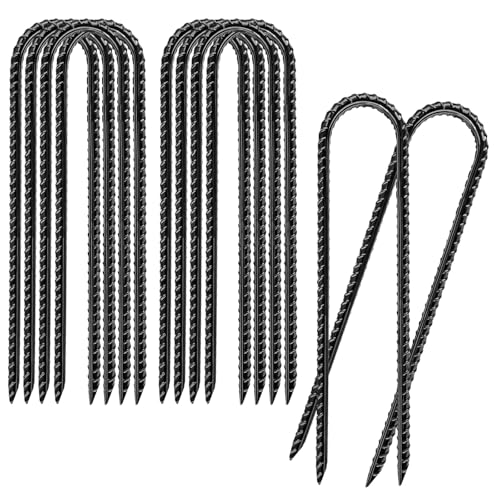
8 Inch Heavy Duty Galvanized U-Shaped Ground Anchor Stakes (10 Pack)
U-shaped galvanized stakes that hold in soil far better than the flat sheet-metal ones in the box. Ten is enough to properly anchor two inflatables.
A few rules that hold across almost every display:
Use every tie-down point. Manufacturers put four to six loops on an inflatable and most people use two. Use all of them.
Drive stakes at an angle, away from the load. A stake driven straight down pulls out. A stake driven at roughly 45 degrees leaning away from the direction of pull grips several times harder.
Guy lines should be taut but not straining. A slack line lets the decoration build momentum before the line catches, which is what tears grommets.
On hard ground, go to sandbags. Stakes are useless in compacted clay, gravel, or anywhere with a sprinkler line you would rather not puncture. Sandbags or water-filled weights on the tie-down loops work anywhere.
Posed skeletons need tying off, not just staking. A skeleton in a chair or on a fence is a light frame that moves at every joint. Our skeleton posing guide covers UV-rated zip ties at the joints and strapping to chairs, fences and trees.
Tombstones and flat props catch more wind than you expect. A foam tombstone is a sail. Stake it at the base and, if it is in an exposed spot, run a length of fishing line from the top to a stake behind it. For stones you build yourself, our front-yard graveyard guide shows how to set a post inside the stone and a sleeve flush with the lawn, so nothing sharp is left standing when a gust knocks one over.
Waterproofing: Connections, Not Decorations
Most outdoor Halloween decorations tolerate rain fine. The failures are almost always at the electrical connections.
Get connections off the ground. A cord junction lying in grass will sit in standing water after any real rain. Hang it on a stake, a fence, or a brick. Six inches of elevation prevents most of it.
Make a drip loop. Let the cord hang below the connection point before rising to it, so water runs down the cord and drips off the low point instead of tracking into the plug. This is a two-second habit that solves most connection failures.
Cover the junction. Purpose-made outdoor cord covers exist and cost a few dollars. A plastic container inverted over the connection works nearly as well, as long as it does not trap water.
Bring the electronics in. Projectors, controllers, and anything with a fan belong under shelter regardless of rating. An IP-rated flood light can live outside. A projector should be behind a window or in a covered box that still lets air move: projector manuals warn against blocking the vents or closing one up in a confined space. The whole-house projection guide has what each maker says about rain, cold, and airflow.
Power: The Part That Is Actually Dangerous
This is the section to not skim.
Every outdoor circuit needs GFCI protection. A GFCI outlet cuts power in milliseconds when current leaks to ground, which is precisely what happens when water gets into a connection while someone is standing on wet grass. Modern exterior outlets are required to be GFCI. If your house is older and yours is not, use a GFCI adapter. This is not optional and it is not about protecting the decorations.
Use outdoor-rated cord, not indoor cord. Look for SJTW on the jacket. Indoor cords have insulation that degrades in sunlight and is not rated for wet conditions.
Size the gauge to the run. Longer runs need thicker wire. For a 50-foot run pulling real load, 12-gauge is the right answer. 16-gauge cord at 50 feet under load drops voltage, runs warm, and makes motors work harder.

POWGRN 50 ft 12/3 Outdoor Extension Cord, Waterproof Heavy Duty, Lighted End
12-gauge SJTW outdoor cord with a lighted end so you can see at a glance whether the run is live. The right gauge for a 50-foot run driving inflatables and lighting.
Do not daisy-chain extension cords. Each connection is another water entry point and another voltage drop. Run one correctly sized cord to a covered outdoor power strip instead.
Add up your amps. A standard household circuit is 15 amps, and you should plan to use no more than 12 of them continuously. Inflatable blowers pull about half an amp each, but fog machines are the real load, drawing 8 to 10 amps while the heater is on. One fog machine plus a modest lighting run is most of a circuit.
Put it on a timer. A timer that switches on at dusk and off after a set number of hours means the display runs when people see it and is off the rest of the time, which cuts both the power bill and the hours of weather exposure on your equipment. For schedules you can change from your phone, see our guide to outdoor smart plugs and yard automation.

BN-LINK Outdoor Light Timer, Dusk + Countdown, 2 Grounded Outlets
A photocell turns the display on at dusk, and a 2, 4, 6 or 8-hour countdown turns it off, so it isn't running all night. BN-LINK says to hang it at least 2 feet off the ground outdoors.
A trunk-or-treat is usually the opposite problem: no outlet nearby, and an engine that should stay off. Our trunk-or-treat decorating guide covers battery lights and power stations for the car.
What Actually Survives
After a few seasons the pattern is consistent.
Holds up well: metal yard stakes, foam tombstones that are properly staked, string lights, IP65-rated flood lights, hard-shell props, anything low to the ground. Vintage blow molds are hard-shell too, but sun keeps fading them and old cords need checking; see our blow mold guide.
Needs babysitting: inflatables, fabric ghosts and fabric anything, cornstalks, hay bales, paper or cardboard, spider webbing (it sags into grey strings after one good rain).
Bring inside for weather: projectors, animatronics with exposed motors, speakers, controllers, anything battery-powered with an accessible battery door.
Carved pumpkins are their own category: rain invites mold, frost wrecks the flesh, and most LED tealights are rated for splashes at best. Our jack-o’-lantern lighting and preservation guide covers submersible lights and what slows the rot.
Our outdoor decorating guide covers layout and design, and the outdoor decor roundup covers specific products that hold up.
A Realistic October Schedule
Early October: put up the permanent structure. Stakes, cord runs, lighting, hard props. These live outside all month.
Mid October: add the weather-sensitive layer. Fabric, webbing, cornstalks. Accept you will refresh this at least once.
The week of: deploy the delicate things. Projectors, animatronics, anything with a motor. Check the forecast daily.
Halloween morning: walk the whole display. Re-stake anything that moved, re-tension guy lines, confirm every GFCI still holds, and replace the webbing that the rain wrecked.
The displays that look best on the 31st are not the ones that went up earliest. They are the ones built so the fragile parts could go up last.