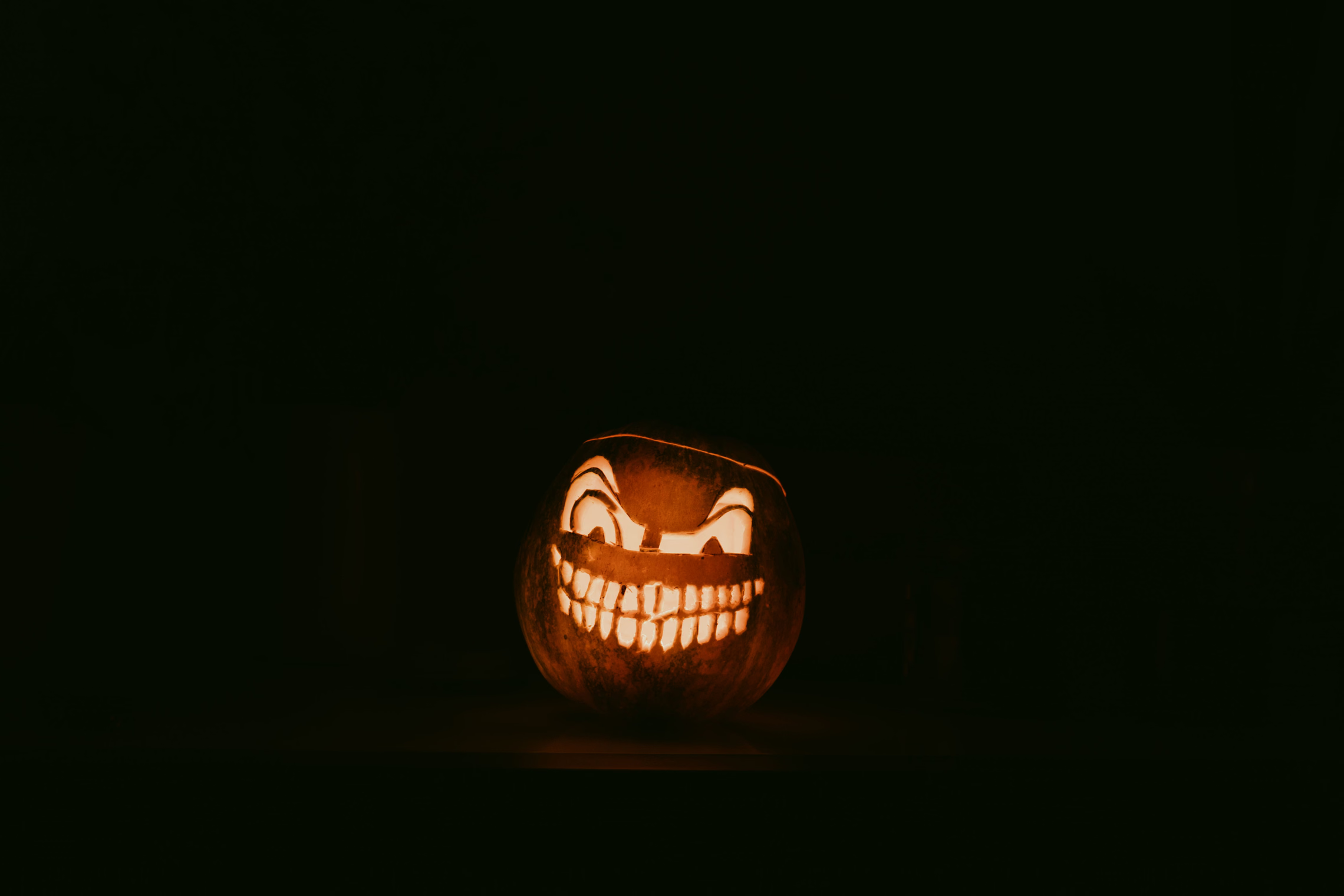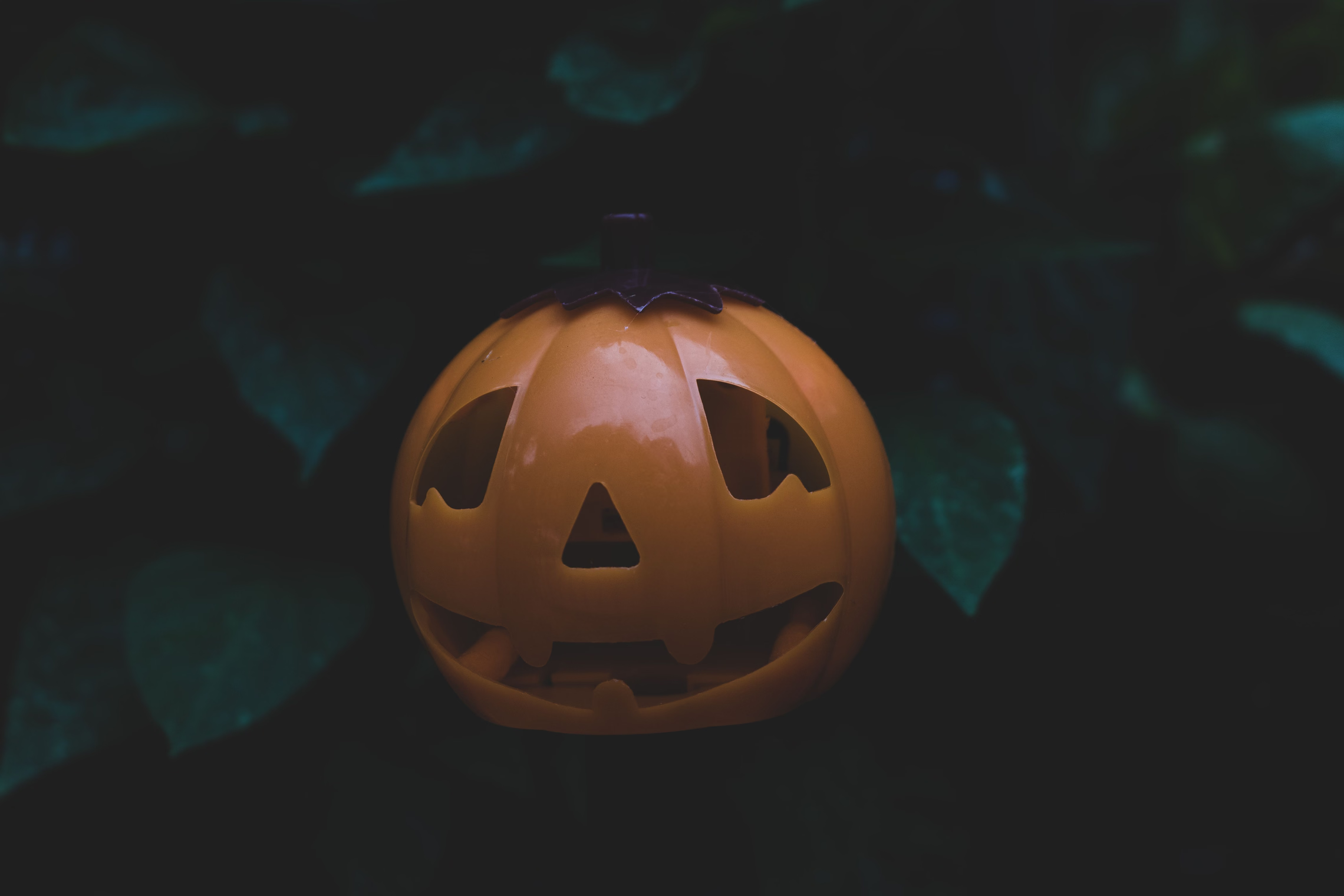
A blow mold is a hollow plastic figure with a light inside: a jack-o’-lantern, a ghost, a pumpkin stack, a candle. The oldest ones in a collection are the ones most likely to crack, the cord inside a 1960s or 1970s piece was built before today’s federal rule on decorative lighting, and the LED bulb sold as a “7W Replacement” can put out less light than the 7-watt bulb it replaces.
How Blow Molding Works, and the Flamingo That Started Out Glued
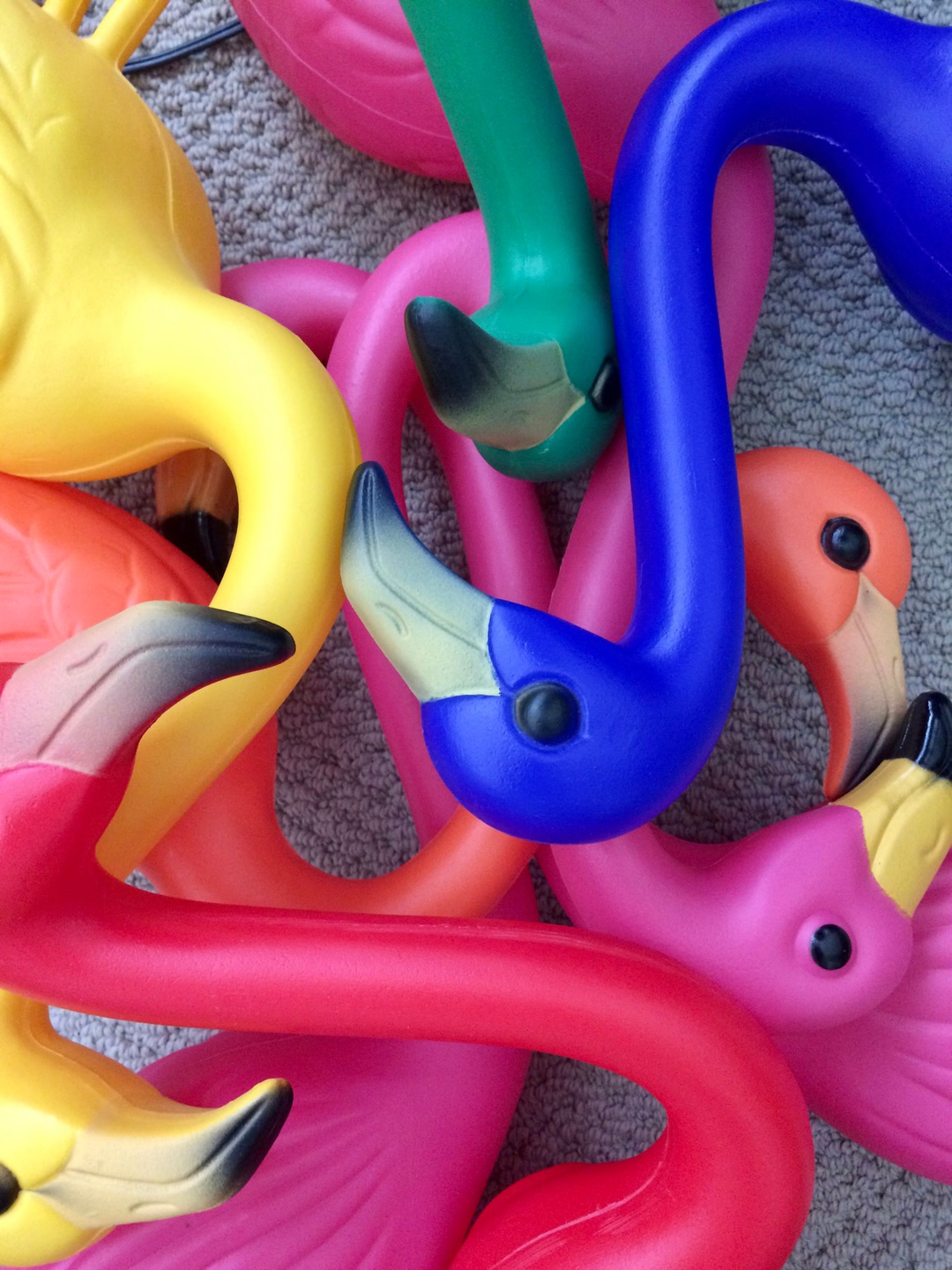
The Smithsonian’s Lemelson Center tells the plastic pink flamingo’s story, and it doubles as a short history of the process. When Union Products first made Don Featherstone’s flamingos, “the two halves of each bird were injection molded, then glued together. However, in the early 1970s, Union Products began to manufacture the birds with blow molding technology.” The Center dates that method to 1938, “invented … by Enoch Ferngren and William Kopitke and inspired by glass blowing,” and says it “used compressed air to blow molten plastic into a mold.” It started with bottles; manufacturers “eventually realized that the technology could be used to create containers and other hollow products of all sizes and shapes” (Lemelson Center).
The two Smithsonian pages disagree on what the first flamingos were made of. The Lemelson story says they “were mass-produced in polyethylene.” The National Museum of American History’s record for a pair of flamingos says “The original flamingoes were made of polystyrene, with painted eyes,” and that “The generations after were made of polyethelene [sic] and are the bright pink (and stable) color with which we associate the birds” (NMAH, Pink Flamingo Lawn Ornament). Neither page cites the other, and we can’t settle it.
The NMAH record’s description of the older birds is the reason collectors handle early pieces gently: “The polystyrene became brittle after time, and though the vintage birds are highly valued, they were also inclined to crack, especially around the legs where the stakes, usually metal rods, were installed.” And on color: “The styrene models were a lighter pink to begin with and they faded badly over time in the sun.”
Union Products and What It Still Makes
Union Products of Leominster, Massachusetts, is the maker with the best record, because of the flamingo. The dates and titles depend on whose page you read:
- Lemelson Center: “In 1956, Don Featherstone, a recent art school graduate, became an industrial designer” at Union, and the flamingo was “Featherstone’s second assignment for Union Products (out of almost 650).” It puts sales at “over 20 million pairs sold as of 2018.”
- NMAH: the flamingo was “Designed for Union Products by the artist, Don Featherstone, in 1957.” A second NMAH record says Featherstone “landed a job with Union Products” in 1957 and that his first project was “Charlie the Duck,” then gives the flamingo’s date as “1987” in the same paragraph (NMAH, Plastic Flamingos). That 1987 date conflicts with the museum’s other record, which says 1957, and with the Lemelson Center’s account.
- Cado Company, which owns Union today: its divisions page says the Pink Flamingo was “developed in 1957 by the company’s president at the time, Don Featherstone” (Cado). Its home page says instead “Don Featherstone, a former Union president, developed this iconic American bird in 1957” (Cado). Cado’s home page fits the Smithsonian accounts, which call him an industrial designer and “the artist”; its divisions page, with “president at the time,” doesn’t.
A signature is one way to tell some flamingos apart. The NMAH’s pair from about 1980 “were made from the original molds with a signature for Featherstone added to the mold,” and “They were made by the company that bought out Union products.” The record doesn’t name that company or say when the buyout happened. Cado says Union was “acquired by Cado Company in the late 2000s.”
Union is still making Halloween pieces. Cado’s 2026 Holiday & Seasonal sheet lists a 34-inch Happy Ghost, a 31-inch Ghost with 2 Pumpkins, a 38-inch Pumpkin Stack, a 40-inch black Lighted Candle, a 22-inch pumpkin “w/Light” and nested black cauldrons from 8 to 22 inches, and prints “All Products Are Made in the USA” on every page (Cado 2026 sheet). The ghosts and the Pumpkin Stack are marked “LED Bulb.” Cado also says “Union Classic Christmas Lawn Decorations are back after being out of production since 2005,” and claims “the largest Halloween cauldron at 22” in diameter,” with “no hole in the bottom.”
Other names come up whenever blow molds are collected. We didn’t find a museum record, federal record or maker page for their histories, so this guide doesn’t retell them.

Union Products Light Up Ghost and Pumpkin Halloween Blow Mold
A Union ghost over two stacked orange pumpkins, 31 inches tall and about 3 pounds, which matches the 31-inch Ghost with 2 Pumpkins on Union's 2026 sheet. The listing says it comes with a 60-watt bulb; Union's sheet marks the piece 'LED Bulb.' Check the wattage printed on the bulb in your box before you plug it in.

Union Products 55120 12 Inch Spooky Witch Cauldron, Black
A 12-inch black blow-molded cauldron from Union. Cado says all of Union's cauldrons are made with no hole in the bottom, so it holds candy, a battery light or a potted plant, but a stake can't go up through it. Weight it from inside for the yard.
A smaller Union piece, the 14-inch Boo Ghost with cord and light, has only a handful of reviews so far. For a whole cauldron scene, see our witch coven yard guide.
Why Old Blow Molds Crack and Fade
Sun is the slow problem. The Library of Congress says “Light damage is cumulative and follows the reciprocity principle. In other words, dim light over a long period of time is just as damaging as bright light over a short period of time.” The damage it lists includes “fading, yellowing, darkening, bleaching, embrittlement, and color change,” and “In most cases, conservation treatment cannot reverse light damage.” It says sunlight is avoided for light-sensitive items because “it is too intense, contains high levels of UV, and is difficult to control” (LOC, limiting light damage).
LOC’s tiers put “plastics” in its very light sensitive group and “degraded plastics” in its extremely light sensitive group, whose advice starts “Do not display.” A museum and a front lawn are different places, but the arithmetic carries over: a porch roof lowers the light, and a whole October under it still adds up. Our reading is to put a vintage piece out for the season, not all fall, and to keep the ones that already look chalky or pale on a covered porch instead of the open lawn.
Age matters too. The Canadian Conservation Institute says “Old plastics are more at risk than new ones because plastics produced more recently benefit from the increased use of stabilizing additives,” and warns that “when deterioration is visibly obvious, it may be occurring at such a rapid rate that drastic action is necessary” (CCI Note 15/1). It names heat as well: “The higher the temperature, the faster the rate of deterioration,” and “Avoid hot lights, proximity to any heat source, or any storage or display practice that heats objects.”
Cleaning, UV Protectant and Paint
Cleaning
The conservation standard is stricter than most yard habits. CCI: “Do not use solvents or even water-based cleaning solutions on rubber and plastics. Although recommendations have been made in the literature to use water with soap, this is now regarded as a dangerous practice.” Its alternative is “to clean objects under dry conditions by careful brushing or vacuum cleaning.”
That advice is written for museum collections, and a blow mold that sits on wet grass for a month gets muddier than a museum object. We found no approved source that says washing a blow mold is safe, so our method starts dry: a soft brush and a dry microfiber cloth, and a vacuum brush attachment for dust inside the light hole. Whether to go further on a muddy piece is your call on a yard decoration; on a piece you care about as a collectible, stop at dry.
For cracks, CCI’s line is “Broken plastic and rubber objects should be repaired by qualified conservators.” We found no approved source for a home glue repair on blow-molded plastic.
UV protectant
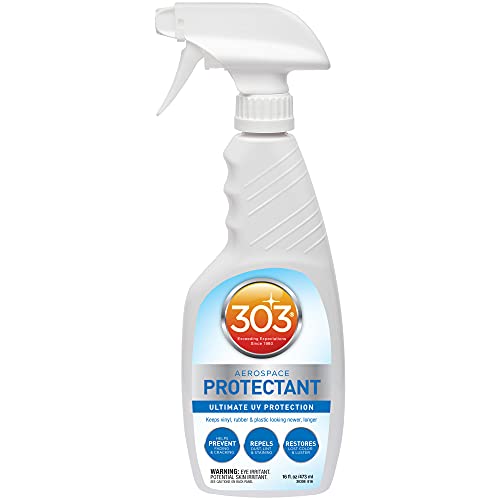
303 Aerospace Protectant is the product people reach for. Gold Eagle, its maker, says it’s “Safe for use on vinyl, rubber, plastics, finished leather, fiberglass, and more,” and “Not recommended for: clear plastics, unfinished leather (e.g., suede), canvas, flooring, gauge panels, or headlights.” The directions: “Use only on clean, dry surfaces,” spray “Out of direct sunlight,” and “Wipe thoroughly and completely dry.” Gold Eagle’s page gives two intervals: reapply every three to five weeks in the directions, and protection that lasts up to 30 to 45 days per application in the feature list (Gold Eagle). For an October display, either one means one coat before it goes out.
The page doesn’t mention painted surfaces, and most blow molds have painted faces. Our method: try it on a painted spot on the back or bottom first, let it dry, and look for streaks or lifted paint before doing the face. Skip any clear plastic, per Gold Eagle’s list.
303 Aerospace Protectant for Vinyl, Plastic and Rubber, 16 oz
Gold Eagle's water-based UV protectant, which it says is safe on plastics and dries to a matte finish. Not for clear plastics. Spray out of direct sun and wipe it completely dry. Test a painted spot on the back of a blow mold before you do the face.
Paint
Krylon’s Fusion All-In-One page lists “Metal, Wood, Plastic, Laminate, Masonry, Concrete, Wicker, Glass, Plaster” under “FOR USE ON,” says it “can be used on metal, wood, plastic, PVC, laminate, glass, ceramic, plaster, and more,” and gives best results “when temperatures are 55° F to 75°F and humidity is below 60%” (Krylon). It doesn’t name polyethylene, and “plastic” on a can doesn’t tell you which plastics. Our method: test on the underside of the base, let it cure a few days, and scratch it with a fingernail before repainting a face.
Repainting covers the original paint for good. Our method: decide whether a piece is a yard decoration or a collectible before you touch it.
Lighting: The Federal Rule, Old Cords and C7 Bulbs
Federal rules name blow molds
A lighted blow mold is regulated as a seasonal lighting product. The federal definition, 16 CFR 1120.2(d), covers “portable, plug-connected, temporary-use lighting products and accessories that have a nominal 120 volt input voltage rating,” including those with “candelabra- or intermediate-screw base lampholders connected in parallel, directly across the 120 volt input.” Its examples: “Such lighting products include lighted decorative outfits, such as stars, wreathes, candles without shades, light sculptures, blow-molded (plastic) figures, and animated figures.” Battery-operated and solar-powered products are outside it (eCFR, 16 CFR 1120.2).
The next section, 16 CFR 1120.3(c), says those products are a “substantial product hazard” if they lack any of three things from the UL 588 standard: “Minimum wire size,” “Sufficient strain relief,” or “Overcurrent protection” (eCFR, 16 CFR 1120.3). The CPSC’s release on the rule gives the context: it took effect June 3, 2015, and “CPSC is aware of 132 fatal incidents that occurred from 1980 through 2014 which led to 258 deaths, and 1,405 nonfatal incidents associated with seasonal and decorative lighting products” (CPSC, 2015).
What that means for an old cord
The rule governs what can be sold, not the cord already in your attic. The CPSC’s consumer advice is direct about old sets: “Use only newer lights that have thicker wiring and are required to have safety fuses to prevent the wires from overheating” (CPSC, 2008). We didn’t find a CPSC page that dates when fuses became standard in decorative sets, so don’t guess an old cord’s age from its looks.
For damaged sets, the CPSC’s newer releases say “Throw out damaged sets” (CPSC, 2018). Its older holiday brochure says “Discard damaged sets or repair them before using” (CPSC 611). We follow the newer releases.
Our method for a vintage piece:
- Pull the cord and socket out and look at the whole length: “broken or cracked sockets, frayed or bare wires, or loose connections,” in the CPSC’s words.
- Look at the plug. A fused plug has a small door or strip that opens to the fuses. No fuse compartment, or any of the damage above, means the cord retires. Keep it in a labeled bag with the mold if originality matters to you; just don’t plug it in.
- Fit a new cord kit that says it meets UL 588 and has a fused plug.
- Outdoors, the CPSC’s 2018 release says to “Check outdoor lights for labels showing the lights have been certified for outdoor use and only plug them into a ground-fault circuit interrupter (GFCI)-protected receptacle or a portable GFCI.”
- “Turn off all holiday lights when you go to bed or leave the house. The lights could short out and start a fire” (CPSC, 2008). A dusk timer, as in our weatherproofing guide, does this for you.
We didn’t find a C7 blow-mold cord kit whose listing claims UL 588, a fused plug and an outdoor rating all at once. The one below has the first two and lists its usage as “Indoor,” so it’s for a blow mold on a table, in a window or inside the house. For a piece on the open lawn, our method is to leave the socket empty and light the mold from outside with an outdoor-rated spotlight, like the uplights in our porch decorating guide.
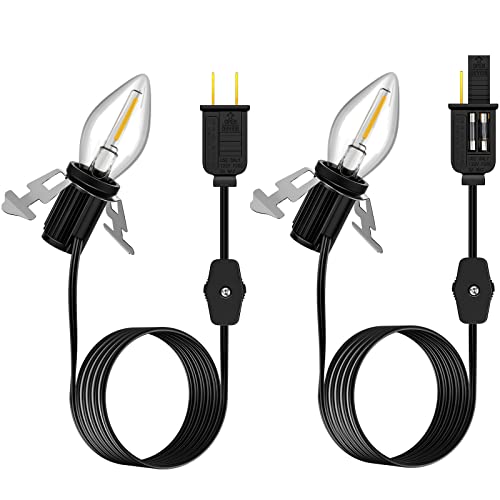
Enhon 6 ft Accessory Cord with C7 LED Bulb, 2 Pack
A single-socket E12 cord with an on/off switch and a clip for the light hole, for indoor displays. The listing says it 'has passed the UL-588' and that 'the plug is equipped with two built in spare fuses.' Its spec line reads 'Indoor/Outdoor Usage: Indoor,' and it says to 'use it in nice weather if you need light outdoor,' which is not an outdoor rating. We found no maker site, so these are the listing's claims.
C7 bulbs: why the LED can be dimmer
The federal definition covers decorations wired with “candelabra- or intermediate-screw base lampholders,” and the replacement cords sold for blow molds, like the one above, take a C7 bulb on a candelabra (E12) base. Check your socket before you buy bulbs. The 7-watt incandescent C7 is the bulb the LEDs are measured against: Feit’s page calls its LED a “7W Replacement.” The makers’ own numbers:
| Bulb | Watts | Lumens | Rated life |
|---|---|---|---|
| Westinghouse 7 W C7, clear | 7 | 43 | 4,000 hours |
| Feit BP7C7/4/CAN, incandescent | 7 | 32 | 3,000 hours |
| Feit BP7C7/827/LED/4, LED “7W Replacement” | 0.6 | 30 | 15,000 hours |
Sources: Westinghouse, Feit incandescent, Feit LED.
Feit’s LED (the BP7C7/827/LED/4 four-pack) puts out 30 lumens against 32 for Feit’s own 7-watt bulb and 43 for Westinghouse’s, so a swapped-in LED can make an old pumpkin glow a little less. What it gives back is heat. ENERGY STAR says “incandescent bulbs release 90% of their energy as heat” (ENERGY STAR), and a bulb inside a closed plastic shell has nowhere to shed it. Feit’s spec sheet also rates the LED “Wet” and “Indoor/Outdoor,” enclosed-fixture rated, and non-dimmable. If a piece looks too dim with one LED, a two-socket cord is our fix rather than a hotter bulb.
Whatever came in the box, read the watts printed on the bulb itself. If it’s a 60-watt incandescent, like the one the Union ghost listing describes, swap it for an LED: CCI’s advice for plastics is to “Avoid hot lights.”
Anchoring and Display
Blow molds are hollow and light. The Union ghost listing gives about 3 pounds for a 31-inch piece, which is a sail in October wind. The CPSC’s brochure says to “Fasten outdoor lights securely to trees, house, walls or other firm support to protect from wind damage,” and a lighted blow mold is an outdoor light.
Our method:
- Weight it from inside. A zip bag of sand or pea gravel dropped through the light hole, lying flat on the floor of the base, lowers the center of gravity. Keep it clear of the bulb.
- Stake behind, not through, a fragile piece. A U-stake or garden stake behind the figure and a loop of soft cord around it holds it without stressing old plastic. The NMAH’s note about polystyrene flamingos cracking “where the stakes … were installed” is the reason not to force a stake into an old base.
- Check the bottom first. Cado says Union’s cauldrons have “no hole in the bottom,” so a cauldron gets weight inside, not a stake through it.
- Don’t leave bare stakes standing when the piece comes in. Our graveyard guide explains why rebar caps don’t make them safe.
The wind-speed bands and stake angles in our weatherproofing guide apply to blow molds as they do to inflatables. The 8-inch galvanized U-stakes from that guide work for the stake-behind method.
For placement, blow molds read best low and lit from inside at the edge of a walk or porch. The porch staging in our porch decorating guide works with them, and a covered porch also cuts the sun they get.
Off-Season Storage
Our storage guide covers bins, pests and where things live. For blow molds specifically:
- Dark. LOC’s reciprocity rule doesn’t stop at October. A blow mold on a garage shelf under a window keeps adding up light all year.
- Not the attic. CCI says “Cooler conditions, therefore, promote longevity,” and “RH values over 65% should be avoided for plastics and rubbers.” A summer attic runs hot, and a damp basement fails the humidity side.
- Handle cold plastic gently. CCI: “plastics are more brittle when they are cold,” and “Degraded plastics and rubbers can be surprisingly brittle.” Bring a piece out of an unheated garage and let it warm up before you handle it much or tie it to a stake.
- Nothing heavy on top. Our method: stand blow molds upright on a shelf or in a large box with nothing stacked on them, since the shells dent.
- Bulbs out, cords checked. Pull the bulb and look over the cord as it comes down, per the lights section of the storage guide, so a bad cord doesn’t wait until next October to be found.
Frequently Asked Questions
Are old blow mold cords safe to use? Not as a default. Federal rules treat a lighted blow mold as a seasonal lighting product that needs minimum wire size, strain relief and overcurrent protection, and the CPSC says to “Use only newer lights that have thicker wiring and are required to have safety fuses.” A cord with a damaged socket or wire, or no fuse in the plug, gets replaced.
What bulb goes in a blow mold? The replacement cords sold for blow molds take a C7 on a candelabra (E12) base; check your socket first. Feit’s LED C7 uses 0.6 watts and makes 30 lumens, a little less than Feit’s 7-watt incandescent at 32, and far less heat.
Can I wash a blow mold with soap and water? The Canadian Conservation Institute says no. It calls water with soap “a dangerous practice” for plastics and recommends dry brushing or vacuuming. We found no approved source that endorses washing.
Were the original pink flamingos blow molds? No. The Smithsonian’s Lemelson Center says the first flamingos were injection molded in halves and glued, and Union switched to blow molding in the early 1970s.
Related Resources
Our outdoor Halloween decorating guide covers yard layout, and the Halloween lighting guide compares the lights you’d put around your blow molds. For the paper side of vintage Halloween, see collecting vintage Halloween.