Prop Building 101 Part 3: Corpsing a Skeleton

A store skeleton is clean, white and obviously plastic. “Corpsing” is the home haunt name for giving it dried skin: thin plastic film shrunk tight over the bones with a heat gun, torn and layered, then painted in browns and grays so it looks mummified instead of molded.
No skeleton maker, film maker or heat gun maker describes corpsing. The method below is ours, and we label it that way. Every fact about the tool and the materials comes from the maker’s manual or a published study.
Know Your Plastics First
The skeleton
Most skeleton makers don’t say what their plastic is. Spirit lists its Pose ‘N’ Stay as “85% PP, 15% METAL,” as our skeleton posing guide notes; PP is polypropylene. The Crazy Bonez Pose-N-Stay listing calls its plastic weather-resistant without naming the resin.

The film
Kitchen trash bags and plastic wrap are the usual skins. Glad says of its own products: “Our products are made from polyethylene and don’t contain any plasticizers,” and “We don’t use any polyvinyl chloride (PVC) plastics in our products” (Glad FAQ). That covers Glad only. We didn’t check other brands, so read the box.
Where they melt
A 2025 study measured the melting points of plastics from household packaging waste by differential scanning calorimetry, including food bags and zip bags (Charitopoulou, Koutroumpi and Achilias, Polymers 2025;17(13):1786, PMC). The Fahrenheit figures are our conversions:
| Plastic | Measured melting point | In °F |
|---|---|---|
| LDPE / LLDPE (bags, film) | 109 to 122°C | about 228 to 252°F |
| HDPE | 129.4 to 135°C | about 265 to 275°F |
| PP | about 164 to 165°C | about 327 to 329°F |
LDPE film melts roughly 75 to 100°F below polypropylene. That gap is why the technique can work on a PP skeleton: the film shrinks before the bones soften. That’s our inference from the study, not a claim any skeleton maker makes, and it only holds if you know your skeleton is PP.
Leave PVC out of it
Some skeletons ride on PVC stands, and some props hide PVC pipe inside. Keep the heat gun off all of it. WEN’s heat gun manual says outright, “DO NOT thaw PVC piping” (WEN HG112V manual).
Overheated PVC gives off hydrochloric acid. In a 1982 study of a plant where a PVC extruder malfunctioned and reached 362°C, 62 of 201 workers fell ill with respiratory problems, headache, nausea and fainting, and the authors write that “One kilogram of PVC heated to 300 degrees C releases an estimated 12.9 g of hydrochloric acid (HCl) and 4.9 g of carbon monoxide (CO)” (Froneberg, Johnson and Landrigan, British Journal of Industrial Medicine 1982;39(3):239, PMC). 300°C is 572°F, well inside every gun’s range below. NIOSH sets a ceiling of 5 ppm for hydrogen chloride, a gas with a “pungent, irritating odor” (NIOSH Pocket Guide).
If you don’t know what a film is made of, don’t heat it.
The Heat Gun: What the Manuals Say
| Gun | Temperature range | Minimum distance | Nozzle after use |
|---|---|---|---|
| Wagner FURNO 500 | 150 to 1050°F (low air), 200 to 1200°F (high air) | at least 2 inches | “may still be hot” after its cool-down mode |
| DeWalt D26950 / D26960 | 120 to 1100°F (D26950) | at least 1 inch when stripping paint | “remains hot for 30 minutes after use” |
| Milwaukee 8988-20 | 120 to 1150°F | not stated | “approximately 20 minutes to cool” |
| WEN HG112V | 122 to 1112°F | “one centimeter (1/2 inch)” | cool “fully” before storing |
Every gun’s lowest setting sits below LDPE’s melting point, and the top settings run roughly 850 to 970°F above it. Film shrinks near the bottom of the dial.
The makers disagree on distance. WEN’s half inch isn’t even consistent (a centimeter is about 0.4 inch), and WEN itself says 3 to 4 inches for paint removal. We use Wagner’s 2 inches as the floor, because it’s the most conservative, and usually hold the gun farther off than that.
The rules the manuals agree on:
- Start low. Wagner: “Always start the heat gun at the lowest temperature in the range then raise the temperature until the optimum temperature is achieved.” WEN says to test on “a piece of similar scrap material” first.
- Keep it moving. Wagner: “Always keep the heat gun in motion.” DeWalt: “Keep the heat gun moving as excessive heat will generate fumes which can be inhaled by the operator.”
- Treat it as fire. Wagner: “Always treat the hot air units with the same respect as an open flame,” and keep “a container of water or an ABC fire extinguisher” within reach. Milwaukee calls it “flameless heat” and still says to keep an extinguisher nearby. DeWalt: “this tool can ignite flammable materials, soften or melt others.”
- Never leave it running. Wagner: “do not leave the appliance unattended when it is switched on.” Milwaukee extends that to “while running or cooling down.”
- Set it down right. Wagner says to set the gun upright and avoid “laying the unit on the side after shutdown.” Never set it on the skeleton.
- Watch the clock. DeWalt: “DO NOT exceed 60 minutes ‘ON’ in a 2 hour period.” A whole skeleton can take longer than that, so plan breaks.
- Hold the work with something else. WEN: “DO NOT HOLD a work piece in front of the heat gun without forceps or clamps.”
- Don’t mix it with spray paint. DeWalt says not to use the gun within 10 feet of paint spraying. Finish all the heat work before you paint.
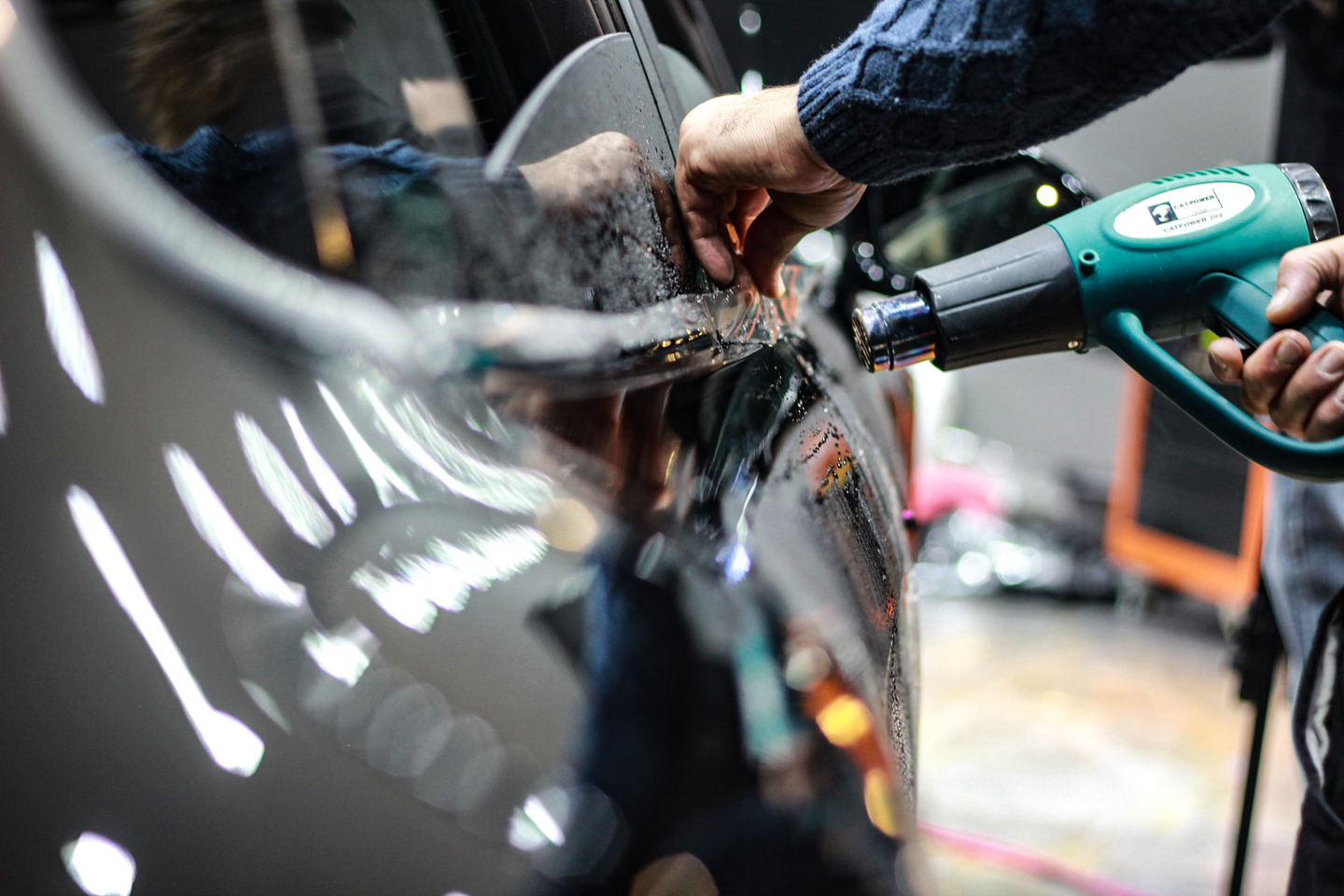
Plug in with a heavy enough cord. WEN’s chart for a 12.5 amp gun calls for a 14 gauge cord at 25 feet and 12 gauge at 50 feet, and rates 100 feet or more “Not Recommended.” WEN also says GFCI protection “should be provided on the circuit or outlet used for this power tool.” Wagner adds: “Only adults should use a heat gun.”

Wagner Spraytech FURNO 500 Heat Gun, 12 Settings, 150°F to 1200°F
Twelve settings from 150°F and a digital readout, so you can start at the bottom and step up. Wagner's manual lists shrinking plastic film at LOW/MED with the flare nozzle, which comes in the box, and the gun has a cool-down mode.

WEN HG112V 12.5-Amp Variable-Temperature Heat Gun
A variable dial from 122°F to 1112°F and two airflow speeds, at 1.3 pounds. Its manual is the one that says not to heat PVC piping and to hold small work in clamps, not your hand.
Air and Fumes
Wagner and DeWalt print the same warning about lingering in one spot: “excessive heat will generate fumes which can be inhaled by the operator.” The manuals’ ventilation and respirator instructions are written for stripping old paint, including a line in Wagner’s that “Disposable paper masks are not adequate.” Applying them to plastic film is our extension, and we’d rather overdo it: work outside or in a garage with the door open and a fan blowing out.
Polyethylene isn’t free of reports either. A 1992 letter in Thorax reported “The first case of occupational asthma in a shrink wrap worker using a different plastic, polyethylene,” confirmed by bronchial challenge testing (Gannon, Burge and Benfield, Thorax 1992;47(9):759, PMC). The worker was an 18-year-old packer who already had asthma, and his machine heated pure polyethylene film briefly to 166°C. In the challenge test, eight minutes of exposure to polyethylene heated to 76°C brought on a reaction, and the authors say the agent responsible is unknown. It’s a single case report in a shrink wrap worker, not a hobbyist, but it’s the reason we don’t treat PE fumes as harmless.
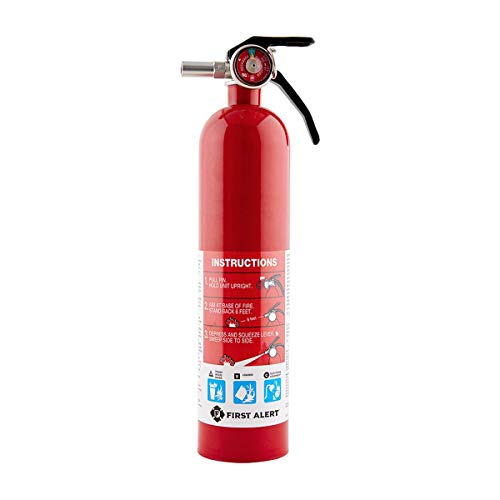
First Alert HOME1 Rechargeable Fire Extinguisher
UL rated 1-A:10-B:C, the multipurpose ABC type Wagner's manual calls for, with a metal valve and gauge. Keep it on the bench, not in the house, while the gun is on.
Our Method
This is how we do it. Test every step on a hidden spot, like the inside of the pelvis, before you touch the face.
- Strip it. Take the skeleton off any PVC stand, pull out batteries, lights and sound modules, and remove wire hangers. Lay it on a metal or concrete surface, never on a drop cloth or cardboard.
- Wrap loosely. Cut a black or clear trash bag into strips and wrap them around a limb, loose and wrinkled. Tuck the ends under.
- Shrink from a distance. Start the gun on its lowest setting, a hand’s width or more away, and move constantly. Film tightens in seconds. When it starts to hole, pull back; the holes are the look you want, but let them happen slowly.
- Layer. Add a second and third layer over the ribs, jaw and joints, where dried skin would bunch. Let the skeleton cool between limbs.
- Add texture, optionally. Ben Nye’s directions for its liquid latex on skin are to “layer with cotton and tissue.” On a prop, we brush latex over torn tissue or cotton to build a leathery patch, then let it dry. See the allergy section below before you open the jar.
- Paint. Once everything is cold, dry-brush browns, grays and a little black into the recesses, then a light bone color on the high points.
Liquid Latex and Allergies
Liquid latex is natural rubber, with ammonia. Ben Nye lists “LATEX RUBBER, AQUA (WATER), AMMONIA,” and says it “MAY CONTAIN” iron oxides (Ben Nye). Graftobian lists “Rubber Latex, Water, Ammonia, Tetramethylthiuram Disulfide (Thiram), Ammonium Hydroxide,” and says it goes on white and dries clear but stays tacky, so “always powder the finished product” (Graftobian). Neither page gives an ammonia percentage. NIOSH lists ammonia’s symptoms as “irritation eyes, nose, throat; dyspnea (breathing difficulty), wheezing” (NIOSH Pocket Guide). Open the window.
The bigger issue is the rubber:
- Who’s sensitive. OSHA estimates “8-12% of health care workers are latex sensitive,” and says the FDA received more than 1,000 reports of adverse effects between 1988 and 1992, “including 15 deaths” (OSHA).
- What it looks like. MedlinePlus lists “Dry, itchy skin,” hives, redness and swelling, watery eyes, runny nose, and “Wheezing or coughing,” and severe reactions that include trouble breathing or swallowing. It names bananas, avocado and chestnuts as the foods most commonly linked to latex allergy (MedlinePlus).
- It can be slow. The American Academy of Dermatology says allergic contact dermatitis “can take hours or days” to show up (AAD).
- Test first. Ben Nye recommends “a patch test on the inside of the wrist before application.” The FDA’s Halloween advice for makeup is to test “at least 24-48 hours in advance” on the arm of the person who will wear it (FDA).
On a prop, the person exposed is the builder. If you already know you react to latex, MedlinePlus’s advice is to “avoid items that contain latex,” so skip it and build texture with tissue and paint alone. Wear nitrile gloves, not latex ones, either way. Our makeup and fake blood guide covers products meant for skin.
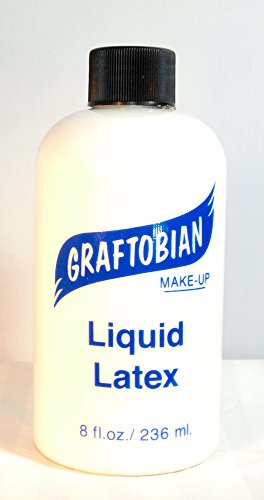
Graftobian Liquid Latex, 8 oz
Goes on white and dries clear, per the listing, so it won't tint the paint underneath. Graftobian's ingredient list for its clear latex names ammonia and thiram, so work with the window open and powder it once dry.
What No Maker Publishes
We didn’t find, from any maker or approved source:
- a heat setting or distance for shrinking film onto a skeleton
- the resin in most store skeletons
- a plastic wrap or trash bag maker other than Glad saying what its film is made of
To dress a corpsed skeleton in aged clothes, see mannequins and dressed props, which covers which Rit dye each fabric takes.
Next: Part 4: The Flying Crank Ghost puts a figure in motion. If you haven’t built one yet, Part 2: Monster Mud covers the other classic shell.
Put It to Work

Mannequins and Dressed Props: How to Make a Figure Look Real
Store mannequins, dress forms, skeletons and PVC frames compared, plus padding a tiny display body into real clothes, heads and hands, Rit dye by fiber, painting plastic, blood on fabric, lighting a face and keeping a dressed figure alive outdoors.

How to Weight and Anchor Halloween Props Indoors
What giant-prop and animatronic manuals say about hard floors, where the sandbags actually go, how to strap a tall prop to a wall stud or toggle bolt, and how to keep the floor, the cords, the pets and the exits safe while it stands in your living room.

Vintage-Style Paper Mache Jack-o'-Lanterns, Modeled on the c. 1940 Originals
What the Smithsonian's papier-mache jack-o'-lanterns from around 1940 actually look like, and how to build a hollow copy from instant papier-mache: a scored-halves shell, tissue-paper face inserts, an LED, an aged paint finish, and the sealer argument between Golden and Zinsser.