Prop Building 101 Part 2: Monster Mud
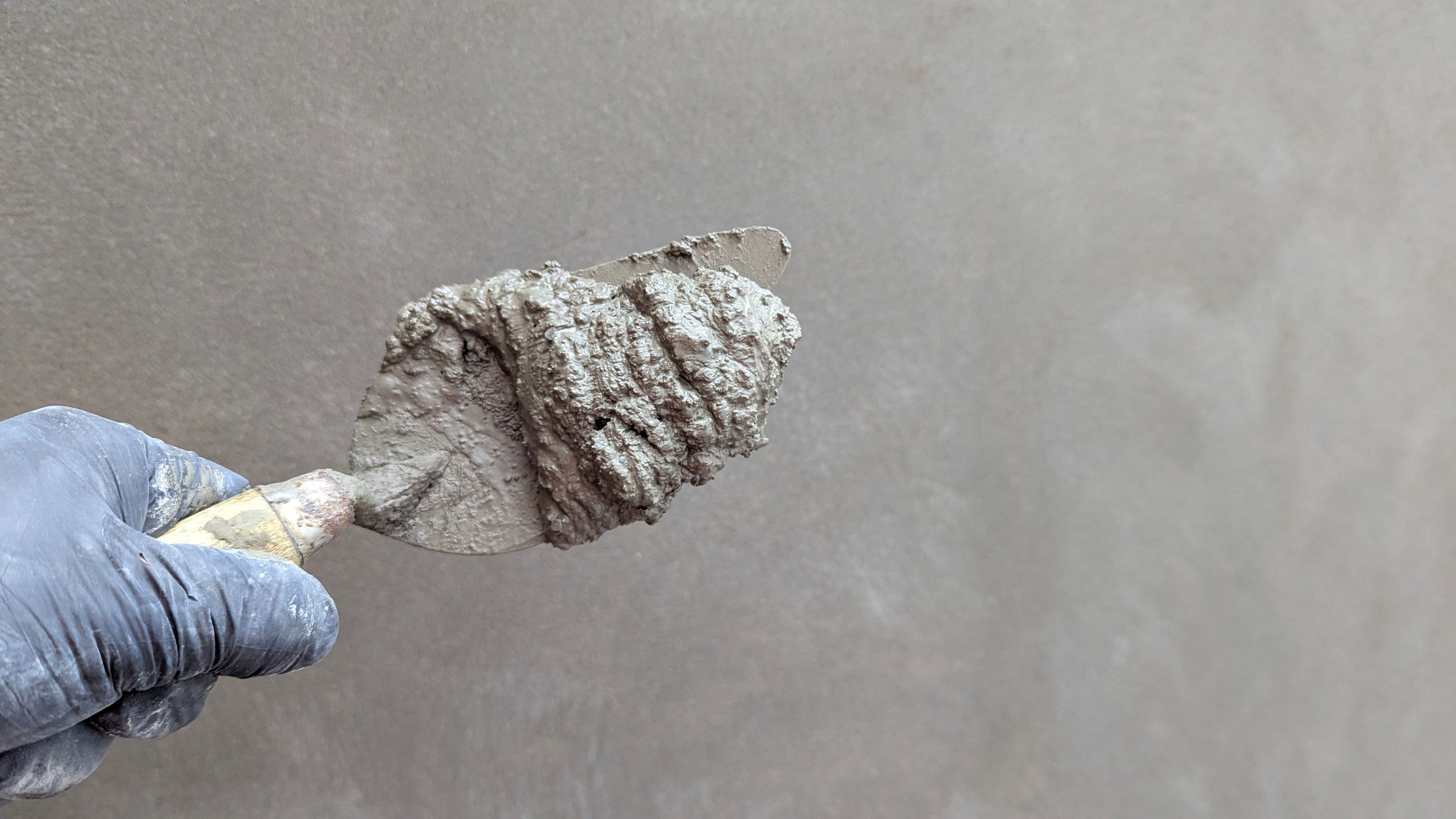
Monster mud is ready-mixed drywall joint compound stirred together with latex house paint. Home haunters dip cloth in it, drape the cloth over a frame, and let it dry into a stiff, rough shell: a hooded reaper, a ghost, a hunched figure on the porch.
No manufacturer stands behind that recipe. USG’s product sheet for Sheetrock All Purpose Joint Compound says, right after its instructions for thinning with water, “Do not mix with any other material” (USG submittal sheet). Its lightweight Plus 3 sheet says the same (USG Plus 3). Monster mud is off-label hobby practice by definition. The method below is ours. The data around it is the makers’, for each material on its own.
What the Makers Say About Each Ingredient
The joint compound
USG’s safety data sheet lists the product’s recommended use as “Interior use” and says it is “Soluble in water” (USG SDS).
The rest of what matters, from the SDS and the submittal sheet:
- It’s heavy. The SDS gives a bulk density of 12 to 15 pounds per gallon. USG sells Plus 3 as having “25% less weight than conventional joint compounds,” and describes it as “vinyl-based.”
- It needs warmth. Before use, USG says to “store at 55-95°F (13-35°C) for 24 hours,” and during finishing the building “shall be maintained at a minimum of 55°F (13°C).”
- Freezing matters. If a pail freezes, “allow it to thaw completely” and “Do not apply any form of heat to container.” Any liquid that separated “is not water and must be remixed into the compound,” and USG says not to use it if it isn’t smooth and lump free after remixing.
- It spoils. Shelf life is “Up to nine months from date of manufacture.” Don’t use a pail that is “discolored or has an unpleasant odor.”
- Over-thinning hurts it. “Over-dilution causes abnormal shrinkage, poor bond and other negative effects.”
A pail left in a cold garage over the winter, or a quart that has been open since the last drywall repair, is the first thing to check.
Buy compound by the pail at a home center for a full figure. For a test batch, a quart of Sheetrock All Purpose is enough to learn how your paint behaves in it.
The paint
“Latex” house paint isn’t rubber. Sherwin-Williams lists the vehicle in its A-100 Exterior Latex as “100% Acrylic” (A-100 data sheet), and OSHA notes that “Some synthetic rubber materials may be referred to as ‘latex’ but do not contain the natural rubber proteins responsible for latex allergy symptoms” (OSHA). Acrylic house paint isn’t a natural rubber latex allergy concern. The liquid latex in Part 3 is.
The A-100 data sheet gives numbers you can plan around:
| What | A-100 Exterior Latex |
|---|---|
| Weight | 9.68 lb per gallon |
| Dry to touch | 2 hours at 35 to 45°F or at 45°F and up |
| Recoat | 24 to 48 hours at 35 to 45°F; 4 hours at 45°F and up |
| Coldest application | 35°F air and surface, and not if it may drop below 35°F within 48 hours |
| Rain | “Avoid using if rain or snow is expected within 2-3 hours” |
Joint compound and gypsum aren’t on the A-100 list of surfaces. The paint’s floor is 35°F and the compound’s is 55°F, so on a cold build night the compound is the limit, not the paint.
Our Method
This is how we build a mud figure. It isn’t a maker’s procedure, and no maker publishes a mixing ratio, a drying time or an outdoor life for the mixture. We don’t publish one either.
1. Build the frame
The shape comes from what’s underneath. A PVC skeleton, a wire hood, a foam head on a stand: Part 1 covers the frames. Build it where the figure will dry, because a wet mud prop is too heavy and too soft to carry.
2. Mix a test cup first
Stir paint into compound, a little at a time, until the mix coats a scrap of your cloth and hangs without running off in sheets. How much paint that takes depends on the paint and the compound, which is why a test cup comes before the bucket. Mix the full batch with a paddle in a drill; a stick leaves lumps.

Buddy Tools Mix It Mud Mixer, 18 Inch
An 18-inch ABS paddle on a 3/8-inch hex shaft. The listing says it's for 1/2-inch drills and mixes mud and paint in 1 to 5 gallon buckets, and that the plastic paddle won't gouge the bucket. Long enough for a five-gallon pail of mud without putting the drill chuck in it.
3. Pick the cloth
Old sheets, muslin, burlap and cheesecloth all take mud. Heavier cloth holds more mix and makes a thicker shell; loose cheesecloth gives the torn, rotted look at the hem.
Think about what happens if a light gets too hot or a candle tips. The CPSC’s flammability rule is written for clothing, not decorations, but its fabric data still describes how cloth burns. It says plain fabrics weighing “2.6 ounces /73 grams per square yard or more” consistently pass as Class 1, as do fabrics made entirely of “acrylic, modacrylic, nylon, olefin, polyester, and wool,” while “sheer rayon or silk” and some cotton terry are likely Class 2 or 3, and Class 3 textiles “exhibit rapid and intense burning” (CPSC 16 CFR 1610 fact sheet). Gauzy cheesecloth is light, plain cotton. Keep it away from flame, mud or no mud, and light the figure with LEDs.

White Cheesecloth, 36 x 360 Inches
Ten yards of bleached cotton cheesecloth, a yard wide. Dip it for the ragged outer layer and the hem of a mud figure, where you want the weave to show, and use heavier cloth underneath for strength.
4. Dip, wring and drape
Work in nitrile gloves. Push the cloth into the mix until it’s saturated, lift it out, squeeze the excess back into the bucket, and drape it over the frame. Pull the folds where you want them now: once it starts to set, it stops moving. Build hoods and sleeves in layers rather than one heavy sheet.
5. Let it dry where it’s warm
Leave it where the air stays above USG’s 55°F minimum, out of direct sun and out of the rain. Thick folds dry last. We wait until the thickest fold is hard and no longer cool to the touch before painting. There’s no published drying time to go by, and a cool garage slows it down.
Sanding and Dust
Sanding dried mud raises the dust USG and NIOSH warn about. USG’s caution box says to “Use a sander with vacuum attachment or wet-sanding to reduce dust” and to wear “a NIOSH/MSHA-approved respirator,” and warns that “Prolonged or repeated breathing of respirable mica dust may cause lung disease (pneumoconiosis).” Sherwin-Williams adds that sanding its dried paint film “may release crystalline silica.” Our paper mache pumpkin guide walks through NIOSH’s drywall sanding study, including how much wet and vacuum sanding cut the dust.
On a mud figure, you rarely need sandpaper. Knock down a sharp ridge with a damp sponge, or sand outside with a respirator on.

3M OV/P100 Multipurpose Respirator 65021, Medium
NIOSH-approved half mask with P100 particulate filters for joint compound and paint dust, plus organic vapor cartridges if you spray-paint the figure afterward.
Paint and Seal
Paint the dried figure with an exterior acrylic latex, every face, including the inside of the hood and the underside of the hem. That coat of exterior paint is the only layer in the stack that a maker rates for outdoors.
Clear coats don’t close the gap. We checked three:
- Minwax Water-Based Helmsman Spar Urethane says “For wood substrates only,” and its first step is a surface that is “free of paint” (Minwax data sheet).
- Minwax Polycrylic is for “interior wood projects” (Minwax).
- Varathane Outdoor Water Based Spar Urethane is written for wood, including “STAINED OR PAINTED WOOD,” and Rust-Oleum says to test it in an inconspicuous area first, which “is particularly important when applying over paints or stains.” It calls for 55 to 90°F, humidity below 85%, no direct sun and a minimum of 4 coats (Varathane data sheet).
None of them mentions joint compound. A clear coat over a painted mud figure is guesswork, so we put the effort into a second coat of exterior paint instead.
Outside in October
Plan on a porch roof, not the open lawn. The compound underneath is interior-rated and soluble in water, so any crack in the paint lets water reach it. That’s our reading of the maker data, not a test result, and no maker publishes an outdoor life for monster mud.
- Rain. Put it under cover, or bring it in when rain is forecast. Look for cracks in the paint after every storm and touch them up.
- Frost. USG says to protect the compound from freezing. A figure that hasn’t dried through should come in on a freezing night.
- Weight. Maker figures put the compound at 12 to 15 pounds a gallon and A-100 at 9.68. If you mixed equal volumes, a gallon of wet mix would weigh roughly 11 to 12 pounds before it dries. Build a base that won’t tip, and stake or weight it. Our weatherproofing guide covers wind, and the skeleton posing guide covers anchoring without leaving hazards in the lawn.
- Storage. Store it dry, off a concrete floor, and away from where a frozen garage could crack it. Check for mold before it goes back out.
What No Maker Publishes
We looked for these and didn’t find them from any maker or approved source:
- a mixing ratio for joint compound and paint
- a drying or curing time for the mixture
- an outdoor life, or a rating for rain or freezing
- a wind rating for a finished figure
Treat anything you read that gives these as someone’s experience, not a spec.
Next: Part 3: Corpsing a Skeleton takes a store-bought plastic skeleton and ages it with heat and liquid latex.
Put It to Work
Mannequins and Dressed Props: How to Make a Figure Look Real
Store mannequins, dress forms, skeletons and PVC frames compared, plus padding a tiny display body into real clothes, heads and hands, Rit dye by fiber, painting plastic, blood on fabric, lighting a face and keeping a dressed figure alive outdoors.
How to Weight and Anchor Halloween Props Indoors
What giant-prop and animatronic manuals say about hard floors, where the sandbags actually go, how to strap a tall prop to a wall stud or toggle bolt, and how to keep the floor, the cords, the pets and the exits safe while it stands in your living room.

Vintage-Style Paper Mache Jack-o'-Lanterns, Modeled on the c. 1940 Originals
What the Smithsonian's papier-mache jack-o'-lanterns from around 1940 actually look like, and how to build a hollow copy from instant papier-mache: a scored-halves shell, tissue-paper face inserts, an LED, an aged paint finish, and the sealer argument between Golden and Zinsser.