Sleepy Hollow Harvest
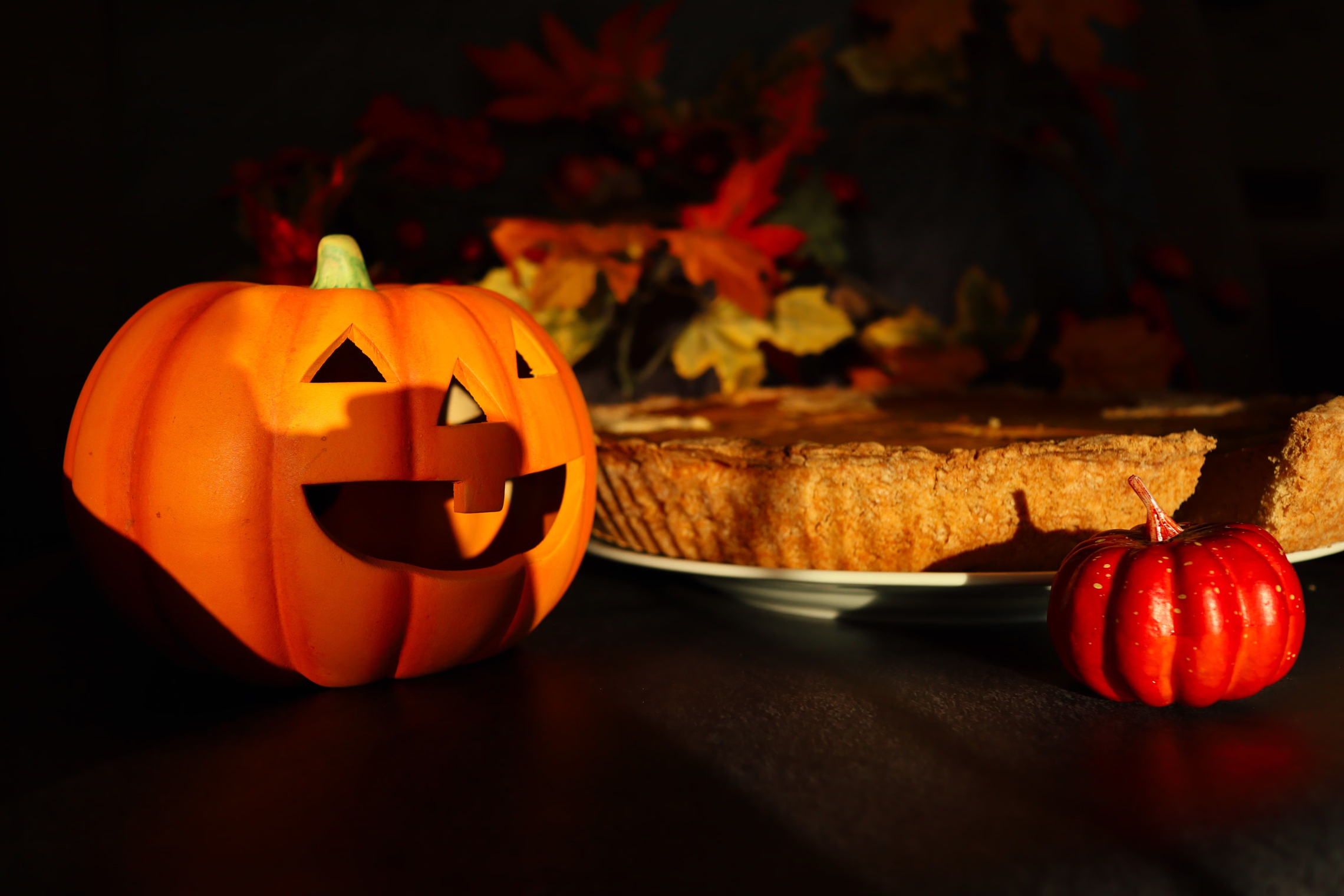
Baltus Van Tassel's quilting frolic, rebuilt from Irving's own pages: the heaped Dutch tea-table, a dance, the ghost stories told that night, roasted apples on the hearth, Brom Bones' bowl of punch and a shattered pumpkin by the brook.
Decor Checklist
- Vintage LED Flame Lanterns (2 Pack) Essential
Battery lanterns with a flickering LED flame for the porch, the hay bales and the tea-table, where a real flame would sit next to dry cornstalks
Shop on Amazon → - Dried Indian Corn (12 Ears) Essential
For Irving's 'gay festoons' of Indian corn along the walls, strung with dried apple rings and red peppers
Shop on Amazon → - Cotton Patchwork Quilt Throw Nice to have
The quilting frolic's namesake, over a bench or the back of the storytelling chair
Shop on Amazon → - Inflatable Headless Horseman with LEDs (6 ft) Optional
The Horseman on the lawn, lit from inside, so the yard gets its rider without a flame near the hay
Shop on Amazon → - Cornstalks, hay bales and pie pumpkins Essential
From a farm stand or feed store, cheaper and bigger than anything shipped; LED light only near them
- Pewter or pewter-look plates Optional
Thrift-store pewter lined up on a sideboard, for the 'rows of resplendent pewter, ranged on a long dresser'
Menu
Playlist
Listen on Hallowmix →
Costumes
Host
- Baltus Van Tassel: homespun coat and breeches, blue stockings, big buckled shoes, and a face 'round and jolly as the harvest moon'
- Katrina Van Tassel: gold ornaments, a laced bodice for the 'stomacher of the olden time', a short petticoat
- The Dutch housewife of the tea-table: close crimped cap, long-waisted gown, a calico pocket tied on the outside
Guests
- Ichabod Crane: a rusty black suit, a coat with long skirts, a small wool hat and a psalm book
- Brom Bones: a fur cap with a fox's tail on top
- The Headless Horseman: 'gigantic in height, and muffled in a cloak,' a pumpkin under the arm
- The woman in white of Raven Rock
- Old Brouwer, the neighborhood skeptic, soaked from the brook
Party Timeline
- 5:30 PM: Fry the doughnuts and clean up the oil before anyone arrives. Pies are already baked.
- 7:00 PM: Guests arrive. Tea, cider and the punch are poured; the Horseman is lit on the lawn.
- 7:30 PM: The tea-table opens, all of it at once, higgledy-piggledy.
- 8:30 PM: The dance, with a prize for the best Ichabod.
- 9:15 PM: The ghost-story circle, in Irving's order: the war, the woman in white, the Horseman, old Brouwer, Brom's race.
- 10:00 PM: Roasted apples and the last of the punch.
- 10:45 PM: The revel breaks up. Someone finds a hat and a smashed pumpkin by the door.
Shopping List
- LED lanterns (2 to 4)
- Cornstalks and 2 to 4 hay bales from a farm stand
- Pie pumpkins for decor, plus one cheap pumpkin to smash
- Dried Indian corn, dried apple rings, dried red chiles, twine
- A patchwork quilt
- A black felt hat for the brook vignette
- Buttermilk, eggs, flour, sugar, butter, nutmeg, lemon, frying oil (6 cups)
- Clip-on deep-fry thermometer and an 8-quart pot
- Boiled cider, a doughnut pan (baked version)
- Pie crusts, pumpkin purée, apples, peaches, light cream
- Sliced ham, smoked beef, jarred plums, peaches and pears, quince paste
- A roast chicken
- Black tea, whole milk, heavy cream
- Pasteurized apple cider (3 gallons), mulling spices
- Rye whiskey (750ml for the punch, plus a second bottle if you're pouring Harvest Moons)
- Maple syrup and Angostura bitters (Harvest Moon)
- Baking apples (1 dozen), cinnamon, brown sugar
- Sleepy Hollow invitations and place cards (free printables)
The Premise
Most Headless Horseman parties are about the chase. Irving’s story spends more pages on a party than on the ride. On a fine autumn afternoon a messenger clatters up to the schoolhouse “with an invitation to Ichabod to attend a merry-making, or ‘quilting frolic,’ to be held that evening at Mynheer Van Tassel’s.” That party has a menu, a dance, a round of ghost stories and a host, and Irving describes all of it. This blueprint runs it as written.
Nobody quilts at the quilting frolic. The name is the whole reference; the evening is food, a fiddle and stories. So the quilt here is decor, and the night’s activities come from the story.
Every quotation from the tale below is from the 1897 R. H. Russell edition of The Legend of Sleepy Hollow, checked against the page scans the Library of Congress has digitized (Library of Congress). The page numbers are that edition’s.
A note on the text. Irving’s party has Black characters, and he writes them in the racial language and caricature of 1820. The invitation arrives with a Black messenger on “a ragged, wild, half-broken colt” (p. 34). The dance music comes from an elderly Black fiddler “who had been the itinerant orchestra of the neighborhood for more than half a century” (p. 42), and the next page describes Black onlookers at the doors and windows in terms we won’t reprint. Those people were part of the real valley too; the history section below says who they were. Nobody at this party costumes as them, and none of that language goes on an invitation or a sign.
The Real Valley
Irving’s Sleepy Hollow
Irving published the story in The Sketch Book, which he wrote in England. Its first American edition “was issued in seven numbers, the first on May 15, 1819, the last on September 13, 1820,” according to Arthur Willis Leonard’s introduction to a 1911 school edition (Library of Congress, pp. xxv and xxvi). The National Park Service’s landmark nomination for the Old Dutch Church says that in 1820, “following the publication of Washington Irving’s Sketch Book, the church received a measure of popular fame as the Sleepy Hollow church” (NPS, National Register nomination).
The Village of Sleepy Hollow traces the name back to a Dutch colonist: “In 1655 Adriaen Van der Donck, a Dutch colonist, first published a work which referred to the Pocantico River as Slapershaven or, literally, Sleepers’ Haven.” It calls Sleepy Hollow “a later, Anglicized version of this name.” The village itself was North Tarrytown until “in 1996 the village voted for the renaming, the same year that the GM plant closed its doors” (Village of Sleepy Hollow).
Irving knew the place from his teens. The village says that “in the late 1790s Washington Irving came to visit his friend and relative, James K. Paulding, in Tarrytown.” The NPS nomination for Sunnyside says that when Irving first saw the Van Tassel cottage on the Hudson “he was a youth of fifteen”; he bought it in 1835 and rebuilt it as Sunnyside (NPS, Sunnyside nomination). Leonard says the same property was “once the home of the Van Tassels” and was called “Wolfert’s Roost” before Irving renamed it. Irving’s narrator remembers the valley the same way: “when a stripling, my first exploit in squirrel-shooting was in a grove of tall walnut-trees that shades one side of the valley” (p. 8).
The Church and the Manor
The Horseman “tethered his horse nightly among the graves in the churchyard” of a real building, the Old Dutch Church, which “stands on a knoll, surrounded by locust-trees and lofty elms” (p. 46). The Historic American Buildings Survey file at the Library of Congress quotes the landmark program: “Built of rubblestone, the church is a reminder of the Dutch influence in Colonial America. Author Washington Irving is buried in the adjacent graveyard” (HABS NY-6143, Library of Congress).
When it was built is a real disagreement, and the sources don’t settle it:
- The Village of Sleepy Hollow: Frederick Philipse “had a mill, manor house, and church constructed on the lower reaches of the Pocantico River about 1685,” and it calls the church “the oldest church in New York State.”
- The NPS landmark nomination: “Constructed between 1697 and 1702.” It notes that the tablet on the front “gives its date as 1699 although the date more generally accepted is 1697,” and that the church’s bell was “cast in Holland in 1685.”
- Edgar Mayhew Bacon’s Chronicles of Tarrytown and Sleepy Hollow (1897) argues that the 1699 tablet is “entirely unsupported by a shadow of other testimony,” was probably “put up at the time of the repairs in 1837,” and that the 1685 bell points to an earlier church (Library of Congress, p. 45).
The “oldest church in New York State” line is the village’s claim; we found no second approved source for it.
The manor around the church was not only Dutch tenant farmers. The village’s history says that alongside the valley’s largely Dutch-American, French Huguenot, Swiss and German families, “also present were African American slaves and persons of Native American descent.” The NPS nomination for Philipsburg Manor describes the estate as “vast holdings of manorial lands, with its tenant farmers, slaves, fields of grain, orchards, stands of timber, and stone quarries” (NPS, Philipsburg Manor nomination). Bacon records that in the Old Dutch Church “the humble retainers, slaves, and redemptioners, sat in the gallery” (p. 42), and that slavery was abolished in New York State in 1827 (p. 142). Bacon, writing in 1897, also says “the yoke of servitude in New York State was a very mild one.” That’s his opinion, and a 19th-century one; the fact worth keeping is who sat in the gallery.
What the Story Says About the Horseman
Irving hedges from the first page. The Horseman “is said by some to be the ghost of a Hessian trooper, whose head had been carried away by a cannon-ball, in some nameless battle” of the Revolution (p. 10). Claims that he was a particular Hessian, killed at a particular battle and buried in that churchyard, go further than Irving did, and we found no approved source for them. The same goes for the real-life Ichabods and Katrinas that tour copy names. Bacon’s preface says an old house torn down the year before for a new schoolhouse was, “according to Mr. Irving, the scene of the courtship, the home of Katrina van Tassel,” without saying where Irving said so.
Irving’s “cow-boys” (p. 43) aren’t cattle hands. The NPS church nomination explains that during the Revolution the valley was “Neutral Ground,” where “bands of Loyalists called Cowboys and patriots, called Skinners, roamed the countryside,” and that Major John André “was apprehended by a band of Skinners not far from the church.”
Setting the Farmhouse
The Van Tassel House
Irving gives you the decor list when Ichabod first walks in. The piazza has “flails, harness, various utensils of husbandry, and nets for fishing”; inside, “rows of resplendent pewter, ranged on a long dresser, dazzled his eyes. In one corner stood a huge bag of wool, ready to be spun; in another, a quantity of linsey-wolsey, just from the loom; ears of Indian corn, and strings of dried apples and peaches, hung in gay festoons along the walls, mingled with the gaud of red peppers” (pp. 25 and 26).
That’s a weekend of work at most:
- The festoons. String dried Indian corn, dried apple rings and dried red chiles on twine and swag them along one wall or the mantel.
- The dresser. Thrift-store pewter, or anything gray and dull, lined up on a sideboard with the pies in front of it.
- The wool and the loom. A basket of yarn and a folded length of rough cloth in a corner. The quilt goes over a bench.
- The piazza. Hang a rake, a basket and a coil of rope by the front door.
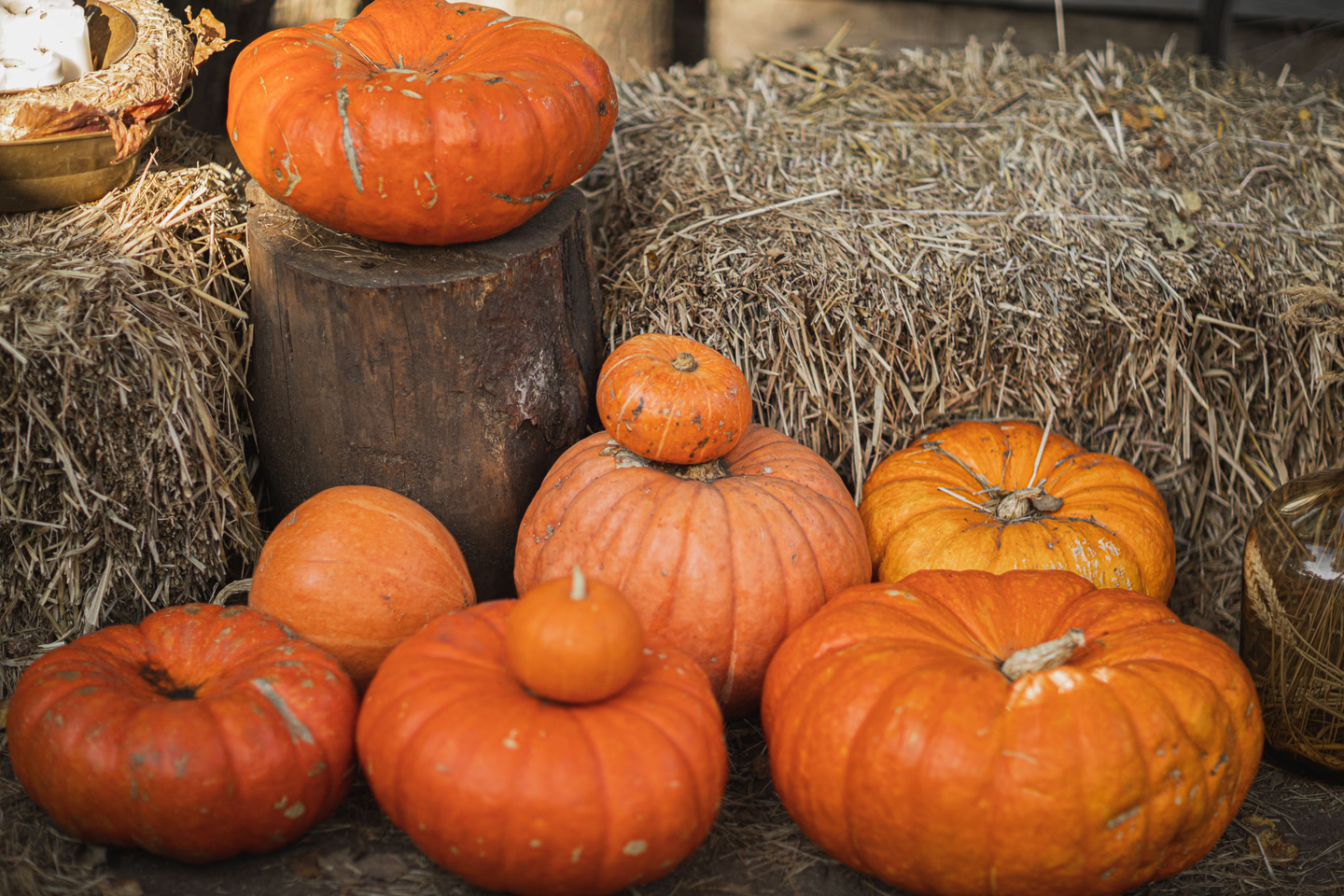
On the ride over, Ichabod passes “the yellow pumpkins lying beneath them, turning up their fair round bellies to the sun” and “the fragrant buckwheat fields” (p. 38). It’s buckwheat and Indian corn in the text, not wheat, if anyone is designing a wreath.

ANDALUCA Dried Indian Corn (12 Ears)
Twelve small ears of ornamental Indian corn with the husks on. Enough for two festoons along a mantel, with dried apple rings and chiles strung between them. Decor only, not for eating.
Cornstalks, Hay and Light
This is the most flammable party on the site. The NFPA’s Halloween tip sheet says “dried flowers, cornstalks, and crepe paper catch fire easily. Keep all decorations away from open flames and other heat sources like light bulbs and heaters,” and “remember to keep exits clear of decorations so nothing blocks escape routes” (NFPA). The same sheet counts decorations as “the first thing to ignite in more than 800 reported home fires each year,” nearly a third of them started by a candle.
So every light in the room is LED: lanterns on the bales, flameless candles on the tea-table, an LED in any carved pumpkin. Stand the cornstalks where no one walks with a drink and no doorway narrows. Our jack-o’-lantern lighting guide compares LED options for pumpkins that sit near the stalks, and the weatherproofing guide explains why cornstalks and hay go out in mid-October, not September.

YAKii LED Vintage Flame Lanterns (2 Pack)
Black metal lanterns with a frosted glass shade and a 20-LED flickering flame, about 10.5 inches tall, on 4 AA batteries each. The maker says to bring them indoors in bad weather, so they suit a covered porch and the tea-table.
The Horseman on the Lawn
Put the Horseman where arriving guests see him first. The simplest version is a lit inflatable. The handmade version is a horse-and-rider silhouette cut from plywood or corrugated plastic and backlit with an LED flood, with a real pumpkin wired to the front of the saddle, where Ichabod saw “the head, which should have rested on his shoulders, was carried before him on the pommel of his saddle!” (p. 54). That build is our suggestion, not a period one. For sightlines and staking props in a yard, see our yard haunt basics, and for a churchyard corner to tether him in, the front yard graveyard guide.

COMIN 6 ft Inflatable Headless Horseman
A six-foot horse and headless rider that lights from inside with built-in LEDs. A cartoon next to Irving's 'gigantic' rider, but it puts a Horseman on the lawn with no heat source near the hay.
The Pumpkin by the Brook
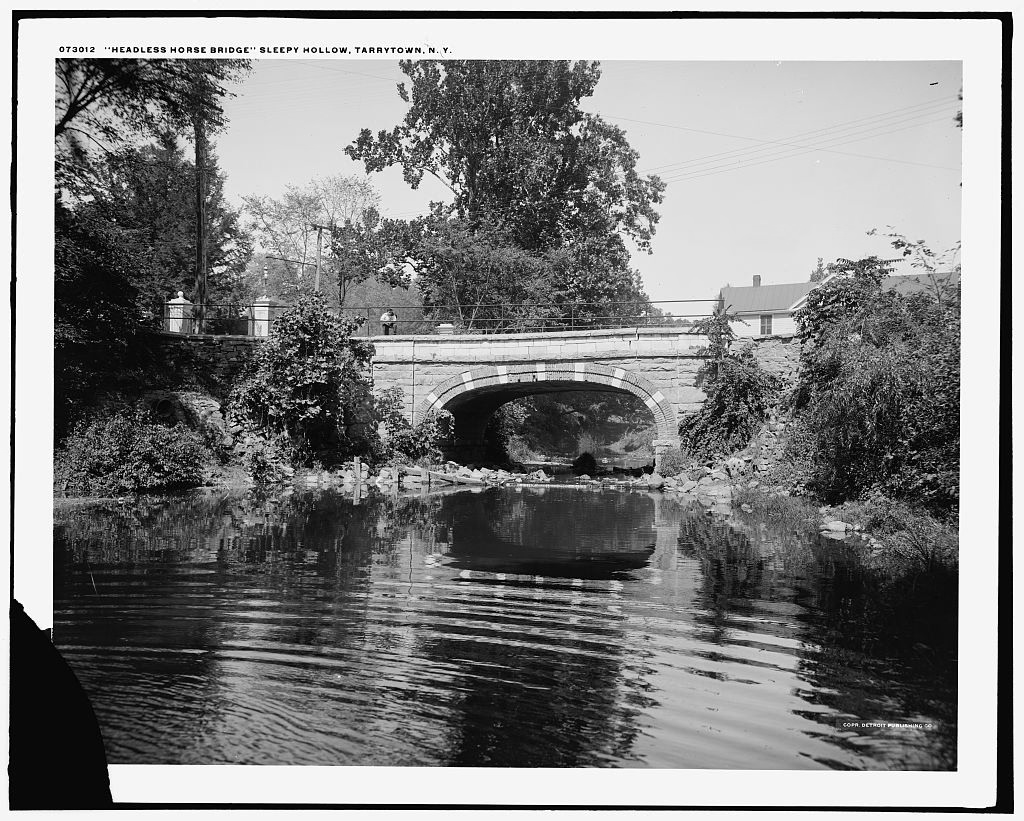
Irving’s last clue is the best prop in the story. The morning after, the searchers trace the hoofprints to the bridge, “beyond which, on the bank of a broad part of the brook, where the water ran deep and black, was found the hat of the unfortunate Ichabod, and close beside it a shattered pumpkin” (p. 57). Stage it by the door for the end of the night: a black hat on a dark cloth and a cheap pumpkin, actually smashed.
Sound and Music
The playlist is Originals. It opens with the classical pieces Halloween took over, “Danse Macabre,” “Night on Bald Mountain,” “In the Hall of the Mountain King,” which fit a candlelit farmhouse better than anything with a drum machine, and its novelty half (“Monster Mash,” “Haunted House”) takes over for the dance. None of the site’s playlists has an 18th-century fiddle reel; if you can find a local fiddler, hire one for the dance and turn the playlist off.
For the gaps, our Sound Mixer can layer a crackling fire under crickets, the sound Ichabod hears on the ride home: “occasionally the melancholy chirp of a cricket” (p. 50).
The Tea-Table
Irving’s Menu
This is the passage the party is built around (pp. 40 and 41):
“Fain would I pause to dwell upon the world of charms that burst upon the enraptured gaze of my hero, as he entered the state parlor of Van Tassel’s mansion. Not those of the bevy of buxom lasses, with their luxurious display of red and white; but the ample charms of a genuine Dutch country tea-table, in the sumptuous time of autumn. Such heaped-up platters of cakes of various and almost indescribable kinds, known only to experienced Dutch housewives! There was the doughty dough-nut, the tender oly-koek, and the crisp and crumbling cruller; sweet cakes and short cakes, ginger cakes and honey cakes, and the whole family of cakes. And then there were apple pies, and peach pies, and pumpkin pies; besides slices of ham and smoked beef; and … delectable dishes of preserved plums, and peaches, and pears, and quinces; not to mention broiled shad and roasted chickens; together with bowls of milk and cream, all mingled higgledy-piggledy, pretty much as I have enumerated them, with the motherly tea-pot sending up its clouds of vapor from the midst.”
Serve it the way he describes it: everything on the table at once, sweet next to savory, with the teapot in the middle. Skip the shad. It’s a spring fish, and you won’t find it fresh in October (that’s our observation, not Irving’s).
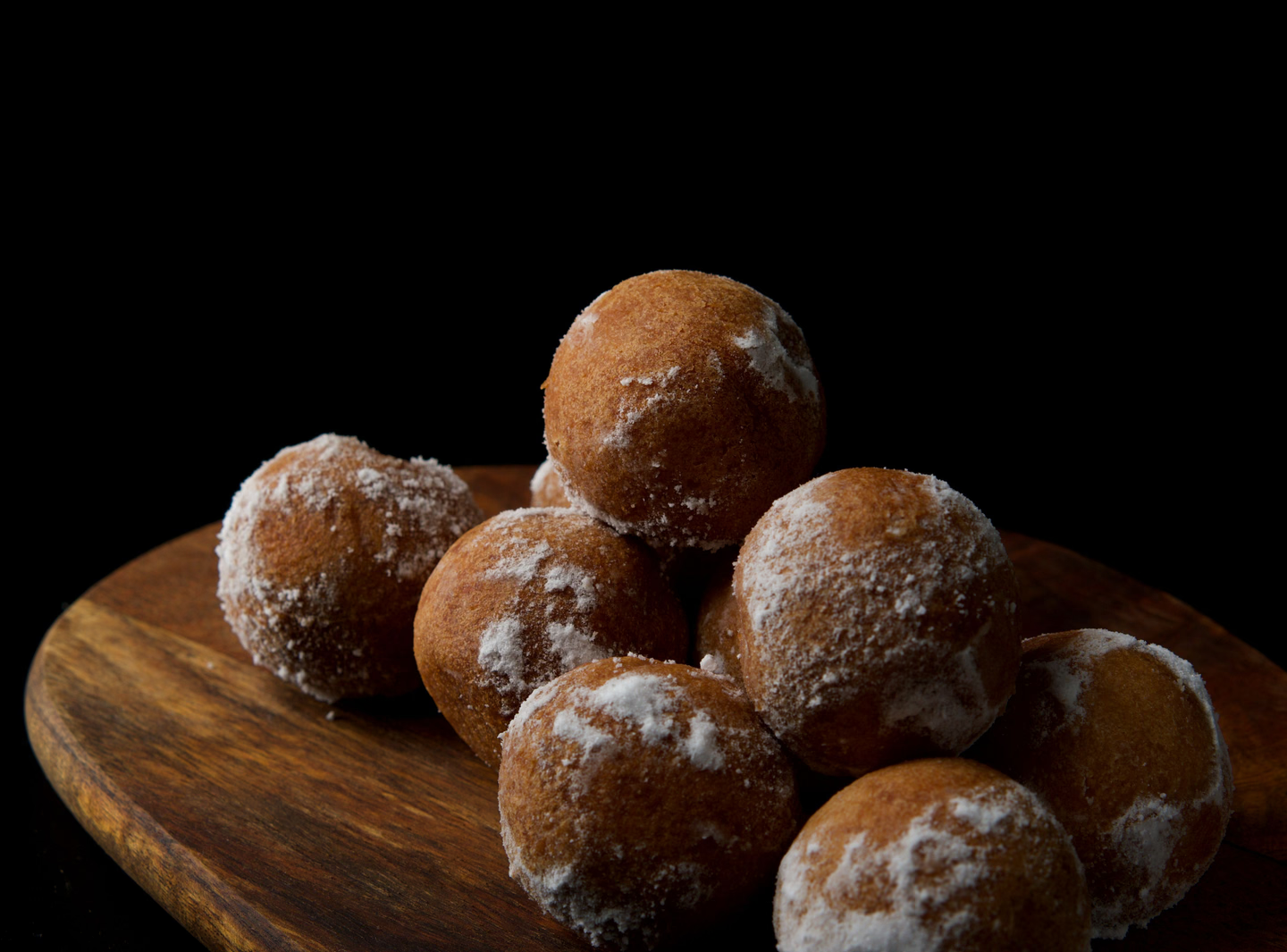
Note that Irving lists the dough-nut, the oly-koek and the cruller as three different things. Copy that calls the olykoek “the doughnut Irving served” loses his distinction. Bacon, describing the Dutch settlers of the valley, says the most celebrated housewives “were those who made the best sausages, or the most toothsome olykoeks” (p. 2), but neither book gives a recipe, and we couldn’t find a source we trust for a period one. The recipes below are modern stand-ins, labeled as such.
The Doughnuts
JSTOR Daily’s history of the doughnut credits James Deutsch with finding “the first American literary reference in an 1809 text by Washington Irving,” and mentions “reports of a doughnut shop near New York’s Wall Street as far back as the 1670s” (JSTOR Daily). By 1820 Irving was putting them on Van Tassel’s table.
For the fried version, King Arthur’s Old-Fashioned Cake Doughnuts use buttermilk, nutmeg and lemon, make 1 1/2 to 2 dozen, and fry “somewhere between 365°F and 375°F.” King Arthur says “an 8-quart stock pot is an appropriate size cooking container” and that “it’s best to have a thermometer that you can clip onto the side of your pot.” Drop some of the dough by the spoonful for round fritters to stand in for the olykoek.
Fry them before anyone arrives. The U.S. Fire Administration found that the leading cause of residential Halloween fires in 2017 to 2019 was “cooking (49%),” and that Halloween fires peak “from 6 to 7 p.m.” (USFA), which is exactly when a host is at the stove waiting for the doorbell. USFA’s cooking rules: “Stand by your pan. If you leave the kitchen, turn the burner off,” and “keep a pan lid or baking sheet nearby. Use it to cover the pan if it catches on fire” (USFA).

Taylor Candy and Deep Fry Thermometer
A 12-inch stainless steel thermometer with a pan clip, the kind King Arthur recommends for holding oil between 365°F and 375°F. It stays on the pot, so you're reading the oil, not guessing.
If you won’t fry at all, King Arthur’s Cider Doughnuts, “a traditional New England harvest treat,” are baked at 400°F for 10 to 12 minutes in a doughnut pan and make 6. Each batch uses 3 tablespoons of boiled cider in the dough and 3 more in the glaze. Double or triple it for 16 guests.

Nordic Ware 6 Cavity Donut Pan
A metal pan with six doughnut rings, which is exactly one batch of King Arthur's baked cider doughnuts. Two pans let one batch bake while the next is piped.
Pies, Cakes and the Board
- Pumpkin pie. King Arthur’s Pumpkin Pie bakes at 400°F for 45 to 50 minutes and is done when it’s set 2 inches in from the edge while “the center should still be wobbly.” Make the filling the night before; the recipe says to “cover and refrigerate the filling overnight before baking.”
- Apple and peach pies. Bake them the day before. Peach is out of season; frozen or jarred peaches are fine.
- Ginger cakes and honey cakes. Gingerbread and a honey cake from any trusted recipe, cut into squares.
- The board. Sliced ham and smoked beef, a roast chicken carved cold, jarred preserved plums, peaches and pears, and quince paste, which is what’s easiest to find of Irving’s quinces.
Roasted Apples at the Hearth
Irving’s other food image is the one that makes the ghost-story circle. Among Ichabod’s “sources of fearful pleasure” was “to pass long winter evenings with the old Dutch wives, as they sat spinning by the fire, with a row of apples roasting and sputtering along the hearth, and listen to their marvellous tales of ghosts, and goblins, and haunted fields and haunted brooks, and haunted bridges and haunted houses, and particularly of the headless horseman” (p. 19). If you have a fireplace, set cored apples with brown sugar and cinnamon in a cast-iron pan on the hearth, away from the flame, and turn them. Otherwise, bake them and bring them in hot at 10:00.
Allergens
The tea-table is wheat, eggs and milk nearly all the way down: the doughnuts (buttermilk in the fried ones, milk in the baked), the crullers, the pies and cakes, and the bowls of milk and cream. All three are on the FDA’s list of nine major allergens, along with fish if you serve the shad after all (FDA). A small card by each platter saves everyone asking.
The Bowl of Punch
Cider
The cider for this party is pasteurized, including the cider in the punch. The FDA’s required warning on untreated juice reads: “This product has not been pasteurized and therefore may contain harmful bacteria that can cause serious illness in children, the elderly, and persons with weakened immune systems.” Pregnant women are in the FDA’s at-risk group too, and the agency notes it “does not require warning labels for juice or cider that is sold by the glass” (FDA), so a cup at an orchard stand may be raw with no sign saying so. Penn State Extension notes that “several highly publicized incidences of foodborne illness have been linked to consumption of unpasteurized cider contaminated with E. coli O157:H7, Salmonella, or Cryptosporidium parasites” (Penn State Extension). Check the jug for the word “pasteurized.”
Keep a pot of mulled cider on low all night for the non-drinkers.

Aspen Mulling Spices, Original Blend (2 Pack)
A cinnamon, clove and nutmeg mulling mix, two 5.65 oz canisters: one for the stove pot of plain cider, one for the punch.
Brom’s Punch
At the party, Brom Bones matches old Brouwer’s ghost story with one of his own: “on returning one night from the neighboring village of Sing Sing, he had been overtaken by this midnight trooper; that he offered to race with him for a bowl of punch, and should have won it too, for Daredevil beat the goblin horse all hollow, but just as they came to the church bridge, the Hessian bolted, and vanished in a flash of fire” (p. 47).
Our version: 1 gallon of pasteurized cider, mulled and cooled to warm, plus one 750ml bottle of rye, a sliced apple and a few cinnamon sticks. Do the math before the bowl goes out. NIAAA counts one standard drink as “about 14 grams, or about 0.6 fluid ounces, of pure alcohol,” the amount in 1.5 ounces of 40% spirits (NIAAA). A 750ml bottle of 80-proof rye holds about 10 ounces of alcohol, or roughly 17 standard drinks, spread through about 150 ounces of punch: a 9-ounce cup is about one drink. Label the bowl, use small cups, and keep the plain mulled cider in a separate pot with its own ladle. Our cocktails and mocktails guide has the Harvest Moon, a cider Old Fashioned, for anyone who wants a single strong glass, and a mocktail list for everyone else.
Running the Evening
7:00 PM: Arrival
Send the free Sleepy Hollow invitation three weeks ahead, with Irving’s own words at the top: a merry-making, or quilting frolic. Put the costume brief on it. At the door, the Sleepy Hollow place cards tell guests where they sit (the set has twelve cards, so for 16 guests print a second sheet and repeat four), and the host, as Baltus Van Tassel, does what Irving’s host does: his welcome is “a shake of the hand, a slap on the shoulder, a loud laugh, and a pressing invitation to ‘fall to, and help themselves’” (p. 42).
7:30 PM: The Tea-Table
Everything comes out at once. Tea is poured from one big pot with milk and cream in bowls. Ichabod “did ample justice to every dainty” (p. 41); so should everyone else.
8:30 PM: The Dance
“Ichabod prided himself upon his dancing as much as upon his vocal powers. Not a limb, not a fibre about him was idle; and to have seen his loosely hung frame in full motion, and clattering about the room, you would have thought St. Vitus himself, that blessed patron of the dance, was figuring before you in person” (p. 42). Clear the floor, put on the liveliest tracks, and the host names the night’s St. Vitus, whoever flails hardest. The prize is the last slice of pumpkin pie.
9:15 PM: The Ghost-Story Circle
After the dance, Ichabod joins the older guests on the piazza, “gossiping over former times, and drawling out long stories about the war” (p. 43), and the talk turns to ghosts. Run your circle in the same order, with LED lanterns only and the lights down. Write each story on a card and deal one to each teller, who retells it in their own words:
- The war stories (p. 44). Doffue Martling, “a large blue-bearded Dutchman, who had nearly taken a British frigate with an old iron nine-pounder from a mud breastwork, only that his gun burst at the sixth discharge,” and the old gentleman who claimed he parried a musket-ball with a small-sword at White Plains.
- The woman in white (p. 45). “The woman in white, that haunted the dark glen at Raven Rock, and was often heard to shriek on winter nights before a storm, having perished there in the snow.”
- The Horseman (pp. 45 and 46). “The favorite spectre of Sleepy Hollow, the headless horseman, who had been heard several times of late, patrolling the country; and it is said, tethered his horse nightly among the graves in the churchyard.”
- Old Brouwer (p. 47). The skeptic who met the Horseman, had to ride behind him “until they reached the bridge, when the horseman suddenly turned into a skeleton, threw old Brouwer into the brook, and sprang away over the tree-tops with a clap of thunder.”
- Brom’s race (p. 47). The bowl of punch, told by whoever came as Brom. Refill the punch bowl when he’s done.
Irving’s own narrator gives you a closing line. In the postscript, a skeptical listener says the tale seems a little extravagant, and the storyteller answers: “Faith, sir, … as to that matter, I don’t believe one-half of it myself” (p. 61). For more ghost-story staging, the Haunted Victorian Seance has its own storytelling break, and if your guests want the old apple and nut fortune games after the stories, the Fortune Teller’s Parlor has them straight from Burns.
10:00 PM: Roasted Apples
The apples come off the hearth or out of the oven. This is the “long winter evenings” scene from p. 19: somebody tells one more.
10:45 PM: The Revel Breaks Up
“The revel now gradually broke up. The old farmers gathered together their families in their wagons, and were heard for some time rattling along the hollow roads, and over the distant hills” (p. 48). As guests leave, they pass the hat and the shattered pumpkin by the door. Nobody explains it. In the story, Brom Bones “always burst into a hearty laugh at the mention of the pumpkin” (p. 60), which led some to suspect he knew more than he let on.
Costume Guide
Irving describes almost everyone at the party, so the costume brief writes itself.
- Ichabod Crane. “He was tall, but exceedingly lank, with narrow shoulders, long arms and legs, hands that dangled a mile out of his sleeves, feet that might have served for shovels, and his whole frame most loosely hung together” (p. 12). For the party he brushes “his best, and indeed only suit of rusty black” (p. 35), wears “a small wool hat,” and the skirts of his black coat flutter “almost to the horse’s tail” (p. 36). Too-short sleeves, a psalm book, and a habit of singing psalm tunes when scared (p. 19).
- Katrina Van Tassel. “She wore the ornaments of pure yellow gold, which her great-great-grandmother had brought over from Saardam; the tempting stomacher of the olden time, and withal a provokingly short petticoat, to display the prettiest foot and ankle in the country round” (pp. 21 and 22).
- Brom Bones. “Broad-shouldered and double-jointed, with short curly black hair,” and in cold weather “a fur cap, surmounted with a flaunting fox’s tail” (pp. 27 and 28). A pumpkin under his arm is an inside joke for anyone who finished the story.
- The Headless Horseman. Seen against the sky, “gigantic in height, and muffled in a cloak” (p. 54). The California Costumes Headless Horseman in our best adult costumes roundup does the tall-shoulders trick with inflatable shoulder pieces.
- The guests. “Old farmers, a spare leathern-faced race, in homespun coat and breeches, blue stockings, huge shoes, and magnificent pewter buckles. Their brisk, withered little dames, in close crimped caps, long waisted gowns, homespun petticoats, with scissors and pin cushions, and gay calico pockets hanging on the outside. Buxom lasses, almost as antiquated as their mothers, excepting where a straw hat, a fine riband, or perhaps a white frock, gave symptoms of city innovations” (p. 39). Or come as a ghost from the circle: the woman in white, or a dripping old Brouwer.

California Costumes Headless Horseman
A cape, vest and ruffled lace ascot with inflatable shoulders worn over your own; the listing says the ascot and chest area are see-through fabric, which is how the wearer sees out. Theatrical across a room, awkward up close. Carry a foam pumpkin.
“Dutch” in this brief means the Hudson Valley farm families in Irving’s text, not wooden shoes and a windmill. And nobody comes as the fiddler or the messenger. The University of Utah’s costume guidance is plain about why: “Most of the scrips [sic] that involved a White person wearing a Black face create an exaggerated racist stereotype of Black people,” and “any costume depicting an entire ethnic group is offensive.” Its test question fits a period party well: “What’s the historical context of this costume?” (University of Utah). Our adult costume guide has more.

SLPR Cotton Patchwork Quilt Throw, 50 x 60
A cotton lap quilt in blue patchwork. Over the storytelling bench it's the one nod to the 'quilting frolic,' and it goes back on the couch the next day.
Production Notes
Budget Breakdown: Two LED lanterns, dried corn and a farm-stand run for cornstalks, bales and pumpkins come to about $100 to $150. Food for 16 is flour, butter, apples, pie fillings, a ham and a chicken, around $120 if you bake. Cider and a bottle of rye add about $60. That’s a floor of about $280. The quilt, the inflatable Horseman, the costume, a second pair of lanterns and the Harvest Moon bottle take it to about $500.
Advance Prep: Send invitations three weeks out. Buy cornstalks and bales the week of the party and keep them outside until the day. Bake pies the day before and refrigerate the pumpkin filling the night before baking. Fry doughnuts in the late afternoon, or bake the cider doughnuts in the morning. Buy one extra pumpkin to smash.
What to Skip: Real candles anywhere near the cornstalks and hay. Frying while guests arrive. Raw cider. The fiddler and messenger costumes. Any story about a “real” Hessian in the churchyard; Irving didn’t vouch for him either.